
Types of Semantic Layers: Warehouse-Native vs Universal vs BI-Tool
Warehouse-native vs universal vs BI-tool semantic layers: how each works, what it is best for, and how to choose the right one for your stack.


There are three types of semantic layer: BI-tool (built into one analytics tool), universal (a standalone layer above the warehouse), and warehouse-native (semantics that run on the warehouse itself). This guide compares all three — how each works, what it’s best for, and how to choose.
TL;DR
- BI-tool semantic layer: lives inside one BI tool. Simplest to start; definitions rarely travel to other tools or AI.
- Universal semantic layer: a standalone layer (dbt, Cube) above the warehouse that every tool shares. Most flexible; most to build and maintain.
- Warehouse-native semantic layer: semantics execute on the warehouse itself — no second copy of your data. Fast to stand up, governed by default, and able to model once and run on any warehouse.
- How to choose: one tool and simple needs → BI-tool. A large, tool-diverse stack with a dedicated data team → universal. Speed plus governance plus data apps and AI on top → warehouse-native.
Every semantic layer does the same job — translate raw warehouse structures into governed business definitions so “revenue” means one thing everywhere. But not all semantic layers are created equal.
Where the layer physically lives changes how it’s built, what it can power, and how much it costs to run. There are three broad types, and picking the right one is mostly a question of your stack and your appetite for maintenance.
1. BI-tool (built-in) semantic layers
Here the semantic model lives inside a single BI tool. You define metrics, relationships, and business names in the tool, and every report built there inherits them. This is the oldest form of semantic layer — the metadata layers that shipped inside BI platforms like Power BI, Looker, and their peers.
Best for: a team standardized on one analytics tool with straightforward needs. It’s the simplest to start with because the layer comes with the tool you already use.
The limitation: the definitions are usually trapped in that tool. Add a second BI tool, a notebook, or an AI agent, and they can’t read your metrics — so each new consumer re-implements “revenue” its own way, and the single source of truth quietly fractures. If your stack will only ever be one tool, that’s fine. Most stacks don’t stay that way.
2. Universal (standalone) semantic layers
A universal semantic layer is an independent layer that sits above the warehouse and below every consumer, so all tools read the same definitions. This is the model popularized by the dbt Semantic Layer and Cube: define metrics once in a dedicated layer, and any connected BI tool, notebook, or application queries them through a shared interface.
Best for: large, tool-diverse organizations with a dedicated data-engineering team and many consumers that all need the same governed metrics. It’s the most flexible and the most vendor-neutral option.
The trade-off: it’s the most work to stand up and maintain. A standalone layer is its own system to build, host, govern, and keep in sync with the warehouse — real engineering effort, and usually a data team’s ongoing responsibility. Powerful when you have the team for it; heavy when you don’t.
3. Warehouse-native semantic layers
A warehouse-native semantic layer executes against the warehouse itself. Definitions, governance, and queries all run where the data already lives, with no extracted second copy to maintain.
It combines the shared-definitions benefit of a universal layer with the low-setup benefit of a built-in one, because it doesn’t stand up a separate system — it uses the warehouse you already have.
Best for: teams that want one governed model powering dashboards, data apps that write back, and AI — without the maintenance overhead of a standalone layer. It’s where modern BI is converging.
The advantages stack up: no extract-and-reload cycle, so data is always live; governance and row-level security inherited straight from the warehouse; and — in the better implementations — the ability to model once and run that same model on Snowflake, BigQuery, or Databricks, so you’re not locked to one warehouse. The main consideration is that you adopt it through a platform built this way rather than assembling it yourself, which is the point: less to build.
How to choose the right type
Cut through it with three questions.
Will more than one tool (or an AI agent) ever need these definitions?
- If no, a BI-tool layer is enough; if yes, rule it out. Do you have a dedicated data-engineering team that wants a vendor-neutral layer to build and own?
- If yes, a universal layer is a strong fit.
- Do you want shared, governed definitions fast — and to build dashboards, data apps, and AI on the same model without maintaining a separate system? Then warehouse-native is the shortest path.
For most teams that aren’t running a large data-platform group, that’s the answer.
Where Astrato fits
Astrato is a warehouse-native BI platform with the semantic layer built into its core. You build the model in the Semantic Layer Editor — tables, joins, dimensions, and measures — and it executes on your warehouse with no second copy.
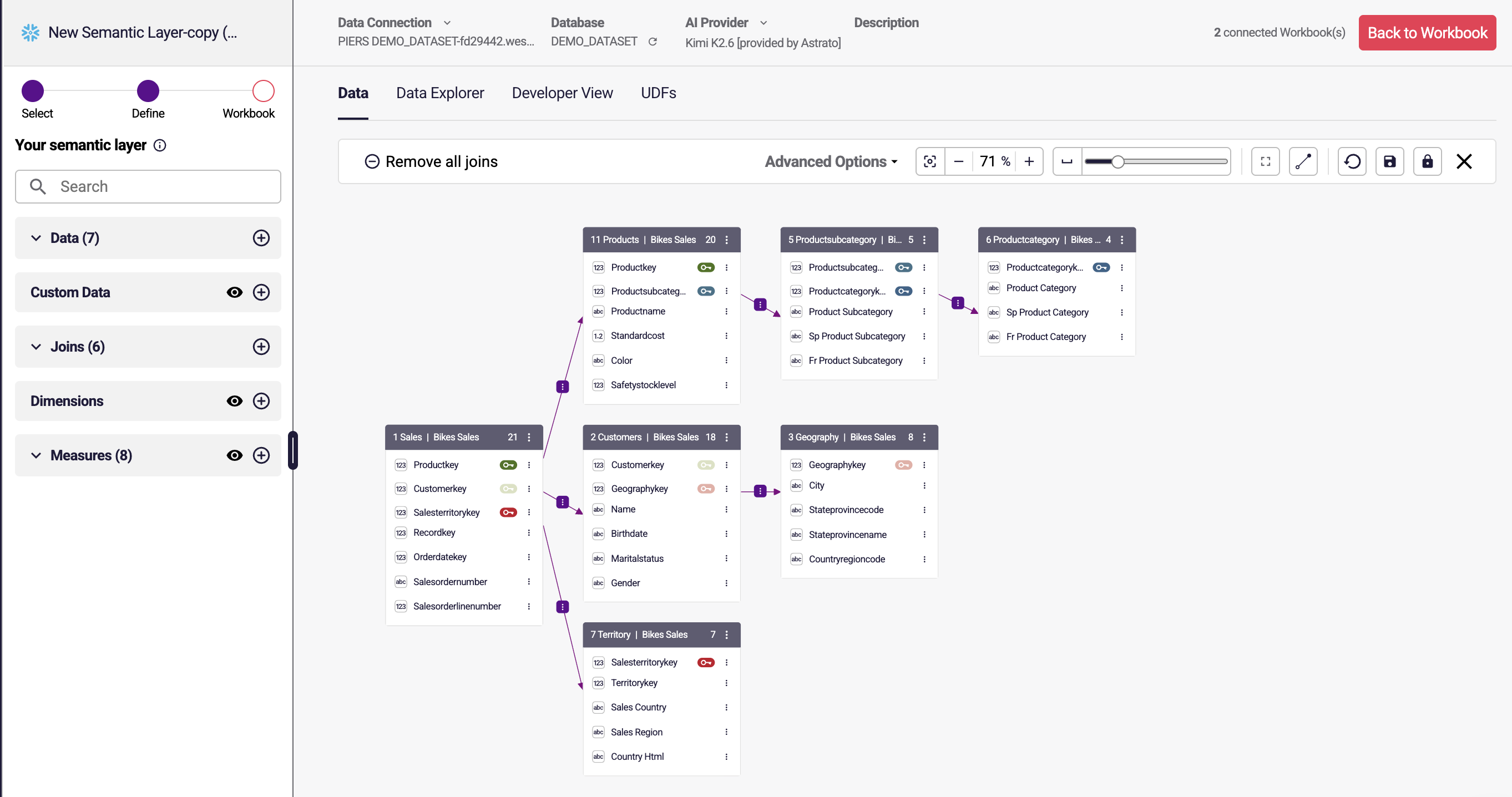
Row-level security is inherited from the warehouse, the model is version-controllable as YAML, and it’s warehouse-agnostic: model once, run on Snowflake, BigQuery, Databricks, or Redshift. One governed model powers dashboards, data apps, and AI alike. See the Astrato semantic layer or book a demo.
Key takeaways
- Three types of semantic layer: BI-tool (built-in), universal (standalone), and warehouse-native.
- BI-tool is simplest but traps definitions in one tool; universal is most flexible but the heaviest to build and maintain.
- Warehouse-native runs on the warehouse itself — low setup, governed by default, no second copy of your data.
- Done well, a warehouse-native layer models once and runs on any warehouse, and powers dashboards, data apps, and AI from one model.
- Choose by stack: one tool → BI-tool; large data team → universal; speed plus governance plus apps and AI → warehouse-native.
Frequently asked questions
What are the types of semantic layers?
Three: BI-tool semantic layers built into a single analytics tool, universal semantic layers that stand alone above the warehouse for every tool to share, and warehouse-native semantic layers that execute on the warehouse itself.
What is a warehouse-native semantic layer?
One where semantics, governance, and queries run directly on your cloud data warehouse — no extracted copy of the data. It gives you shared governed definitions with low setup and maintenance, and can run the same model across multiple warehouses.
Is dbt a semantic layer?
The dbt Semantic Layer is a universal (standalone) semantic layer — you define metrics in dbt and connected tools query them through a shared interface. It’s one option among the three types, best suited to teams with data-engineering resources.
Which type of semantic layer is best?
It depends on your stack. One tool and simple needs favor a BI-tool layer; a large, tool-diverse organization with a data team favors universal; teams wanting speed, governance, and data apps or AI on one model favor warehouse-native.
Ready to experience next-gen analytics?
See how Astrato runs natively in your warehouse.