
Ship Data Apps
on Databricks.
Build approval flows, forecasts and scenario planners on live Databricks data – no code, no extracts, no second copy to govern.
Your dashboards stop reading and start doing: writing back to Databricks and acting on what they find, all inside the access rules you've already set.
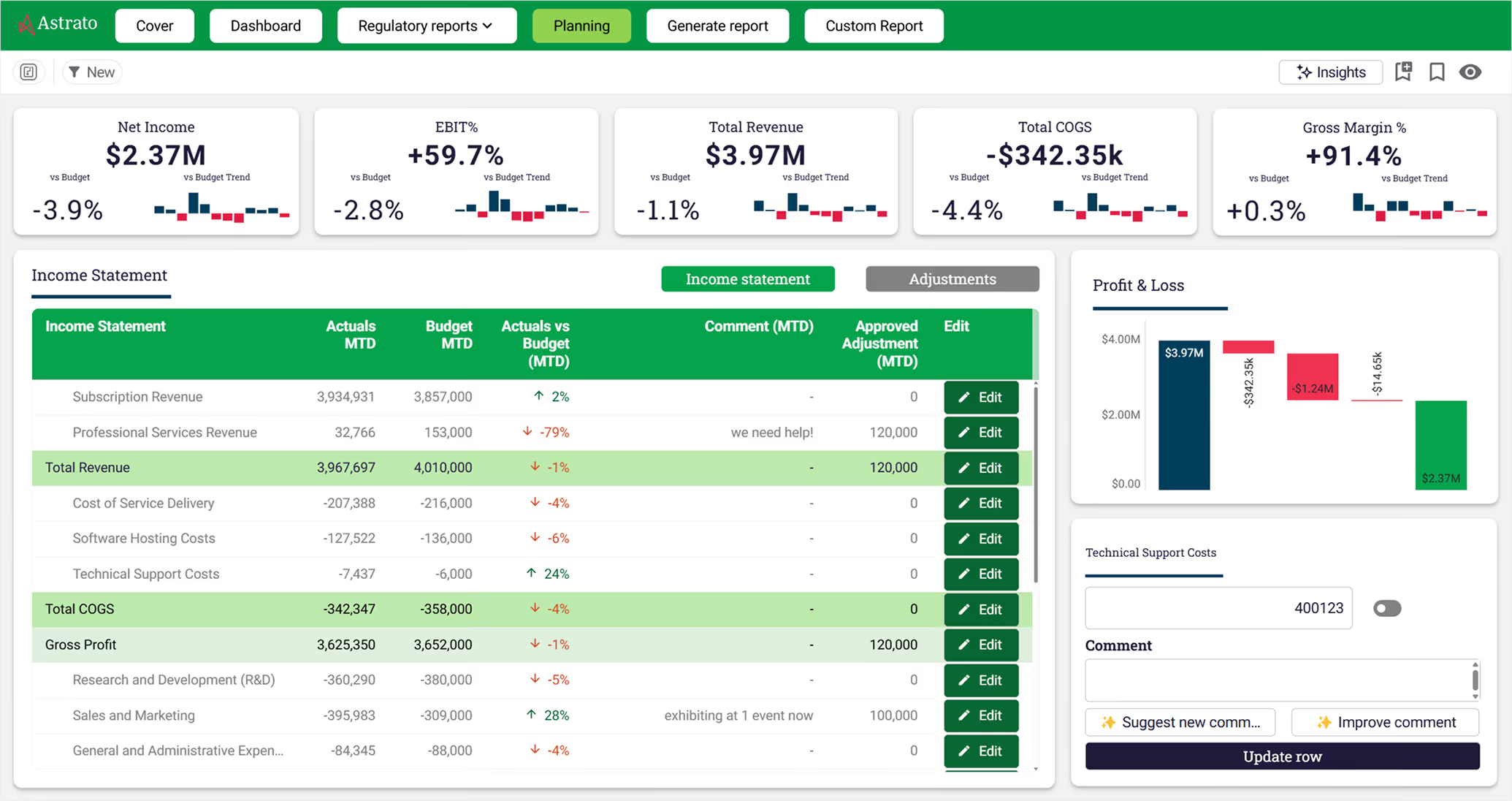

What teams build on Astrato + Databricks
Data Apps & Workflows
Write back to Snowflake from any dashboard and chain no-code actions into guided workflows – approvals, forecasts, scenario plans. Act on insights on the fly.
Customer-Facing Analytics
Embed pixel-perfect, white-labelled dashboards in your product in days – multi-tenant by design, isolated at Snowflake's own row level.
Guided Self-Service
Business users explore live Snowflake data through no-code dashboards on a governed semantic layer – self-service that never breaks the numbers.

Unify data, analytics & AI
with BI that speaks Databricks natively.
Query Databricks live, write straight back to it, and act on what you find – no copy, and a whole lot more than a report.

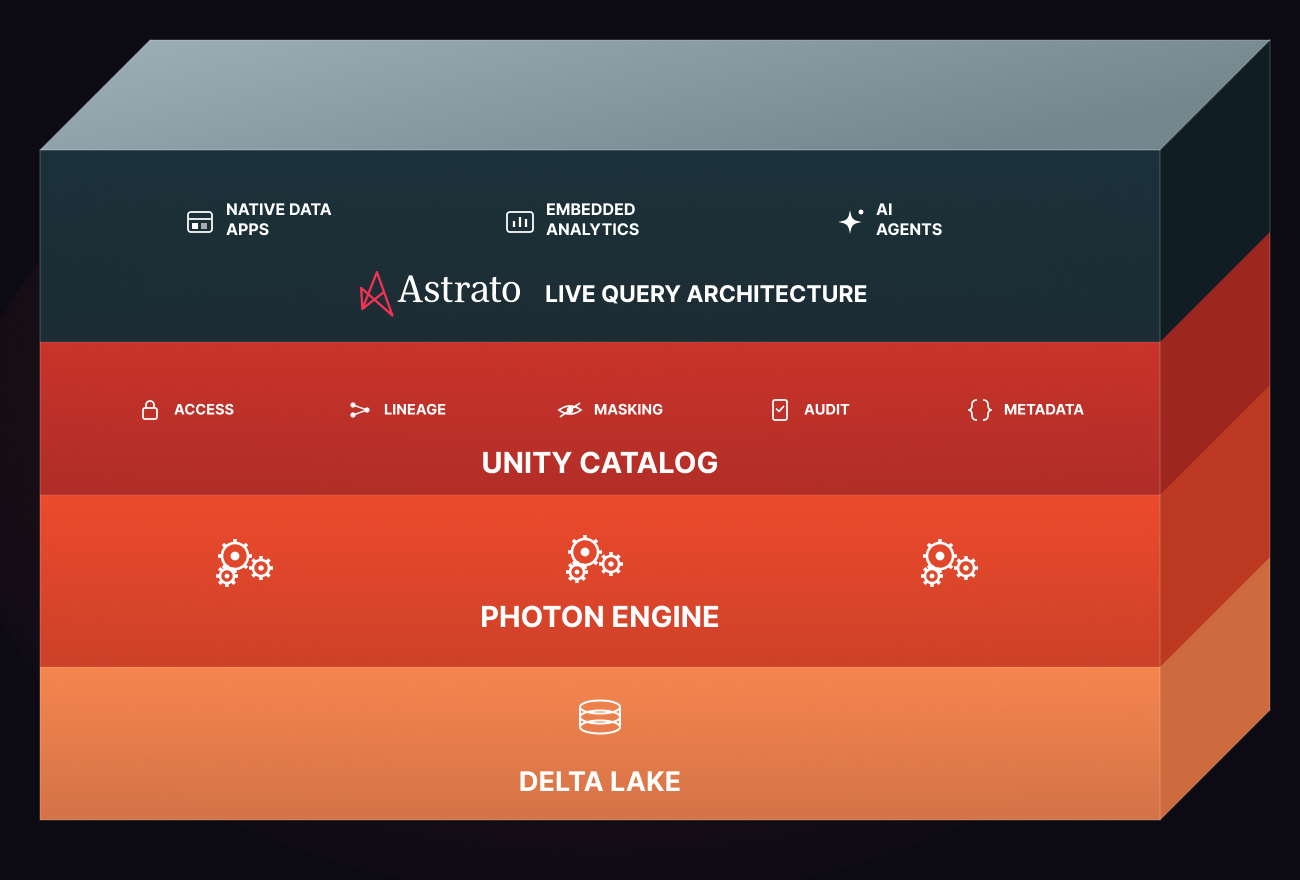
Your queries run on Photon, not a second engine.
Every query runs on the Databricks SQL warehouse you already pay for – Photon does the work across billions of rows, and repeat queries come straight from cache. Nothing to extract, nothing to refresh, no second BI engine to size. Scale to 5,000 viewers by scaling the warehouse, not your bill for a parallel stack.
Deploy Nash AI on your Databricks data
Nash AI is Astrato's agentic assistant that builds your governed semantic model and designs dashboards in plain language. Each query runs inside that user's Databricks access rules, and you pick the LLM, governed feature by feature.
Point Astrato at a catalog and go.
Add your Databricks SQL warehouse – host, HTTP path and a personal access token – or connect with OAuth so Unity Catalog governs every user automatically. Choose a catalog, name the connection, and your first live dashboard is minutes away.
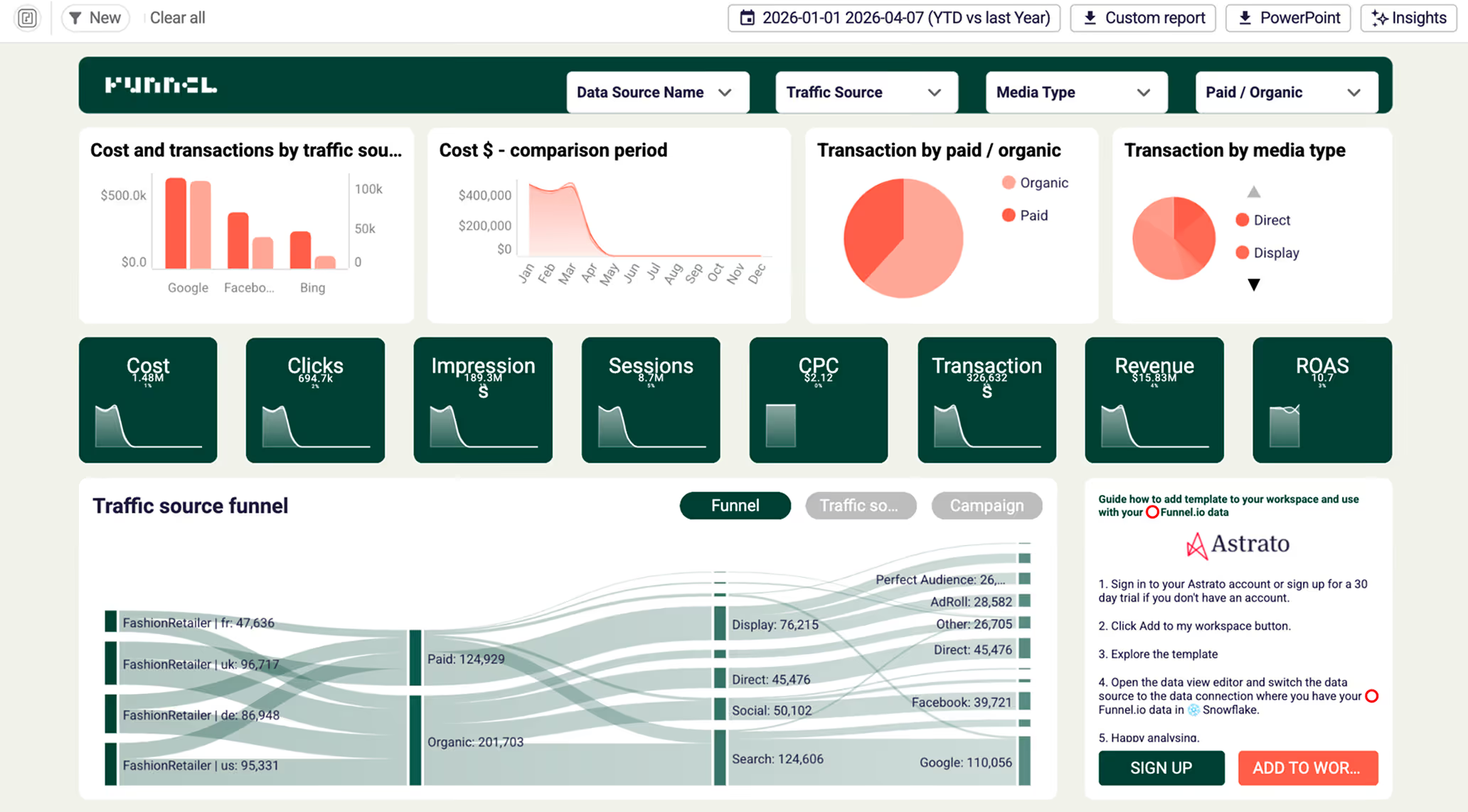


We use Astrato to implement a new financial tool with input table capabilities, dynamic calculations, reporting, and workflow for user assignment and permissions. All this was previously done manually with Excel files where the risk of loss of information and long creation time was a constraint.

Everything you'd expect from an Enterprise BI on Databricks
Semantic
Layer

Time Travel

Native
Writeback
Executive reports
Custom Report

AI-powered insights


A validated Databricks Technology Partner.
Astrato isn't bolted onto Databricks – it's a verified Technology Partner, validated by Databricks to run live on Databricks SQL with your Unity Catalog governance left fully intact.
Connect Astrato to Databricks.svg)

Unlock the true power of Snowflake

Frequently asked questions
Does my data ever leave Databricks?
No. Astrato runs live queries against your Databricks SQL warehouse – nothing extracted, copied, or cached in a separate BI layer. Every dashboard reads your lakehouse in real time.

Does Astrato respect my Unity Catalog permissions?
Yes – that's the whole point of connecting with OAuth. Every rule you've set in Databricks (table grants, row-level security, column masking) is inherited automatically. Nothing to re-secure in Astrato, and no one sees a row they couldn't query themselves.
How is this different from Databricks AI/BI and Genie?
Genie is great for asking questions and exploring. Astrato is the production layer it doesn't cover: pixel-perfect dashboards, customer-facing embedded analytics, scheduled reporting, and no-code data apps that write back and act. Most teams run both – explore in Genie, operationalize in Astrato.
Can users write data back to Databricks?
Yes. Writeback updates your Delta tables directly from a dashboard – approvals, forecasts, status changes, scenario inputs – and Delta Time Travel keeps every change tracked and reversible. It's what turns a read-only report into a data app.
Will Astrato run up our Databricks bill?
It runs on the SQL warehouse you already pay for – Photon does the work, repeat queries come from cache. No separate BI engine to provision, no extract to refresh. Adding viewers means scaling your warehouse, not paying for a parallel stack.
How do we connect Astrato to Databricks?
Point it at a SQL warehouse – host, HTTP path and a personal access token – or use OAuth so Unity Catalog governs every user. Pick a catalog, name the connection, and most teams build their first live dashboard the same day.