
What Is a Semantic Layer? Definition, Architecture & Benefits
A semantic layer is the translation layer between raw warehouse data and the tools people use it in. Learn how it's built, and why it matters.


A semantic layer is the translation layer between your raw warehouse data and the people and tools that use it — one governed place where “revenue” means the same thing everywhere. This guide explains what it is, the architecture and components behind it, the main types, and why it has quietly become the most important layer in the modern data stack.
Two analysts pull “revenue” for the same quarter. They get two different numbers. One included refunds; the other didn’t. One counted bookings; the other counted recognized revenue. Both queries were correct. Both analysts were competent. And the Monday meeting still dissolved into “where did you get that number?”
That argument is the symptom. The semantic layer is the cure. It’s the part of the data stack that decides what your data means — so a metric is defined once and is identical everywhere it’s used.
For years it was a quiet piece of plumbing only data teams thought about. Now, with self-service analytics and AI both depending on trustworthy definitions, it’s arguably the most important layer in the modern data stack. Here’s what it actually is.
TL;DR
A semantic layer is an abstraction layer that sits between your raw data (in a data warehouse or data lake) and the BI tools, applications, and AI that consume it.
It translates technical data structures — tables, columns, joins — into business terms (“revenue,” “active customer,” “churn”) defined once, in one place.
The payoff: every dashboard, query, and AI agent pulls from the same data definitions, so numbers are consistent, governance is centralized, and business users can self-serve without writing SQL — or arguing about whose number is right.
What is a semantic layer?
A semantic layer is a layer of your data architecture that maps complex, technical data structures to familiar business language. “Semantic” simply means “relating to meaning” — so a semantic layer is the part of the stack that holds the meaning of your data, separate from where the data is physically stored.
It’s often described as a translation layer or abstraction layer: underneath, your raw data lives in warehouse tables with names like fct_ord_ln_v2; on top, a business user sees “Orders.” The semantic layer is what connects the two.
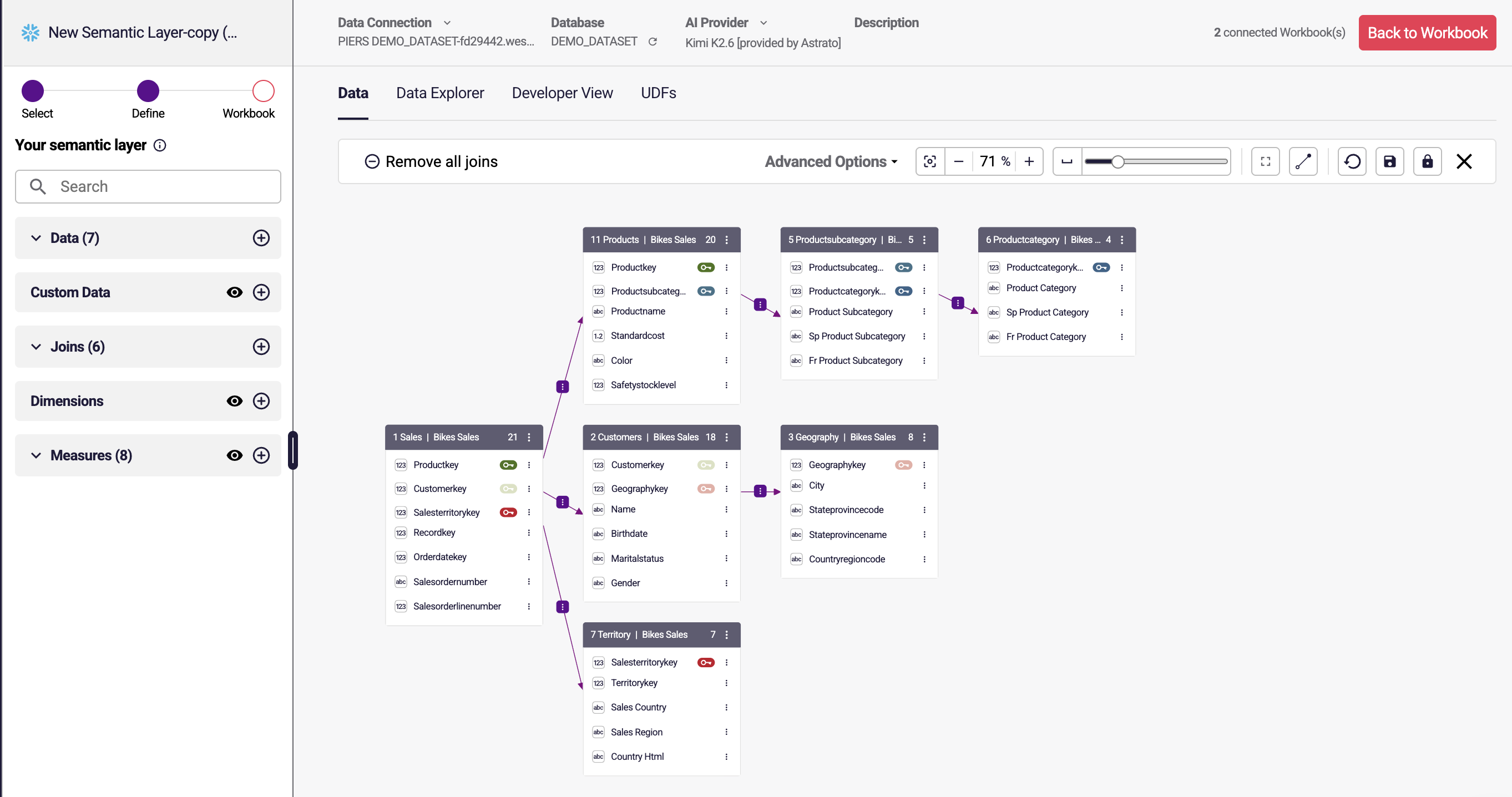
Crucially, it defines more than names. A semantic model captures the metrics (how “revenue” is calculated), the dimensions (how you slice it — by region, product, time), the relationships between tables, and the business logic that turns rows of enterprise data into answers.
Define those once, and every tool that queries through the semantic layer inherits the same definitions. That’s the whole idea: one definition of revenue, everywhere.
To understand the semantic layer architecture, picture three tiers. At the bottom is your data source — a data warehouse (Snowflake, BigQuery, Redshift), a data lake, or a lakehouse like Databricks — where raw data is stored and processed.
At the top are the consumers: BI tools, embedded apps, notebooks, and increasingly AI agents and generative AI assistants. The semantic layer sits in the middle, as the single interface for data access between them.
That position is what gives it its power.
Because every query flows through the semantic layer on its way from the warehouse to a tool, it can enforce one set of definitions, one set of permissions, and one source of truth — no matter which analytics tool sits on top.
A metric defined there is the same whether it’s read by a dashboard, an AI chatbot, or an export to Excel. The semantic layer serves all of them from the same governed model.
The components of a semantic layer
Most semantic layers are built from the same core components:
- A data model. The map of your data structures — which tables exist, how they join, and which data elements matter. This is the backbone the rest hangs on.
- Metric and dimension definitions. The business logic: how “net revenue” or “monthly active users” is calculated, and the dimensions you can break them down by. These data definitions are the part that ends the “whose number is right” argument.
- A naming and metadata layer. Friendly business names, descriptions, and semantic standards mapped onto cryptic warehouse data schemas — the translation that makes data legible to non-engineers.
- Governance and access controls. Row-level security and role-based permissions, so the same model can expose sensitive data to those allowed to see it and hide it from everyone else — ideally inherited from the warehouse rather than maintained twice.
- A query interface. The mechanism that translates a business request (“revenue by region, last quarter”) into the correct SQL against the data source, and returns a governed result.
Types of semantic layers
There are a few types of semantic layers, and the distinction matters when you’re choosing an approach:
BI-tool (built-in) semantic layers
Many BI platforms include a built-in semantic model — definitions live inside the tool. This is the simplest to start with, and for teams standardized on one BI tool it’s often enough. The limitation: those definitions usually don’t travel. A metric defined in one tool isn’t automatically available to another, or to an AI agent.
Universal (standalone) semantic layers
A universal semantic layer sits independently, above the warehouse and below all consumers, so every tool — BI, notebooks, AI — reads the same definitions. Tools like dbt’s Semantic Layer and Cube popularized this model. It’s the most flexible and the most work to stand up, and it’s where much of the “open semantic” standards conversation is happening.
Warehouse-native semantic layers
A newer cloud-native semantic approach pushes definitions down into the warehouse itself — for example, Snowflake and Databricks have introduced semantic views and metric definitions that live in the platform. The advantage is that governance and semantics sit with the data, not in a separate tier. Modern BI platforms increasingly build on or complement this, so the semantic layer provides one governed model without a second copy of your data to maintain.
Why a semantic layer matters: the benefits
The benefits of a semantic layer all trace back to consistency. To see them, picture the alternative.
Without a semantic layer, definitions live wherever someone last wrote them — in a dashboard, a SQL script, a spreadsheet, an analyst’s head. Every tool re-implements “revenue” slightly differently, complex data stays locked behind people who know the schema, and data quality becomes a matter of opinion. The Monday-meeting argument is the default state.
With one, you get:
- consistency: every consumer shares the same definitions
- centralized data governance: permissions and logic maintained once, not per tool
- data democratization: business users explore governed data without SQL or a ticket
- trust: when anyone can inspect the underlying SQL and lineage behind a number, “where did you get that?” has an answer.
For most organizations, the semantic layer is what makes genuine self-service data access safe to offer at all.
The semantic layer and AI
This is why the semantic layer suddenly matters to people who never cared about it before. Generative AI and AI agents are only as trustworthy as the definitions they query. Point an AI chatbot at a raw data warehouse and ask for “revenue,” and it has to guess which table and which logic — and it will, confidently, sometimes wrong. Point it at a semantic layer, and it inherits the same governed definition a human would get.
In other words, the bottleneck for trustworthy enterprise AI usually isn’t the model or even the raw data — it’s the missing shared meaning in between. The semantic layer is that shared meaning. It’s fast becoming the layer that makes AI on your own enterprise data safe to deploy, because it gives the model a governed map instead of a pile of tables to interpret.
The semantic layer and data apps
There’s one more reason the semantic layer has moved to center stage: it’s the foundation that makes data apps possible.
A dashboard only reads data, so an inconsistent definition is an annoyance.
A data app lets people act on data — submitting values, approving figures, writing back to the warehouse — and there, an inconsistent definition is a liability. (See what a data app is for the full picture.)
When users are changing data through an operational workflow, everyone has to be acting on the same governed numbers, or the writes themselves become untrustworthy.
So the semantic layer is what lets a data app stay safe at scale: one definition of every metric, row-level security inherited from the warehouse, and full lineage behind each value.
Self-service exploration, AI insight, and governed action all draw from the same model. Governance isn’t a layer you bolt on top — it’s the foundation everything else sits on.
Implementing a semantic layer
A few principles for implementing a semantic layer without it becoming a multi-year project. Start where the data already lives: a warehouse-native approach keeps governance and semantics with the data and avoids a second copy to maintain.
Don’t hand-build everything — modern platforms can infer relationships from your warehouse data schemas to give you a working semantic model on day one, which you then refine.
Define metrics collaboratively with the business so the logic reflects how the company actually thinks. And treat it as living data management: as definitions change, change them once, in the layer, and let every tool inherit the update.
Frequently asked questions
What is a semantic layer in simple terms?
It's a translation layer between your raw data and the people who use it. Underneath, data lives in warehouse tables with technical names; on top, the semantic layer presents business terms like “revenue” and “active customer,” defined once so they mean the same thing in every tool.
What is the difference between a semantic layer and a data model?
A data model describes how data is structured — tables, columns, relationships. A semantic layer uses that model and adds the business meaning on top: metric definitions, friendly names, governance, and a query interface. The data model is part of the semantic layer, not the whole of it.
What are the main types of semantic layers?
Three: BI-tool (built-in) layers where definitions live inside one tool; universal (standalone) layers that sit above all tools so every consumer shares definitions; and warehouse-native layers where definitions live in the warehouse itself, via features like semantic views.
Why is a semantic layer important for AI?
AI agents and chatbots are only as reliable as the definitions they query. Pointed at raw tables, an AI has to guess which logic to use for “revenue” — and can be confidently wrong. A semantic layer gives it a governed map, so it inherits the same trusted definition a person would.
Do I need a semantic layer if I only use one BI tool?
You still need the definitions a semantic layer provides — but a single tool's built-in model may be enough at first. The case for a universal or warehouse-native layer grows the moment a second tool, an embedded app, or an AI assistant needs to share those same definitions.
Where should the semantic layer live — in the BI tool or the warehouse?
Increasingly, as close to the data as possible. A warehouse-native semantic layer keeps governance and definitions with the data, so there's no second copy to maintain and every tool inherits the same model. BI platforms then build on or complement it rather than holding the definitions in isolation.
A semantic layer that’s the foundation, not an add-on
Astrato is a warehouse-native BI platform with a built-in semantic layer at its core: define your metrics, dimensions, and logic once, inherit row-level security from your warehouse, and let every dashboard, report, AI insight, and data app pull from the same governed model — with the underlying SQL and lineage inspectable behind every number. Explore guided self-service, or book a demo to see one definition of revenue, everywhere, on your own warehouse.
Ready to experience next-gen analytics?
See how Astrato runs natively in your warehouse.