AI Can't Check Its Own Work: Why Analytics Needs a Verifiable Foundation
Analytics accuracy is binary — a number is right or wrong. Why AI can't verify its own output, and what a verifiable foundation requires.


Software has a compiler. Analytics doesn’t. When generative AI writes code, the code either builds or it fails loudly — but when AI produces a number, nothing tells you it’s wrong. This guide explains why AI analytics accuracy is a fundamentally different problem from model accuracy, why a better model won’t solve it, and what a verifiable foundation actually requires.
TL;DR
- Analytics accuracy is binary. A number is right or wrong. There is no 90%-correct dashboard — one visibly wrong chart discredits the whole thing.
- AI has no verification loop for analytics. Generated code compiles or fails; generated analytics returns a confident number with no signal attached.
- This isn’t a model-accuracy problem. Better training data, bigger models, and drift monitoring address probabilistic prediction. Analytics failures come from missing business context, not weak inference.
- Verification has to come from outside the AI: agreed definitions, inspectable logic, enforced permissions, and a human in the lead.
- The semantic layer is where that verification lives — it makes correctness checkable rather than something you hope for.
Here is a small moment that should worry anyone deploying AI on business data. An AI assistant generates a dashboard.
One chart shows a net value trend, and something about the shape is off — not obviously broken, just wrong enough that a person who knows the business squints at it. Another tile shows total order quantity with a dollar sign in front of it. Quantities aren’t currency.
Neither error announced itself. No warning appeared, no confidence score dropped, no test failed. The AI produced both outputs with exactly the same fluency as the correct ones. And in that moment the entire dashboard became worthless — because once a viewer catches one wrong number, every other number on the page is now suspect.
That is the accuracy problem in AI analytics, and it is not the problem most people think it is.
Analytics accuracy is binary, not probabilistic
Most discussion of AI accuracy comes from machine learning, where accuracy is a distribution. A model is 94% accurate. Precision and recall trade off.
You improve results with more high-quality training data, more diverse and representative data, better data preparation and data cleaning, and you watch for data drift as new data diverges from historical data.
In that world, accuracy is a dial you tune, and a well-tuned model delivering accurate predictions most of the time is a success.
Business analytics does not work like that. When someone asks what revenue was last quarter, there is exactly one correct answer. The number matches the approved definition or it does not.
There is no 60% solution, no 70% solution, no 90% solution — a metric that is nearly right is simply wrong, and often more damaging than no metric at all, because it carries the authority of a dashboard while quietly misleading the person reading it.
This distinction matters enormously for how you evaluate AI in analytics. A generative AI tool that produces the right answer nine times out of ten sounds impressive and is, in practice, unusable for reporting — because you cannot tell which time was the tenth.
Probabilistic accuracy is acceptable when the output is a recommendation, a draft, or a forecast with error bars attached. It is not acceptable when the output is a figure someone will put in a board pack.
Software has a compiler. Analytics has nothing
The reason AI has transformed software development so quickly is not that models write flawless code. They don’t. It is that code exists inside a dense verification loop that catches failure automatically.
Code either compiles or it doesn’t. Tests pass or they fail. The application runs or it crashes. A developer using AI gets fast, unambiguous, machine-generated feedback about whether the output is broken — not whether it is elegant, but whether it fundamentally works.
Analytics has no equivalent. When an AI system writes a query and returns 4.2 million, nothing in the stack objects. The SQL is syntactically valid. The query executes. A number comes back and renders in a chart.
Every mechanical check passes. The only thing that can detect that the number used the wrong filter, joined the wrong table, or applied a definition nobody approved is a human being who already knows what the answer should look like — which is precisely the person the AI was supposed to save time for.
This is the structural gap at the centre of AI analytics accuracy. Not that AI models are unreliable, but that in this domain unreliability is silent. Errors don’t surface as failures.
They surface as confident, well-formatted, plausible answers. And the more fluent the AI system becomes, the more convincing its wrong answers get — which makes capability improvements a double-edged development rather than a straightforward fix.
Where AI analytics accuracy actually breaks
It helps to be specific about the failure modes, because they are not the ones the AI accuracy literature usually describes. These errors have little to do with model quality and everything to do with missing business context.
Ambiguous definitions
The most common failure. Ask for revenue and the AI must decide: bookings or recognized? Gross or net of refunds? Including or excluding a discontinued line? Those are business decisions, made by people, and they are rarely written anywhere the AI can read them.
So the model does what any system does with missing input — it picks the most statistically plausible option and proceeds without flagging that it made a choice at all. The same applies to “active customer,” “churn,” and every other metric your business has argued about.
Silent aggregation errors
An average where the model should be a sum. A count where a distinct count was needed. These produce numbers in a believable range — not obviously broken, just quietly incorrect — and they propagate cleanly into every roll-up built on top of them. Nothing about the data patterns in the output reveals the mistake.
Relationship and join errors
Enterprise data lives across many tables and data sources. If the AI joins two tables on the wrong key or misses a relationship entirely, results can be silently duplicated or silently missing.
A fan-out join can inflate a total several times over while still returning something that looks like a normal number.
Presentation and unit errors
The dollar sign on a quantity. A percentage rendered as a whole number. A currency that was never converted. These feel cosmetic and are not: the moment a viewer spots a unit that makes no sense, trust in the entire dashboard collapses.
Formatting errors are accuracy errors, because accuracy is what the reader perceives, not what the query technically returned.
Drift in meaning, not just data
Data drift is a familiar concept — the world changes and new data stops resembling the data a model learned from. Analytics has a second, less-discussed version: definition drift.
The business redefines a metric, a source system changes a field, a team adopts a different fiscal calendar. If those changes aren’t reflected in one governed place, an AI keeps confidently producing yesterday’s answer to today’s question.
Why a better model won’t fix this
The reasonable objection at this point is that models keep improving, so surely this resolves itself. It doesn’t — and the reason is worth being precise about.
Every failure above stems from information that does not exist in the data. Which revenue definition your finance team approved is not inferable from your warehouse schema, however much of it the AI reads and however capable the model is at reasoning.
It is not a hard inference problem; it is an absent-information problem. Scaling intelligence against missing context produces more articulate guesses, not correct answers.
There is also a compounding effect. As generative AI gets better, its wrong answers become harder to catch, because the tells that used to give them away — clumsy phrasing, implausible magnitudes, obvious formatting mistakes — disappear first.
Fluency improves faster than correctness. A confidently wrong number wrapped in a well-written explanation is more dangerous than a visibly broken one, because it survives review.
So the path to trustworthy AI analytics does not run through a bigger model. It runs through giving the model the context it is currently guessing at, and building a way to check what it produced.
What a verifiable foundation actually requires
If AI cannot verify itself, verification has to be supplied by the system around it. Four things are required, and they are all things AI cannot generate on its own:
- Agreed definitions. Every metric defined once, by the people who own it, in a place every consumer reads. This removes the guessing at source rather than correcting it afterwards.
- Inspectable logic. When a number looks wrong, you must be able to open it and see exactly which definition, which join, and which filter produced it. Explainable AI in analytics means traceable arithmetic, not a natural-language rationale.
- Enforced permissions. Access control applied below the AI, so it can only ever surface data the user was already cleared to see — regardless of how a question is phrased.
- Human review in the loop. Someone with business knowledge confirming the output before it becomes a decision. Not as a bottleneck on everything, but as the final check on anything that matters.
Notice what these have in common: none of them is an AI capability. They are properties of the data environment the AI operates in. Which is why organizations that bolt AI onto an ungoverned stack get so little from it — they added intelligence to a system that had no way to tell right from wrong in the first place.
The semantic layer is where verification lives
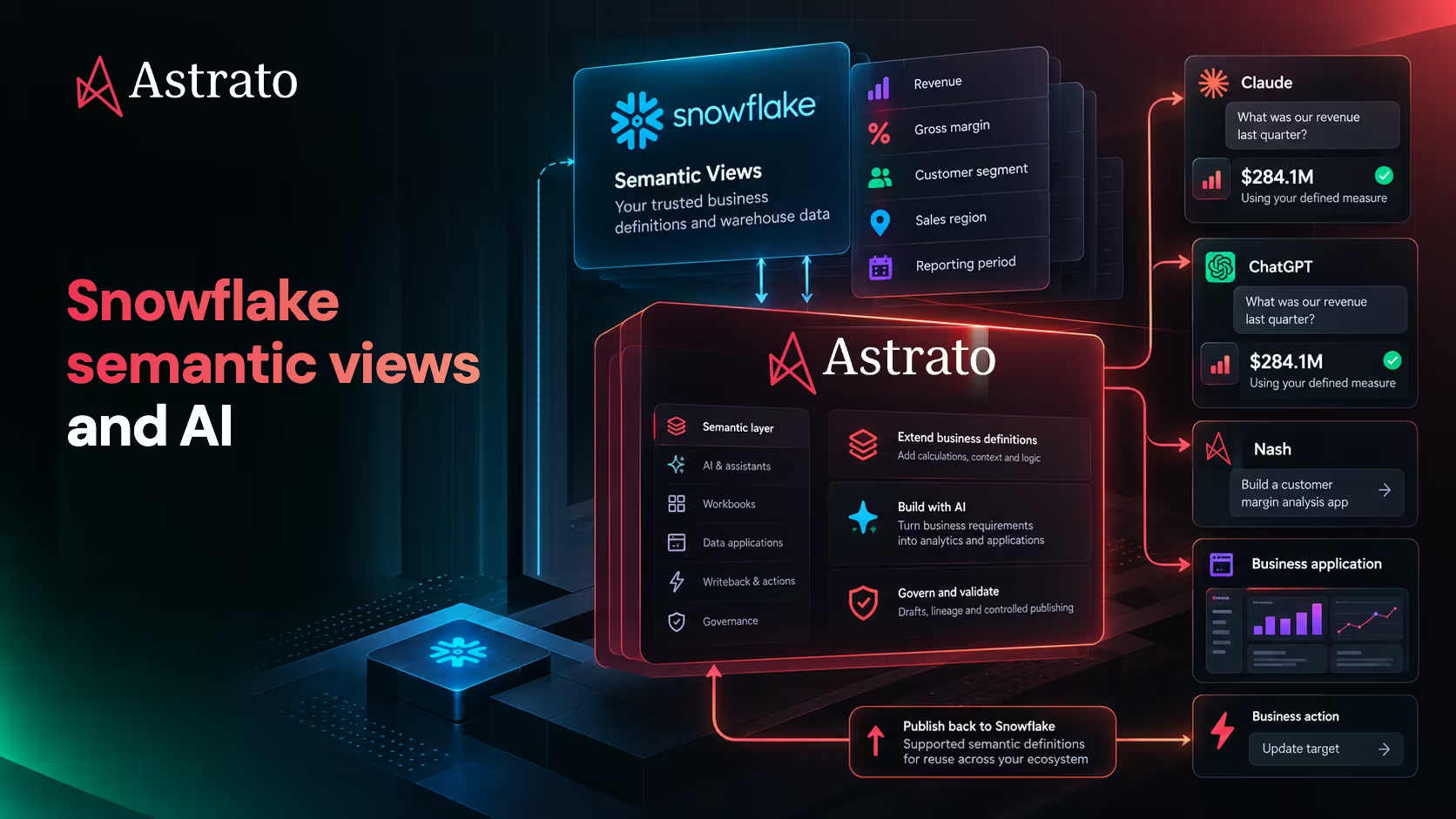
All four requirements point at the same piece of architecture. The semantic layer is the governed place where metrics, relationships, and permissions are defined once, independently of any single dashboard or query. It exists precisely to hold the business context that raw tables don’t carry.
When AI operates through that layer rather than around it, the failure modes above stop being possible in the way they were. It cannot invent a revenue definition, because the approved one is the only one available to it.
It cannot choose the wrong aggregation, because the measure specifies it. It cannot silently mis-join, because the relationships are already modelled. It cannot expose data a user shouldn’t see, because row-level security is inherited from the warehouse and applies underneath the AI.
And when something still looks wrong, the logic is inspectable — you can open the measure and read exactly how the number was produced.
This is the difference between hoping an AI is right and being able to check. The semantic layer doesn’t make AI infallible; it makes AI verifiable, which is the property analytics actually requires. It converts a probabilistic system into one operating inside deterministic constraints — the same queries, the same definitions, the same answers, every time.
It is also why the sequencing matters so much. Building the semantic layer first and defining your core metrics once is not preparatory work you do before the interesting AI project. It is the AI project’s foundation. Layer AI on top of inconsistent definitions and you don’t get intelligent analytics — you get your existing inconsistencies, automated and accelerated.
Human in the lead, not human in the way
None of this argues against using AI in analytics. It argues for using it where it is strong. AI is genuinely transformative at the construction work: modelling data, drafting measures, generating dashboards, translating logic from a legacy platform, restyling and restructuring at scale.
That work is slow, repetitive, and technical — and crucially, its output is checkable. A generated dashboard either uses the approved measure or it doesn’t, and you can see which.
What AI cannot do is stand behind the number. Judgment about whether a result is plausible, whether a definition fits the business question, whether a chart tells an honest story — that remains human work, and the last stretch of human refinement is what separates a demo from a tool people trust with real decisions.
The productive model is not AI replacing the analyst. It is AI removing the boilerplate so the analyst spends their time on the part that requires knowing the business.
How Astrato approaches this
Astrato is a warehouse-native BI platform with the semantic layer at its core, which means AI capabilities are grounded in governed definitions by design rather than added on top of raw tables.
Nash, its built-in assistant, is scoped deliberately: it accelerates the people who build analytics rather than acting as an autonomous analyst. It reads your live semantic model and builds dashboards from it, drafts measures and dimensions in plain language, and translates existing logic — Power BI DAX, Qlik Set Analysis, Excel formulas — into governed semantic definitions.
Every output stays anchored to the model: measures come from your definitions, row-level security applies automatically, and the underlying SQL and lineage remain inspectable behind every number. Nothing ships without a human reviewing it. That combination — AI doing the construction, the semantic layer supplying the constraints, a person making the call — is what a verifiable foundation looks like in practice. See the Astrato semantic layer or book a demo.
Key takeaways
- Analytics accuracy is binary — a number is right or wrong, and one visibly wrong chart discredits an entire dashboard.
- Code has a compiler and tests; AI-generated analytics has no automatic verification, so errors surface as confident answers rather than failures.
- The failures come from missing business context — ambiguous definitions, silent aggregation and join errors, unit mistakes, definition drift — not weak models.
- Better models make wrong answers more fluent and harder to catch; fluency improves faster than correctness.
- Verification requires agreed definitions, inspectable logic, enforced permissions, and human review — none of which AI can supply itself.
- The semantic layer is where those constraints live, which is what makes AI analytics checkable rather than merely convincing.
FAQs
Why can’t AI verify its own analytics output?
Because there is no automatic test for whether a number is correct. Generated code compiles or fails, but a generated query returns a syntactically valid, plausible figure whether or not it used the right definition, filter, or join. Only business context can distinguish the two, and that context isn’t in the raw data.
Isn’t AI analytics accuracy just a data quality problem?
Data quality matters, but it isn’t sufficient. You can have perfectly clean, accurate data and still get a wrong answer, because the error lies in which definition was applied — a business decision that clean data doesn’t encode. That’s a governance and semantics problem, not a data-cleaning one.
How is analytics accuracy different from model accuracy?
Model accuracy is probabilistic — a percentage you improve with better training data and monitor for drift. Analytics accuracy is deterministic: the metric matches its approved definition or it doesn’t. A 95%-accurate reporting number is not a good result; it’s an unusable one, because you can’t tell which cases are the other 5%.
Does a semantic layer guarantee AI gives correct answers?
It removes the largest source of error — guessed definitions — and keeps AI outputs consistent with your governed metrics and security. It makes correctness checkable rather than assumed. Human review still matters, but grounded AI is verifiable in a way ungoverned AI cannot be.
Should we wait for AI to get more accurate before using it in analytics?
No — but scope it to work whose output you can check. AI is reliable today at construction tasks like modelling, dashboard generation, and migrating logic, because those produce inspectable artifacts. Treat open-ended interpretation as assisted work requiring review, not as a finished answer.
Ready to experience next-gen analytics?
See how Astrato runs natively in your warehouse.