Snowflake Semantic Views and AI: Getting Assistants to Use Your Definitions
Learn how Snowflake Semantic Views help AI assistants use trusted business definitions, reduce inconsistent answers and power AI-driven analytics.

Your finance team has agreed on how revenue should be calculated.
Refunds are handled consistently. Currency conversion follows an approved method. Internal transactions are excluded. The reporting calendar is defined.
Your data team has captured that logic in Snowflake Semantic Views.
Then someone connects an AI assistant to the warehouse and asks:
"What was our revenue last quarter?"
The assistant writes SQL, runs a query and returns a number.
But did it use the revenue definition finance approved?
Or did it find a promising-looking column, apply its own filters and calculate something that happens to be called revenue?
That's the gap many organizations face as they bring AI into their analytics workflows.
They've already done the work of defining their business. Now they need AI assistants to use those definitions rather than independently interpret the underlying data.
Snowflake Semantic Views provide an important part of that foundation. The next challenge is making those definitions available, understandable and reusable wherever people ask business questions.
Your AI assistant can query the warehouse without understanding your business
Connecting an AI assistant to Snowflake is useful. It gives the assistant a way to work with actual business data rather than rely on information supplied in a prompt.
But access to data and understanding its meaning are different capabilities.
Consider a business with three revenue-related fields:
order_amount: the value of orders placed.
invoiced_amount: the amount billed to customers.
recognized_revenue: revenue recognized under the company's accounting rules.
All three might be legitimate measures for different purposes.
If a sales director asks about bookings, the first may be relevant. If finance asks about recognized revenue, the third is more appropriate.
An AI assistant examining table names and column descriptions might infer which one to use. It might even write perfectly valid SQL.
But an inference isn't the same as applying the organization's agreed business definition.
And the problem becomes harder when the calculation involves multiple tables, exchange rates, refund rules, customer exclusions or reporting periods.
The risk isn't simply that AI writes incorrect SQL. It's that AI can write correct SQL for the wrong interpretation of the question.
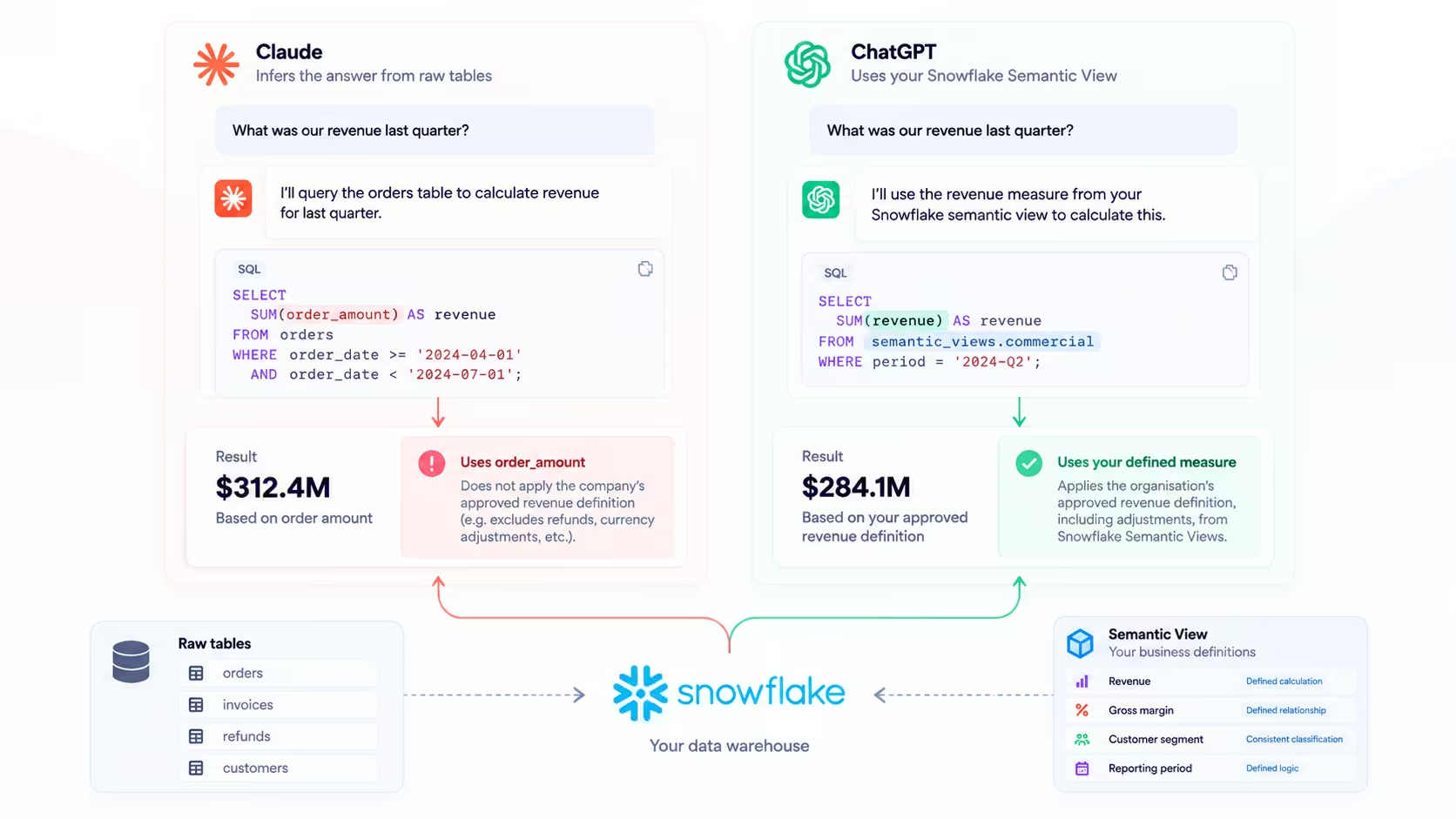
This is why giving an assistant access to every table in a warehouse doesn't automatically make it a dependable business analyst.
What Snowflake Semantic Views change
A Snowflake Semantic View captures business meaning in a reusable structure.
Instead of leaving every consuming tool to reconstruct how the data should be interpreted, a semantic view defines the relevant business entities, relationships, dimensions and measures.
For example, a commercial semantic view might establish that:
These are illustrative examples; the actual definitions depend on the organization.
The important change is that business logic becomes something analytical tools can reference rather than something each tool must rediscover.
A semantic view can help answer questions such as:
- Which measure represents net revenue?
- Which dimensions can that measure be grouped by?
- How are customers related to transactions?
- Which calculation should be used consistently across different analytical questions?
For AI, this reduces ambiguity.
For the data team, it creates an opportunity to reuse definitions they've already developed and reviewed.
For business leaders, it provides a stronger basis for comparing answers across different analytical experiences.
But there is an important qualification: creating a semantic view doesn't guarantee that every AI assistant will automatically use it.
The assistant's connection, available tools and query workflow must actually expose and apply the relevant definitions.
That's where the implementation becomes as important as the semantic model itself.
The business cost of letting every AI assistant interpret metrics independently
Imagine a company with three departments using AI to investigate quarterly performance.
Finance asks Claude to calculate net revenue.
Sales asks another assistant to compare revenue across regions.
Operations uses an AI-powered application to examine customer profitability.
All three systems query Snowflake.
Yet each might reconstruct the calculation differently.
Finance excludes refunds. Sales uses order value. Operations joins transactions to customer records in a way that duplicates certain amounts.
The results don't reconcile.
Now the organization has a familiar problem in a new form: different reports presenting different versions of the business.
Except AI makes it easier to create those interpretations and distribute them.
More time spent reconciling numbers
When two answers disagree, someone has to investigate the difference.
That may involve reviewing SQL, comparing filters, checking date fields and tracing calculations back to the underlying tables.
The original question might take seconds to answer, but resolving conflicting answers can consume considerably more time.
Less confidence in AI-assisted decisions
If a CFO receives one revenue figure from a finance report and another from an AI assistant, the natural response is to question the assistant.
Even when the difference has a legitimate explanation, that explanation needs to be visible.
An assistant that cannot establish which business definition it used makes its answer harder to trust.
More duplicated analytical work
Every team that independently defines revenue, margin or customer status creates another piece of logic to maintain.
A change to the approved definition then needs to be reflected across those implementations.
The challenge isn't just producing the first answer. It's keeping future answers consistent as the business evolves.
The opportunity with Snowflake Semantic Views is to make the organization's approved definitions reusable across these experiences.
That doesn't eliminate every source of disagreement. Different filters, user permissions, reporting periods and analytical assumptions can still produce different results.
But it removes an important source of unnecessary variation: independently reconstructed business logic.
The goal isn't identical answers. It's consistent business meaning.
There's a subtle distinction here.
Two people can ask the same AI assistant about revenue and legitimately receive different numbers.
A global CFO might have access to company-wide performance.
A regional sales director might only be authorized to see EMEA.
A customer success manager might be investigating a specific customer segment.
The answers can differ because the scope differs.
Similarly, one user may ask about recognized revenue while another asks about bookings.
Those are different business questions, even if both involve revenue.
The goal of governed AI analytics isn't to force every user to receive the same result.
It's to make sure that the same business concept is interpreted consistently, while the appropriate filters, time periods and access controls are applied.
A dependable answer therefore depends on several things working together:
- The business question is interpreted correctly.
- The approved measure and dimensions are used.
- The relevant filters and reporting periods are applied.
- The user's authorized data scope is enforced.
- The result can be checked against its underlying logic and evidence.
Semantic definitions address a critical part of that process, but they don't replace access control or validation.
That's why AI readiness requires more than connecting a language model to a database.
Make your Snowflake investment useful beyond the semantic model
For a Head of Data or Analytics, there's a broader question.
Your team has invested time in defining business entities, measures, relationships and calculation rules.
How much of that work can the rest of the organization actually use?
If those definitions only support a limited set of analytical workflows, their business value remains constrained by where they're available.
AI changes the opportunity.
A sales leader can ask a question in natural language. An analyst can investigate a result through an interactive interface. A finance team can work with a purpose-built application for a recurring review.
These experiences don't need to independently invent the meaning of revenue or gross margin.
They can work from the semantic investment the organization has already made, provided the relevant integrations support it.
That creates three potential business benefits.
First, faster delivery of analytical experiences. Teams can build on existing definitions rather than repeatedly specifying and implementing the same calculations.
Second, more consistent analytical logic. Different experiences can reuse the same approved business concepts instead of creating competing interpretations.
Third, better reuse of data-team work. Semantic definitions become building blocks for additional business questions, analytical workflows and applications.
These are architectural opportunities, not automatic outcomes of enabling Semantic Views. Realizing them depends on how the consuming tools work with the definitions.
The important shift is to stop treating semantic modeling as the final deliverable.
The semantic model is the foundation. The business value comes from what people and AI can do with it.
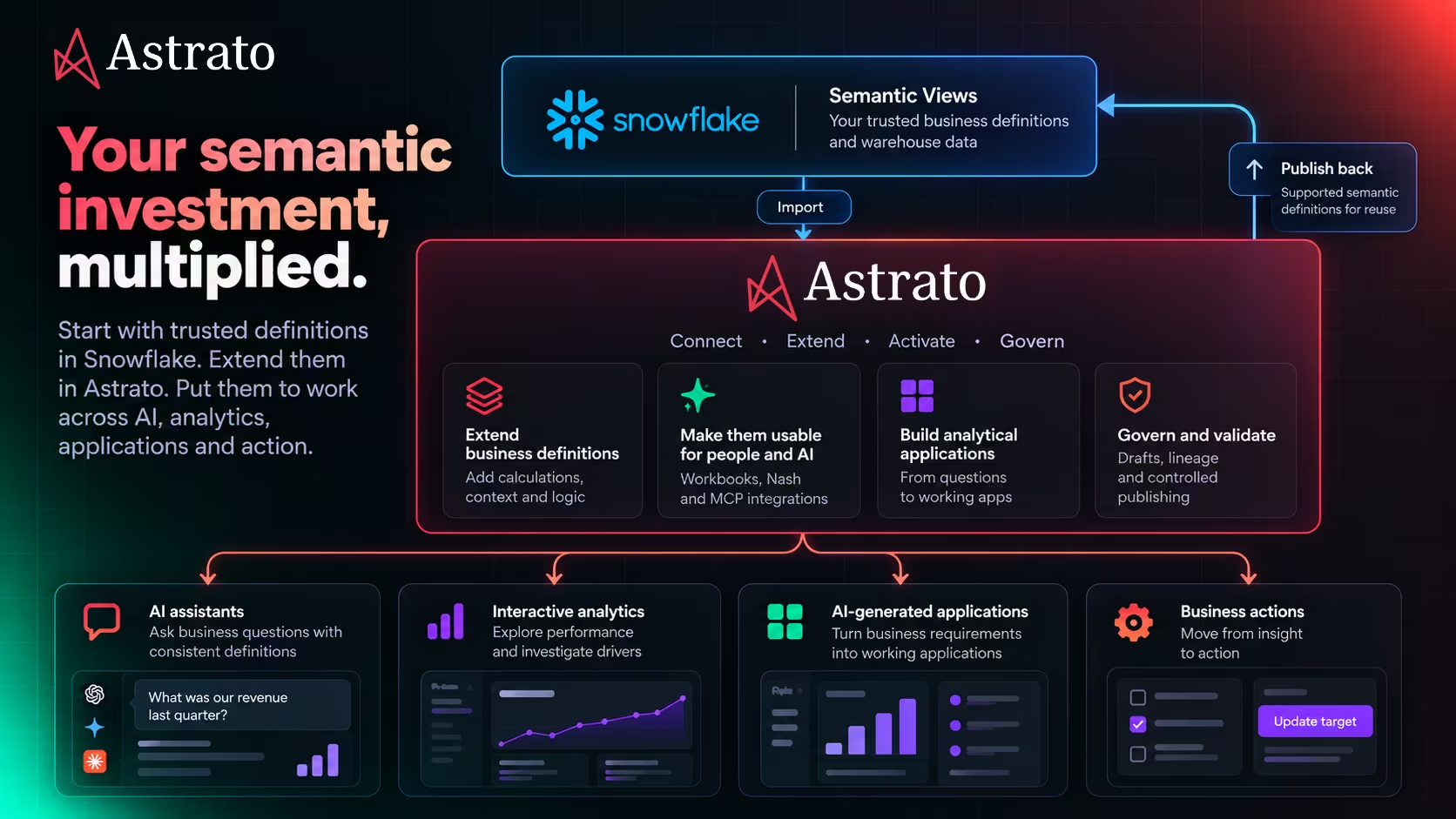
From trusted definitions to business applications
Consider a commercial team reviewing declining customer margins.
The question isn't simply:
"What was gross margin last quarter?"
The team needs to understand which customer segments are underperforming, compare performance across periods, examine the underlying costs and decide what to do next.
An AI assistant can help investigate the problem.
But a recurring margin review may need more than a conversation.
It might benefit from an application that brings together revenue, cost, margin, customer segments and relevant comparisons in one interactive experience.
The advantage of starting with Snowflake Semantic Views is that the team doesn't have to establish the meaning of those measures from scratch.
The data team may already have defined revenue, gross margin and customer relationships. Those definitions can become the starting point for a more useful analytical workflow.
Illustrative example: A commercial margin review
The same approved business definitions support progressively more useful work.
Snowflake Semantic Views
Revenue, gross margin, customer segments and relationships
AI-assisted investigation
Which customer segments saw margin decline?
Interactive business application
Compare segments, examine scenarios and support decisions
Conceptual workflow, not a representation of a specific production application.
This matters because the cost of creating analytical interfaces is changing.
AI can help build applications from natural-language requirements, reducing some of the manual work involved in designing and assembling them.
But building an interface is only part of the challenge.
An application still needs the correct measures, business relationships, calculations and data access rules.
The easier it becomes to build applications, the more important it becomes to have a reliable foundation underneath them.
Otherwise, organizations risk multiplying inconsistent interpretations of their business at the same time they're accelerating application development.
How Astrato puts Snowflake Semantic Views to work
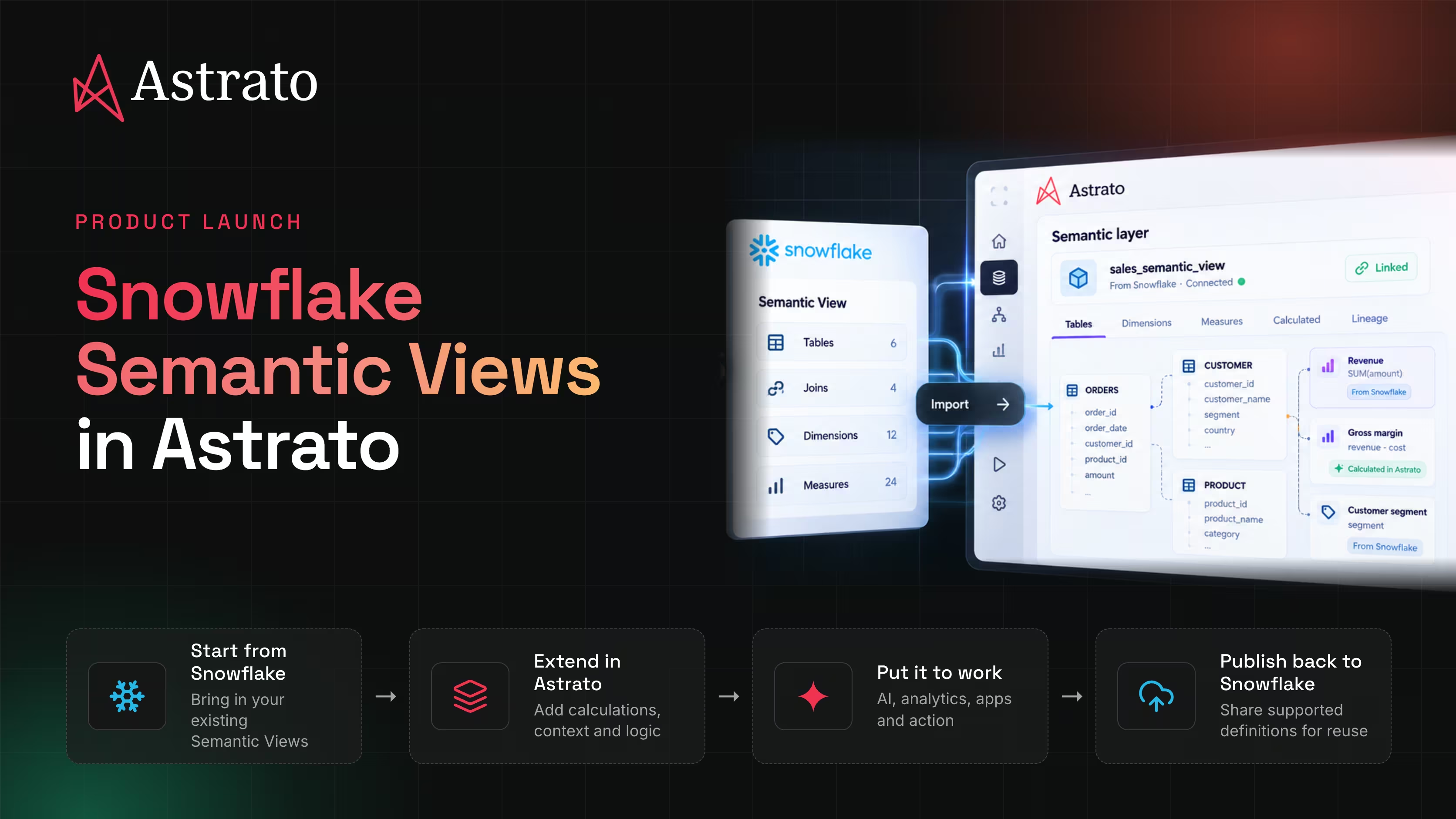
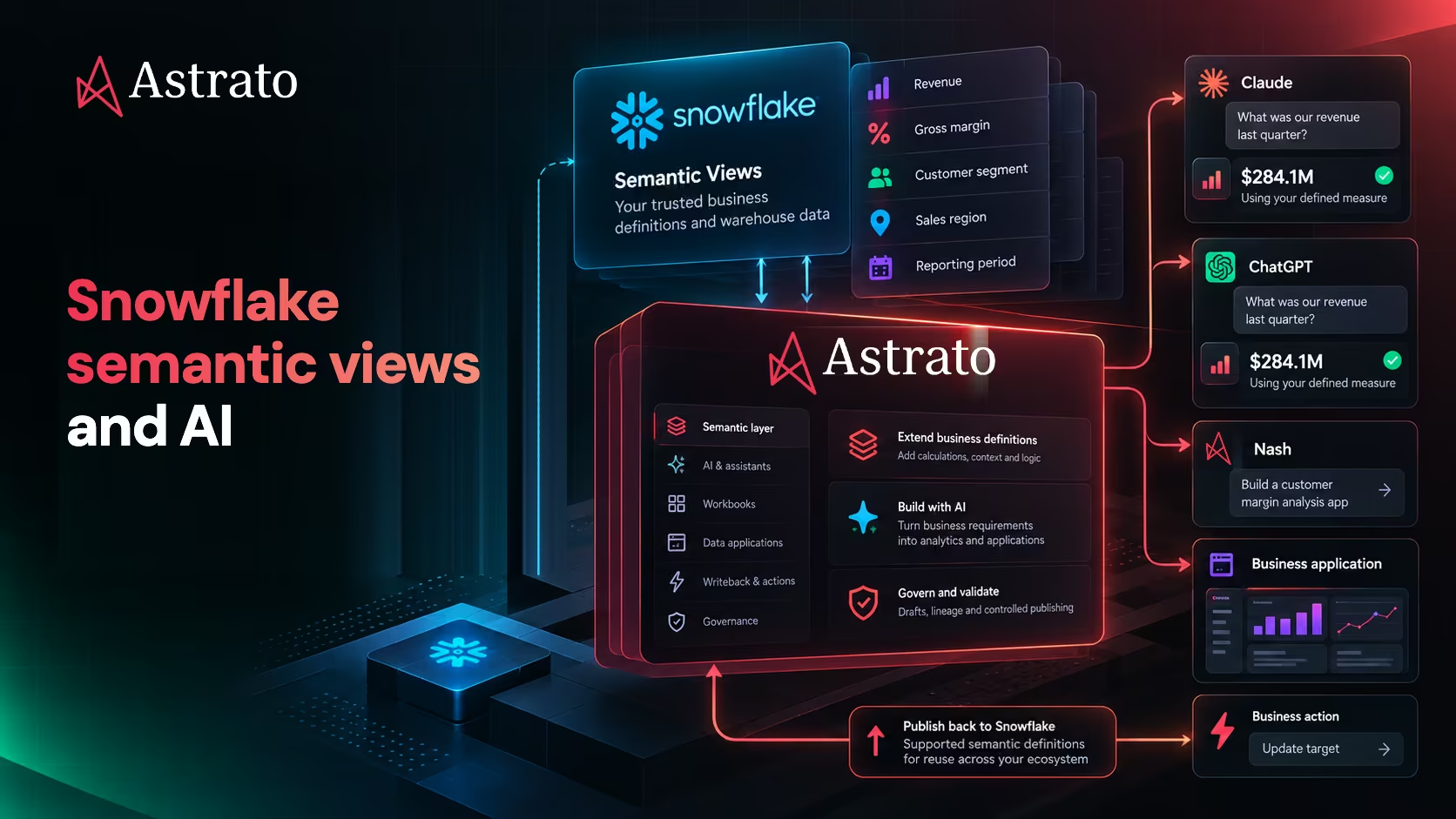
Astrato connects to existing Snowflake Semantic Views so teams can reuse business definitions in analytical workflows and AI-powered applications.
The idea is to build on the semantic investment already made in Snowflake, rather than recreate it in another environment.
There are three parts to that approach.
Start with the definitions you already have
Astrato imports existing Snowflake Semantic Views, including supported measures, dimensions and relationships.
Snowflake-owned definitions remain identifiable and connected to their source. When upstream definitions change, Astrato can surface those changes for review before adoption.
This helps teams retain visibility into where their business logic originates while making it available for additional analytical work.
Extend the definitions for richer analysis
Not every analytical requirement will be fully expressed in the original semantic view.
A margin investigation might need additional calculations, dynamic comparisons or business context.
Astrato allows teams to extend imported definitions with supported analytical logic while managing changes through semantic-layer validation, lineage and publishing controls.
Those definitions can then support interactive analytics, Nash and supported MCP-connected AI workflows.
The distinction matters: Astrato extends the usefulness of Snowflake's semantic foundation; it doesn't need to replace that foundation.
Build applications and reuse supported semantic work
Astrato can use those definitions as a foundation for AI-assisted business application development.
Instead of beginning with disconnected tables and manually reconstructing calculations, teams can start from existing business meaning and build experiences around the decisions people need to make.
For example, a commercial margin application could bring together approved revenue and margin measures, customer segments and interactive comparisons to support a recurring performance review.
Supported semantic definitions and descriptions created or extended in Astrato can also be explicitly exported as Snowflake Semantic Views for reuse elsewhere in the Snowflake ecosystem.
That export is a controlled operation, not an automatic two-way synchronization. Not every Astrato-specific construct is necessarily exportable.
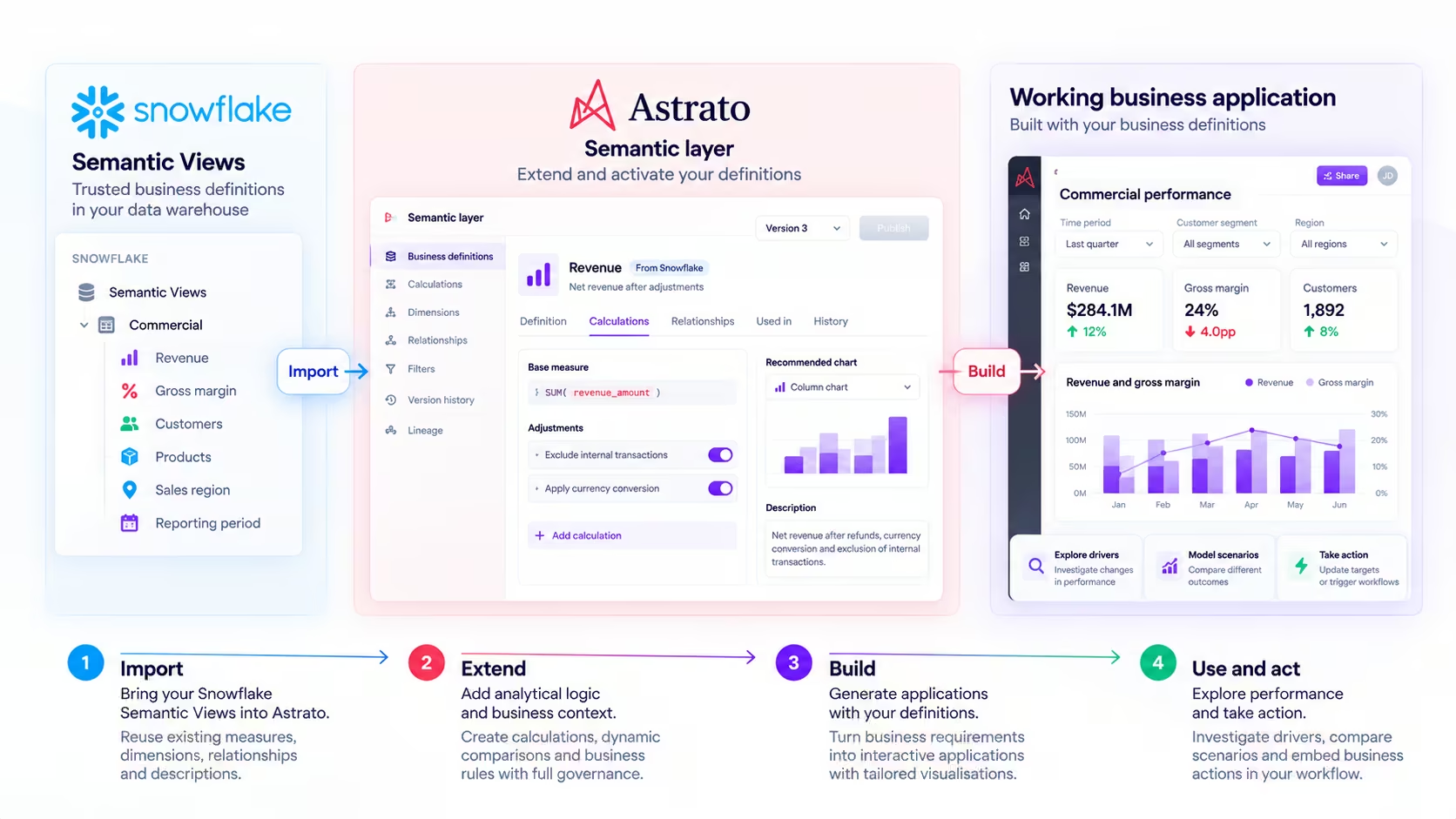
For the technical details of importing, extending and exporting definitions, see Introducing Snowflake Semantic Views in Astrato.
What to check before connecting an AI assistant to your semantic definitions
The existence of a semantic view is only the starting point.
Before relying on AI-generated analytical answers, data teams should establish how the assistant actually works with the semantic foundation.
The questions worth asking are practical:
- Definition usage: Does the assistant query through approved semantic definitions, or can it independently calculate measures from raw tables?
- Business context: Can it access relevant descriptions, relationships and calculation rules?
- Access enforcement: Which identity is used for queries, and where are permissions enforced?
- Traceability: Can users inspect the query, filters, calculations and assumptions behind an answer?
- Change management: What happens when an approved metric definition changes?
These questions matter regardless of which AI assistant the organization prefers.
A connection through MCP, for example, can provide access to analytical tools and resources. But MCP itself doesn't guarantee correct business logic or authorization. Those responsibilities belong to the systems and tools behind the connection.
A well-designed analytical workflow should make it easier to determine not just what number the AI returned, but how that number was produced.
Your Snowflake definitions should outlive the AI tool you use today
The AI interface your organization prefers may change.
Teams may adopt Claude, ChatGPT, Nash or another assistant. They may use conversational analysis for one task and an interactive business application for another.
What shouldn't need to change every time is the organization's definition of revenue, gross margin or customer retention.
That business knowledge represents work your data team has already done.
Keeping it reusable gives the organization more flexibility to adopt new AI experiences without rebuilding the same analytical logic for each one.
Snowflake Semantic Views provide a foundation for that reuse.
Astrato helps turn those definitions into analytical experiences and business applications that people can use to investigate performance, make decisions and take action.
The opportunity isn't simply to let more AI assistants query Snowflake.
It's to make the business knowledge you've already defined in Snowflake useful wherever people and AI need it.
You've defined your business in Snowflake. Now put it to work in Astrato.
Ready to experience next-gen analytics?
See how Astrato runs natively in your warehouse.