
Auditing Your Semantic Layer: How to Catch Duplicate Metrics & Definition Drift
Catch duplicate metrics and definition drift before they erode trust. A practical checklist for auditing and governing your semantic layer.


A semantic layer keeps definitions consistent — until it grows. Over time, duplicate metrics, conflicting KPI definitions, and drift creep in and quietly erode trust. This guide is a practical checklist for auditing your semantic layer: what to look for, how to run a review, and how to keep it clean as it scales.
TL;DR
- Semantic layers drift as they grow: duplicate metrics, inconsistent KPI definitions, conflicting logic, and incomplete joins accumulate and erode trust.
- Audit for five things: duplicate/overlapping measures, inconsistent definitions of the same KPI, non-standard aggregations, gaps in the join web, and orphaned or unused fields.
- Run it as a review, not a one-off: inventory every measure with its formula and source, group by type, and flag conflicts.
- Keep it clean with version control, a single owner per metric, and a change process — change a definition once, and every consumer inherits it.
A semantic layer is supposed to be your single source of truth. On day one, it is. But definitions multiply as teams add metrics, and without maintenance the layer slowly fills with near-duplicates and quiet inconsistencies. Two measures both called some version of “revenue,” defined slightly differently. A KPI that means one thing to finance and another to sales. Governance drifts, and the trust the layer was built to provide starts to leak. Auditing is how you catch that before it reaches a dashboard.
Why semantic layers drift
Drift isn’t a failure — it’s entropy. Every new project adds measures. Different teams name the same concept differently. Someone builds a one-off metric for a deadline and it never gets reconciled. A join gets added for one analysis and leaves the web slightly inconsistent. None of these is a disaster alone; together, over a year, they turn a clean model into one where nobody’s quite sure which “active customer” measure is the real one. At scale, a manual review of hundreds of measures would take weeks, so it never happens — which is exactly why the problems compound.
A good semantic-layer audit looks for five specific problems:
1. Duplicate and overlapping measures
The most common issue: two or more measures that compute the same thing, or nearly. “Revenue,” “Total Revenue,” and “Net Sales” may all point at the same logic — or worse, differ in one filter nobody remembers. Every duplicate is a future argument. Consolidate to one canonical measure and alias the rest.
2. Inconsistent definitions of the same KPI
The same KPI defined differently in different places — churn using different bases, ARR including different revenue types. This is the drift that produces two “correct” numbers. Standardize on one definition per KPI; our guide to defining metrics in a semantic layer covers how to pin these down.
3. Non-standard aggregations
Measures using an aggregation that doesn’t match the rest of the model — an average where a sum is expected, a count that should be a distinct count. These produce subtly wrong roll-ups that are hard to spot downstream.
4. Gaps in the join web
Tables that should connect but don’t, or joins that are incomplete. A gap here means some cross-table questions silently return wrong or empty results. Map every join and confirm the web is complete for the questions the model needs to answer.
5. Orphaned and unused fields
Dimensions and measures nobody uses, or fields left behind by a deprecated source. Clutter isn’t harmless — it’s where the wrong field gets picked. Flag unused elements for review and removal.
How to run a semantic-layer audit
Turn the five checks into a repeatable review:
- Inventory every measure with its formula, source table, and meaning — you can’t reconcile what you can’t see in one place.
- Group measures by type (revenue, product, order, time-intelligence) so overlaps and gaps become obvious.
- Diff the near-duplicates: where two measures look alike, compare their exact logic and decide on one canonical version.
- Map the join web and mark where it’s incomplete.
- Assign an owner to each surviving metric, so there’s a person accountable for its definition going forward.
Keeping the layer clean as it scales
An audit fixes today’s drift; the process prevents tomorrow’s. Three habits keep a semantic layer trustworthy at scale. Put the model under version control — expressed as code (e.g. YAML), every change is reviewable and reversible, so drift is visible in a diff. Give every metric a single owner, so new definitions go through a person rather than appearing ad hoc. And change definitions in the layer, not in dashboards: change “revenue” once and every consumer inherits it, instead of forking a new version. This matters most where the layer feeds data apps that write back, because an inconsistent definition doesn’t just mislead — it writes bad data.
Making audits fast in Astrato
Astrato’s warehouse-native semantic layer gives you the raw material for a clean audit: every measure is defined in one place with inspectable formula and lineage, the model is version-controllable as YAML, and it runs on one governed model across any warehouse.
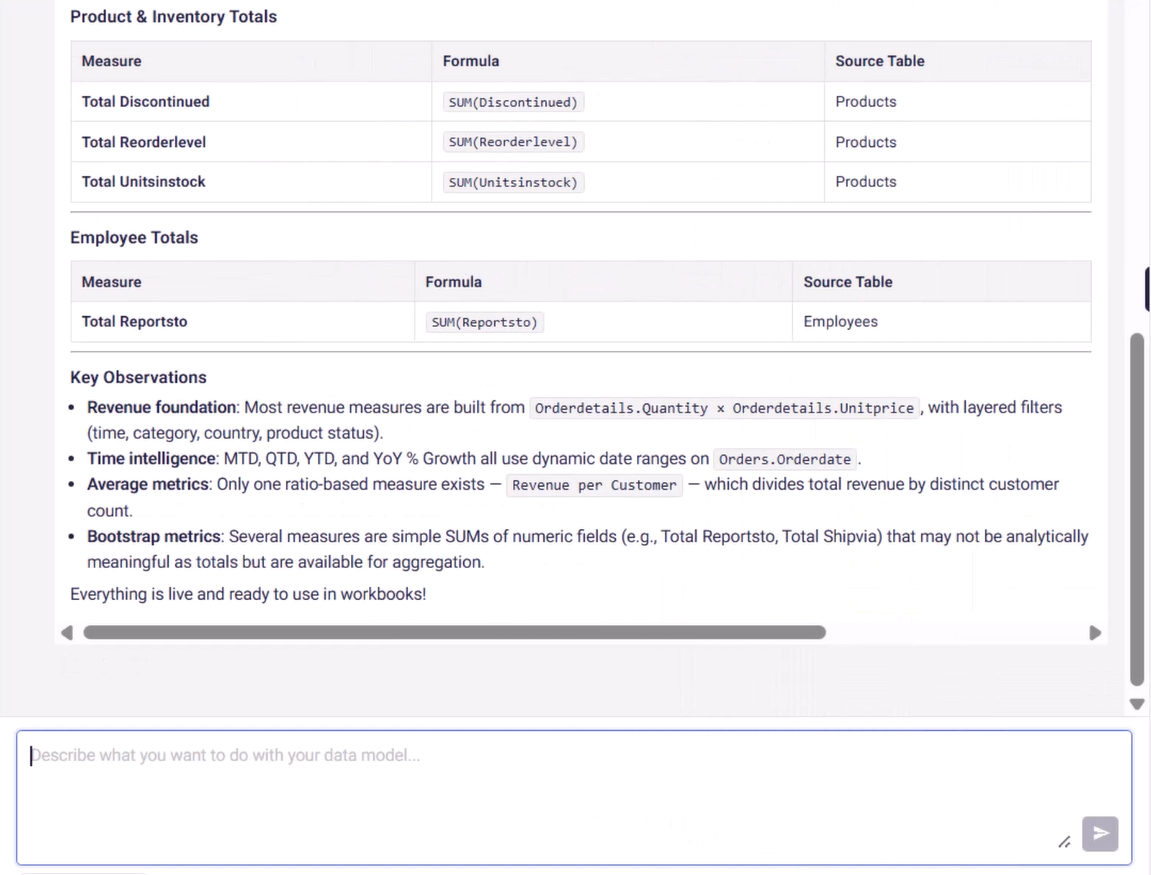
On top of that, Nash — Astrato’s built-in AI assistant — accelerates the review itself: ask it to describe your semantic layer and it returns a structured summary of tables, joins, and measures; ask for the full measure catalogue and it lists each with its formula and source, grouped by type; and it flags quick observations such as duplicate tables, non-standard aggregations, and incomplete joins. It surfaces where definitions overlap so a review that would take weeks by hand takes far less — while the decision on which definition wins stays with you. See the Astrato semantic layer or book a demo.
Key takeaways
- Semantic layers drift as they grow — duplicates and inconsistent definitions accumulate and erode trust.
- Audit for five things: duplicate measures, inconsistent KPI definitions, non-standard aggregations, join-web gaps, and orphaned fields.
- Run the audit as a repeatable review: inventory, group by type, diff duplicates, map joins, assign owners.
- Prevent future drift with version control, a single owner per metric, and defining metrics in the layer, not dashboards.
- Astrato’s inspectable, version-controlled layer — and Nash’s model description and measure catalogue — make audits fast.
Frequently asked questions
What is semantic layer drift?
Drift is the gradual accumulation of duplicate metrics, inconsistent KPI definitions, and conflicting logic as a semantic layer grows, which erodes the consistency the layer was meant to guarantee.
How often should I audit my semantic layer?
Treat it as ongoing rather than annual: version control surfaces drift in every change, and a fuller review each quarter (or whenever the model grows significantly) keeps duplicates and gaps from compounding.
What causes duplicate metrics?
Usually different teams naming the same concept differently, or one-off metrics built to a deadline and never reconciled. Consolidating to one canonical measure with aliases fixes it.
Can AI help audit a semantic layer?
Yes — an assistant like Nash can inventory every measure with its formula and source, group them by type, and flag duplicates, non-standard aggregations, and incomplete joins, so the review is far faster. The decision on which definition to keep stays with the team.
Ready to experience next-gen analytics?
See how Astrato runs natively in your warehouse.