Astrato Semantic Layer Upgrade: Turn Recurring Questions Into Reusable Analysis
Discover Astrato's semantic layer upgrade: Business Questions, Set Filters, Time Intelligence and Grouped Dimensions for reusable analysis.

Every business has questions it needs to answer again and again.
Which customers are most profitable? How is revenue changing year over year? Which products are tying up the most stock? Where should the commercial team focus next?
The measures behind these questions may already be defined in the semantic layer. Revenue means revenue. Customers have agreed definitions. Products and regions have consistent identifiers.
But a recurring business question involves more than selecting a measure.
Someone still needs to decide which customers qualify, which reporting periods to compare, how to group the results, what calculations to apply and which results deserve attention.
Those decisions are part of the analysis, too.
Yet they often live in individual charts, workbook configurations or AI conversations. When someone needs the same analysis next week, they may have to reconstruct the logic behind it.
Astrato's Semantic Layer Upgrade helps teams keep more of that work.
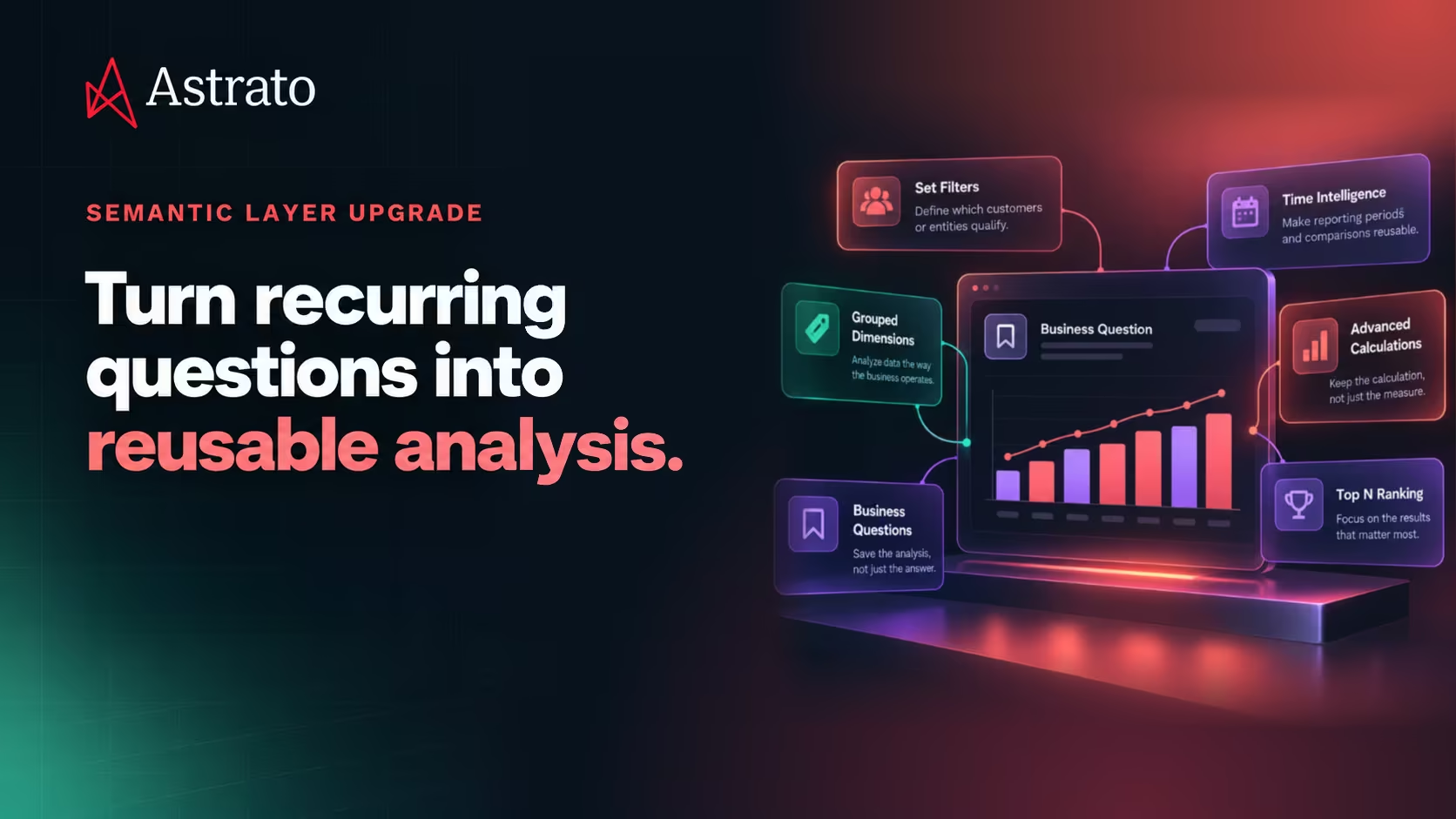
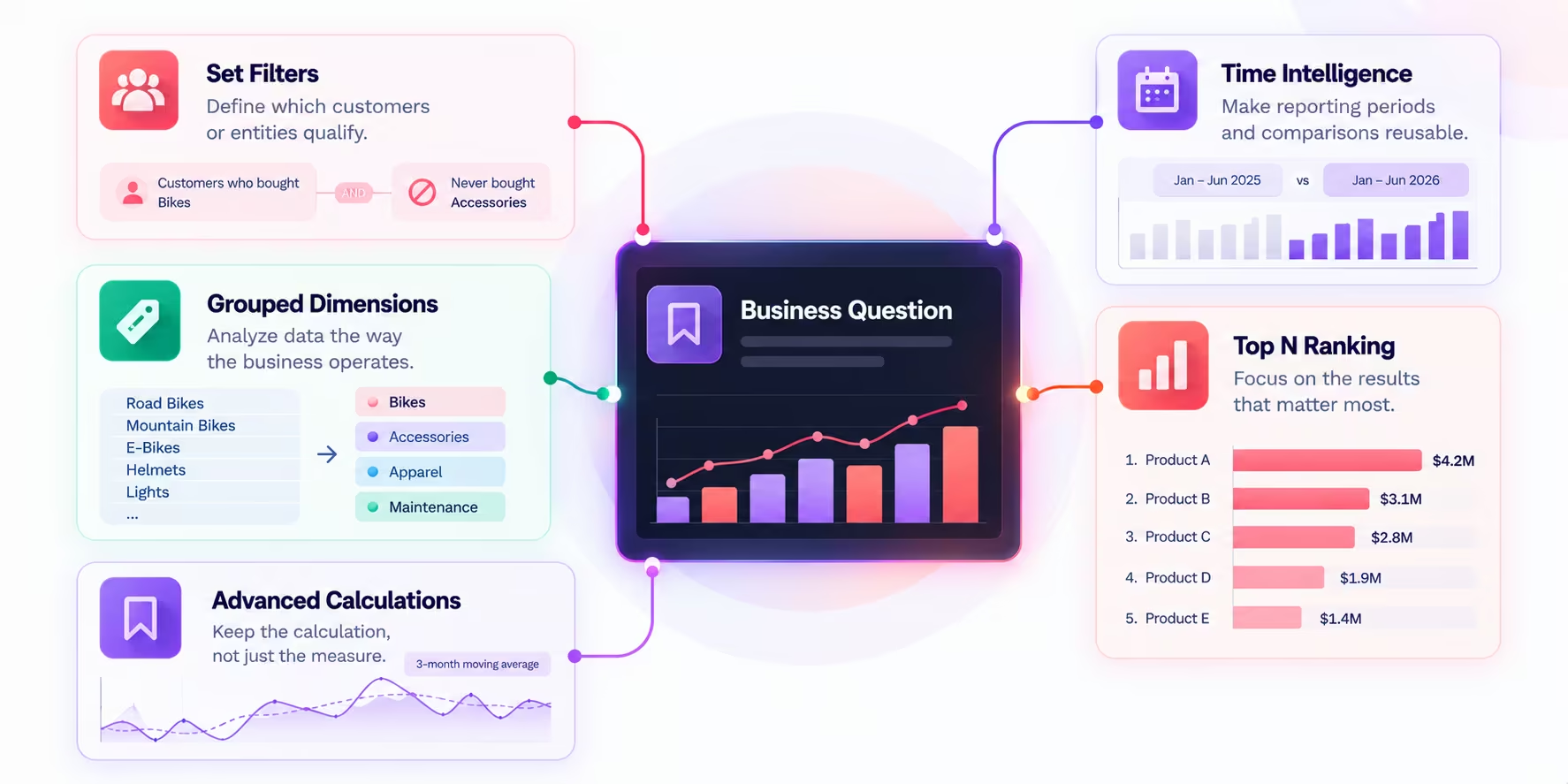
With Business Questions, Set Filters, Time Intelligence, Grouped Dimensions, Advanced Calculations and Top N Ranking, Astrato brings more of the analytical definition into the semantic layer.
The result is a way to retain the work behind recurring questions, rather than repeatedly starting from the underlying measures.
From shared definitions to reusable analysis
A traditional semantic layer establishes shared business definitions.
It helps people work with consistent measures, dimensions and relationships rather than interpreting raw data independently.
That's an essential foundation. But it doesn't capture every decision involved in answering a business question.
Consider this example:
How is year-over-year revenue changing among customers who bought Bikes but never Accessories, across our market groups?
To answer it, an analyst needs to determine:
- Which customers qualify as having bought Bikes but never Accessories.
- Which reporting periods should be compared.
- How individual markets map to the business's reporting groups.
- Which revenue measure and analytical configuration to use.
Now imagine the analyst also wants to examine a three-month moving average, or identify the five fastest-growing products.
Those questions introduce additional decisions about calculations and ranking.
If those decisions exist only in a particular chart or one-off analysis, they may need to be rebuilt when the question returns.
Astrato's upgrade addresses this by retaining more of the analytical logic in reusable semantic-layer definitions and saved Business Questions.
Six capabilities that work together
1. Business Questions: Save the analysis, not just the answer
Suppose an inventory manager asks:
Which products have the most stock on hand?
The answer is useful today. But the manager needs to revisit it every Monday.
A static screenshot won't help much next week. The stock levels will have changed.
What matters is retaining the analytical definition: the selected measures, product breakdown, filters, sorting and other supported settings.
That's what Business Questions provide.
A Business Question saves the configuration behind an analysis so people can return to it as the underlying data changes.
Rather than preserving a single result, it preserves the question's analytical setup.
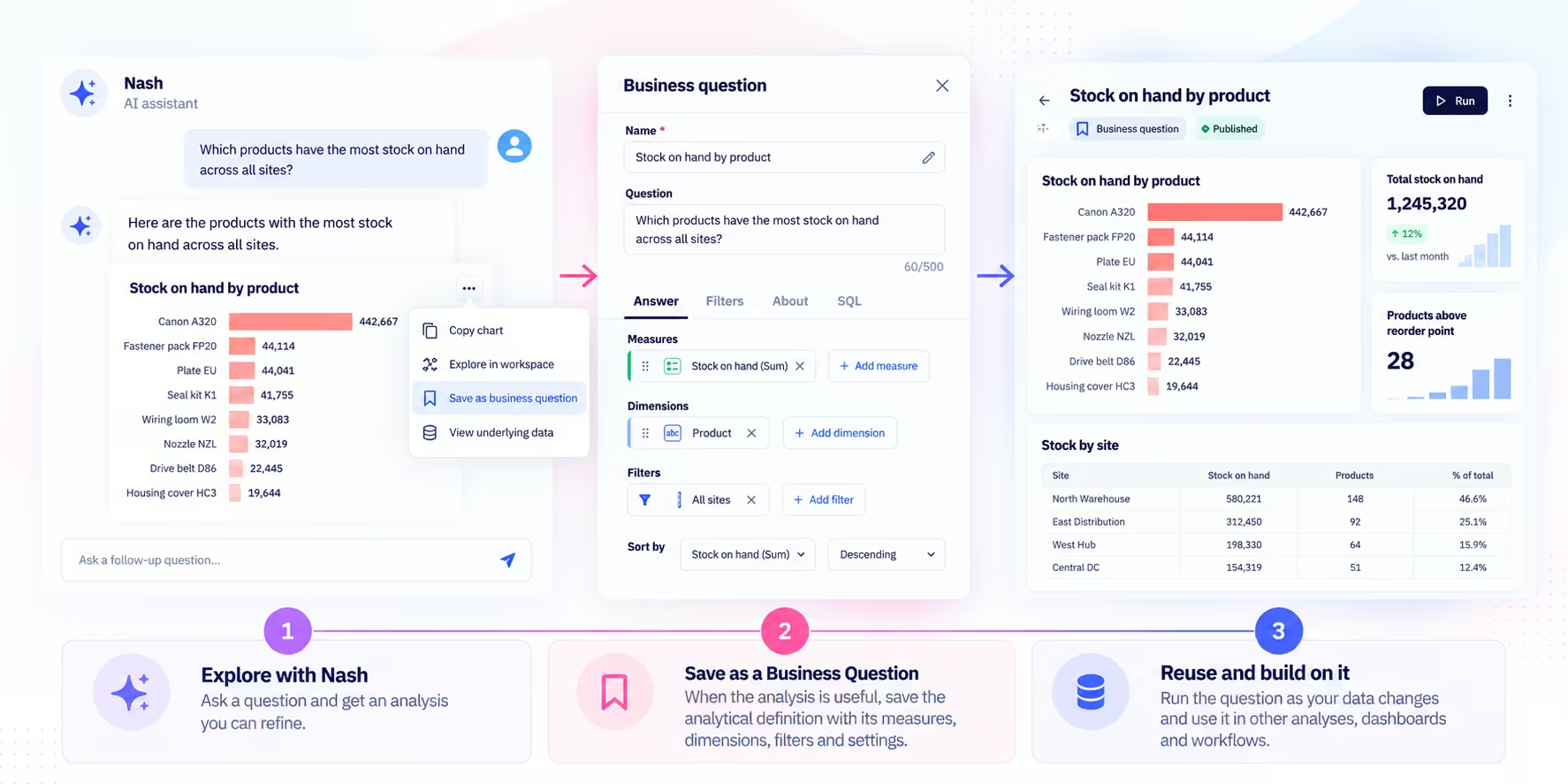
Business Questions can also be created through supported Nash exploration. A user can investigate a question in natural language, save the supported analysis as a Business Question draft, then review and publish the relevant definitions through the semantic-layer workflow.
This creates a path from an exploratory question to analytical work that can be revisited and built upon.
2. Set Filters: Define which customers or entities qualify
Consider a retailer investigating cross-sell opportunities.
It wants to understand revenue from customers who purchased Bikes but never Accessories.
Filtering transactions to show Bikes while hiding Accessories doesn't answer that question. Customers who purchased both categories may still appear in the results.
The retailer needs to qualify customers based on their purchase activity.
Set Filters allow teams to define reusable populations using related activity and conditions.
For example, a qualifying population could include customers who purchased Bikes while excluding those who also purchased Accessories within the defined purchase-history scope.
That population logic can then support different analyses without independently reconstructing the same qualification rules each time.
The benefit is a more consistent understanding of which entities belong in an analysis.
3. Time Intelligence: Make reporting periods and comparisons reusable
Revenue increased 12% year over year.
Compared with what?
The same completed months last year? A partial month? A different reporting window?
A correct revenue measure doesn't automatically guarantee a meaningful time comparison.
Astrato's Time Intelligence measures and dimensions provide supported reporting windows, time groupings and comparisons as reusable analytical building blocks.
For a finance team preparing a recurring monthly review, that means supported year-over-year logic can form part of the analysis rather than being reconstructed in each new report.
Teams can focus on interpreting performance while retaining clearer definitions of the periods being compared.
4. Grouped Dimensions: Analyze data the way the business operates
Your warehouse might contain categories such as Road Bikes, Mountain Bikes, E-Bikes, Helmets, Locks, Cycling Jerseys and Repair Kits.
But your leadership team may manage the portfolio through four groups:
Bikes, Accessories, Apparel and Maintenance.
Those business groups don't necessarily exist in the source data.
Without a reusable definition, analysts may create their own mappings in SQL, dashboards or spreadsheets.
Grouped Dimensions allow teams to organize underlying values into business-defined categories and retain those grouping rules in the semantic layer.
That gives supported analyses a consistent way to examine revenue, margins and other measures according to how the organization actually manages its business.
5. Advanced Calculations: Keep the calculation, not just the measure
Some recurring questions need more than a sum or an average.
A finance team might want a running revenue total. A sales leader might examine each region's share of total revenue. An analyst might use a moving average to understand performance without focusing on every short-term fluctuation.
These calculations already existed in Astrato's workbook charts.
What's new is that supported advanced calculations can now be saved as part of a Business Question in the semantic layer.
That includes capabilities such as moving calculations, running totals and rates, ranking, comparisons to totals, supported control values and percentiles, nested calculations and result formulas.
For example, a commercial analyst might ask:
What is the three-month moving average of revenue in each market group?
The moving calculation becomes part of the Business Question's saved analytical configuration.
When the question is reopened, the calculation remains part of its definition.
Nash can also help create supported advanced calculations through natural-language requests.
This matters because the calculation often carries business meaning beyond the underlying measure.
A three-month moving average isn't interchangeable with a six-month moving average. A region's share of total revenue isn't the same as its absolute revenue.
Retaining those choices helps recurring analysis preserve the logic behind the result.
6. Top N Ranking: Focus on what matters most
An inventory manager rarely needs to inspect every product before identifying where to investigate.
They might start with:
Which five products hold the most stock value at each site?
That question involves several choices.
Which measure determines the ranking? How many products should be included? Should the ranking apply across the entire business or separately within each site?
Top N Ranking lets teams retain those choices inside a Business Question.
Builders can rank by a selected measure, keep the highest or lowest results, and configure ranking across dimensions or within groups.
For example, a question can identify the top five products at each site rather than only the top five products across the entire organization.
An optional Others row can retain an aggregate view of results outside the selected ranking. Tied members at the cutoff are also kept.
Top N already existed as a chart capability in Astrato. The upgrade brings supported ranking rules into Business Questions, where they can be retained as part of the analytical definition.
Nash can help configure these rankings, too.
The value isn't simply showing fewer rows.
It's keeping the rules that determine which results are included in a recurring shortlist.
What happens when you bring these capabilities together?
The individual features solve different problems. Their value becomes clearer when a recurring question needs several kinds of analytical logic.
Take a commercial team investigating customers who bought Bikes but never Accessories.
It wants to understand how revenue from that population is developing across its market groups.
Set Filters define the qualifying customers.
Grouped Dimensions organize the results according to the company's management markets.
Time Intelligence provides supported reporting periods and comparisons.
Advanced Calculations can add a three-month moving average to examine the revenue trend.
Business Questions retain the supported analytical configuration so the team can revisit the analysis.
Now consider a different question:
Which five products grew fastest year over year?
Time Intelligence provides the supported year-over-year comparison.
Top N Ranking selects the five highest-growth products according to the chosen measure.
The Business Question retains that ranking configuration for the next review.
These are different analyses, with different requirements.
The common principle is that the analytical decisions behind them don't have to disappear when the initial answer has been produced.
From AI exploration to lasting analytical work
AI makes it easier to ask questions about data.
A business user can explore revenue trends, investigate inventory or ask for a ranking without manually constructing every analytical step.
But there's a difference between getting an answer and retaining the analysis that produced it.
If the logic exists only within an AI conversation, the next person may have to ask the question again and reconstruct the choices behind it.
Astrato connects supported Nash exploration with Business Questions.
A user can explore an analytical question, save the supported configuration as a Business Question draft, and review the definitions before publishing them for reuse.
Advanced Calculations and Top N Ranking extend the kinds of analytical choices that can be retained.
That means the saved question can contain more than a measure and a breakdown. It can also preserve supported moving calculations, comparisons, ranking rules and other settings that shape the answer.
The aim isn't to remove human judgment from analytics.
It's to make the analytical work worth keeping easier to retain, inspect and revisit.
What's next: From reusable analysis to business applications
Recurring analysis rarely ends with the first answer.
A finance team identifies an unexpected revenue decline and needs to investigate its causes.
An inventory manager finds products with unusually high stock value and needs to decide what to review next.
A commercial team identifies a customer population and wants to evaluate a potential opportunity.
These are not simply reporting tasks. They're parts of ongoing business decisions.
Astrato is developing Data Apps to bring analytical context into richer, decision-oriented workflows.
Data Apps are not part of this Semantic Layer Upgrade release.
But the direction is connected.
Business applications need reliable business context: definitions of the relevant populations, time periods, categories, calculations and analytical questions.
By retaining more of that context in the semantic layer, Astrato is building a stronger foundation for the workflows that follow the analysis.
Get more value from the analytical work you've already done
A useful analysis involves more than a correct measure.
It also involves deciding who qualifies, which periods matter, how results should be grouped, what calculations to apply and where to focus attention.
Those choices take work.
And when the same business questions return, that work shouldn't have to begin again.
Astrato's Semantic Layer Upgrade brings six capabilities together to retain more of the analytical logic behind recurring questions.
Business Questions preserve the supported analytical setup. Set Filters retain population definitions. Time Intelligence provides reusable period logic. Grouped Dimensions organize results through business categories. Advanced Calculations preserve the maths behind the answer. Top N Ranking retains the rules for focusing on the results that matter most.
From shared definitions to reusable analysis.
That's the next step in making business questions more valuable each time they're asked.
Explore Astrato's upgraded semantic layer and see how Business Questions and reusable analytical definitions can support your recurring business questions.
Ready to experience next-gen analytics?
See how Astrato runs natively in your warehouse.