MCP for business intelligence, explained without the jargon
Learn what MCP means for business intelligence and how Claude or ChatGPT can work with Astrato's business definitions and live warehouse data.

Your team already uses Claude or ChatGPT. People ask it to summarize documents, research competitors, write reports and work through complicated problems.
Then someone asks a question about the business.
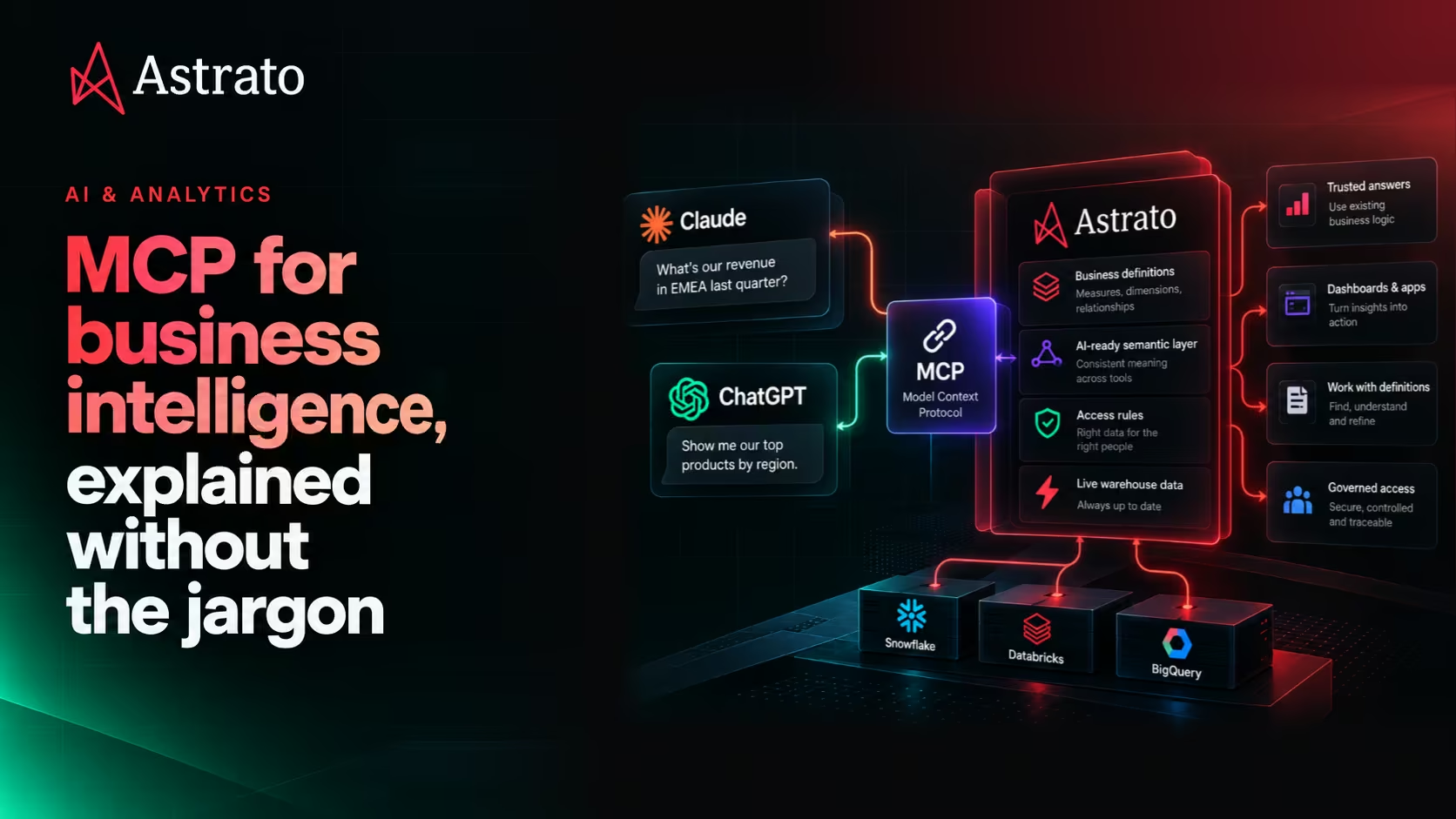
"What's our revenue in EMEA last quarter?"
The assistant understands the words. But does it know what your company counts as revenue? Whether returns are deducted? Which countries belong to EMEA? Or which data the person asking is allowed to see?
Those answers don't live inside the AI model. They live in your company's data systems, analytical definitions and access rules.
Model Context Protocol (MCP) helps connect the AI assistant to those systems.
It's a technical name for an idea that's straightforward: keep using the AI tool you're comfortable with, but give it a way to work with the business systems that hold the information it needs.
Here's what that means for business intelligence.
What is MCP, in plain English?
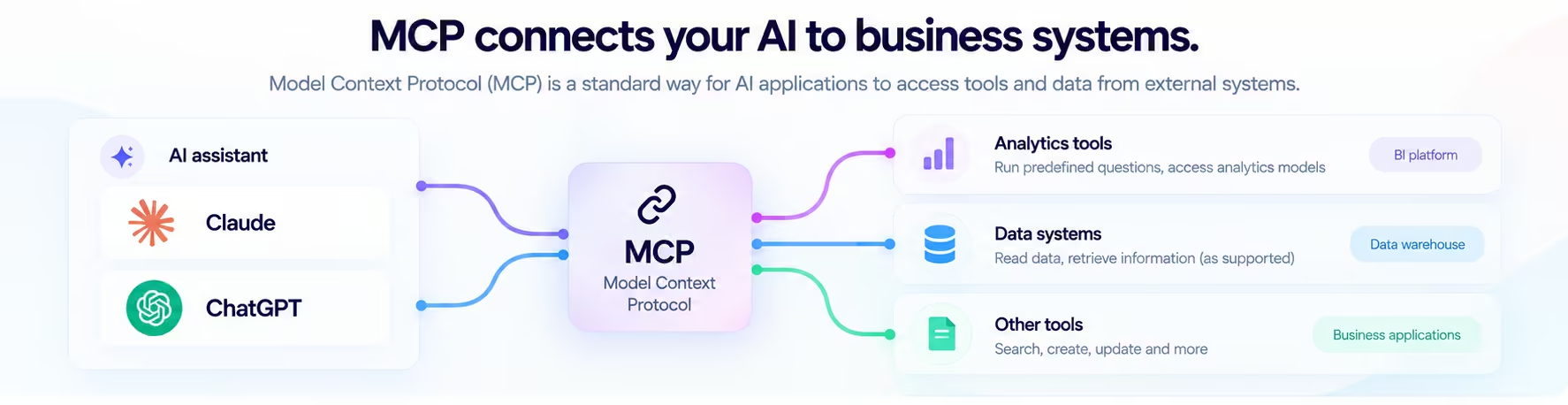
MCP stands for Model Context Protocol.
It's a standard way for AI applications to connect to external tools and information.
Imagine you use Claude to help prepare for a quarterly business review. Claude can help structure the discussion, explain financial concepts and draft the presentation.
But it doesn't automatically have access to your company's approved revenue calculations, current warehouse data or analytical models.
A connection built using MCP can make specific capabilities from those systems available to Claude.
For example, a connected analytics system might let the assistant look up an existing revenue measure, inspect its definition or run an approved analytical question.
The important word is might.
MCP defines how AI applications communicate with connected systems. It doesn't require every system to provide the same functions.
One connection might let an assistant search documentation. Another might let it retrieve business data. Another might allow it to change an analytical model.
MCP is the connection method, not the intelligence or business logic behind the connection.
Why does MCP matter for business intelligence?
Traditional BI tools generally expect people to visit a dashboard, open a report or explore a dataset.
AI introduces another starting point.
Someone can begin by asking a question in the assistant they're already using.
That's useful, but it creates a problem if the assistant has to reconstruct the business's analytical definitions independently.
Consider two people asking about revenue.
The finance director asks ChatGPT for last quarter's net revenue. A sales manager asks Claude how much the company sold over the same period.
Both assistants might produce reasonable-looking calculations. But one could subtract refunds while the other counts gross sales. One could use invoice dates while the other uses order dates.
The problem isn't necessarily that either assistant generated invalid SQL.
It's that they may be working from different interpretations of the same business concept.
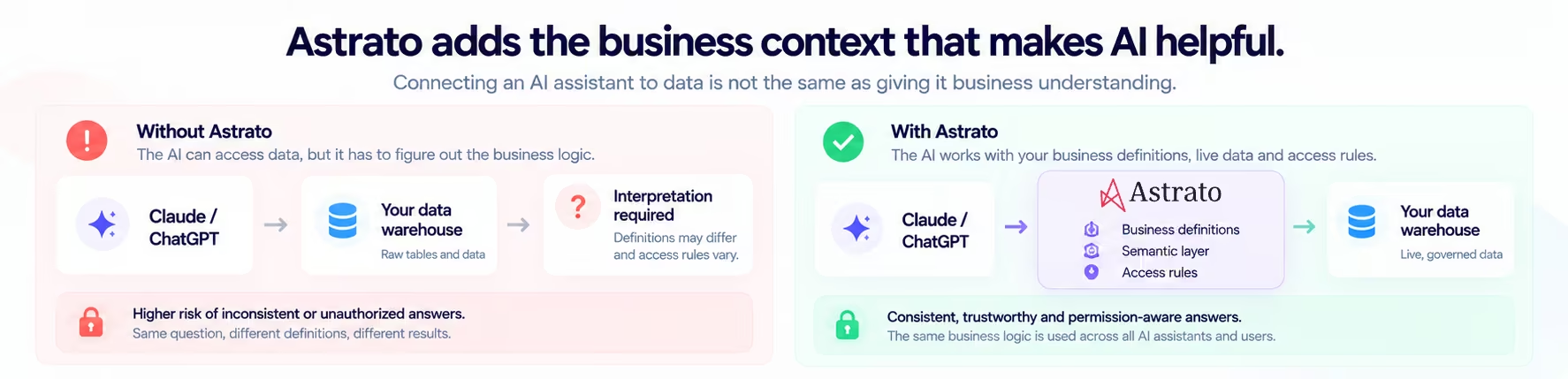
Connecting AI to the warehouse alone doesn't resolve this.
The assistant also needs access to the definitions that explain what the data means.
A connection to data isn't the same as understanding the business
Suppose an AI assistant can see a database containing orders, customers, refunds and sales territories.
It might be able to identify relevant tables and write a query.
But the database structure doesn't necessarily explain that:
- Revenue excludes refunded transactions.
- Active customers are defined using a particular reporting period.
- EMEA follows the company's approved territory mapping.
- Certain users are restricted to particular regions.
These rules are part of the business's analytical context.
A semantic layer provides a place to define measures, dimensions, relationships and business logic that analytical tools can reuse.
For instance, rather than asking an AI assistant to invent a revenue calculation, a connected system can expose the revenue measure already defined by the analytics team.
This doesn't make the AI infallible. It gives the assistant a more reliable starting point than guessing from raw table names.
And it means the organization can maintain business definitions independently of whichever AI assistant employees choose to use.
How Astrato connects AI assistants to business context
Astrato's semantic layer is where teams define and manage the business logic used across their analytical experiences.
It contains measures, dimensions, relationships and other context that explains how business data should be interpreted.
Astrato also supports connections through MCP, allowing compatible AI assistants to work with supported semantic-layer capabilities.
That includes tools such as Claude, ChatGPT and Snowflake Cortex Code, subject to the relevant integration and permissions.
The distinction is important.
The assistant remains the interface. Astrato provides the analytical definitions and supported operations behind it.
For example, someone working in Claude could ask it to find the existing revenue measure in Astrato's semantic layer.
Instead of constructing its own definition from scratch, Claude can use the connection to inspect the measure that the analytics team has already created.
Depending on the available tools and permissions, the assistant can also help create or modify measures and dimensions, with changes handled through Astrato's versioned semantic-layer workflow.
This moves the conversation beyond retrieving information.
AI can assist with the analytical work itself, while the definitions remain managed in Astrato.
What can you actually do with MCP in Astrato?
The most useful way to understand the connection is through everyday tasks.
Find an existing business definition
Imagine a finance analyst asks:
"How do we calculate gross margin?"
Rather than relying on a generic explanation of gross margin, a connected assistant can search the measures defined in Astrato and inspect the relevant calculation.
That gives the analyst a way to understand the company's actual definition.
Work on an analytical model
Suppose the analytics team needs a new margin measure.
A user with the appropriate permissions can ask a connected assistant to help create or modify that measure in Astrato.
The change is handled within Astrato's semantic-layer workflow, where revisions can be reviewed and managed.
The AI helps perform the work. It doesn't need to become the permanent owner of the definition.
Answer an established business question
If a Business Question has already been defined in Astrato, the MCP connection can expose the supported operation for running it.
This is different from giving an assistant unrestricted access to generate any warehouse query it wants.
The existing Business Question provides a defined analytical starting point.
There are also important limits.
Astrato's documented MCP capabilities currently focus on semantic-layer operations and running already-defined Business Questions. They do not provide unrestricted ad hoc warehouse querying or general dashboard building through the connection.
That's worth understanding before assuming an assistant can perform every task available inside Astrato.
What happens to security and control?
Connecting an AI assistant to a business system should raise questions.
What can the assistant access? Can it change a shared measure? Can someone see those changes? What happens if it makes a mistake?
MCP doesn't answer those questions by itself.
The connected system needs to authenticate users, authorize operations and enforce its own controls.
With Astrato's MCP connection, users sign in through Astrato and approve the access requested by the assistant.
The available operations are tied to the user's permissions. An assistant doesn't automatically receive unrestricted access simply because a connection exists.
There is also a difference between reading an existing definition and changing one.
Reading a revenue measure helps the assistant understand the business.
Editing that measure could affect other analytical work that depends on it.
That's why version history, reviewable changes and controlled publishing matter.
The goal isn't to assume AI will never make a mistake. It's to make useful AI-assisted work possible without bypassing the systems responsible for managing shared analytical definitions.
Do you need to replace your current AI assistant?
No. And that's one of the more useful implications of MCP.
Different people may prefer different AI tools.
An analyst might use Claude. A marketing manager might work in ChatGPT. A developer might use an assistant inside their coding environment.
Trying to recreate the company's business definitions independently in each of those tools would create unnecessary duplication.
A shared analytical layer offers another approach.
The organization maintains its definitions in Astrato, while supported AI assistants connect to the capabilities they need.
This doesn't mean every assistant will behave identically or produce identical answers in every situation.
It means the underlying business definitions don't have to be reinvented for each interface.
The choice of AI assistant can remain separate from the ownership of business logic.
MCP isn't the strategy. What it connects is.
It's easy to get distracted by the technology.
MCP is useful because it provides a common way for AI applications to interact with external systems.
But connecting an assistant to a warehouse, a document repository or a semantic layer can produce very different experiences.
For business intelligence, the important questions are what the assistant can access, which business definitions it uses, what actions it can perform and how those actions are controlled.
That's where Astrato fits.
Its semantic layer provides a managed home for business definitions. Its MCP connection makes supported analytical capabilities available to compatible AI assistants. And its governance and versioning workflows help teams retain control over changes to shared business logic.
The result is a more practical way to bring AI into analytical work without rebuilding the business context around every new assistant.
Keep the AI your team already uses. Connect it to the business definitions that make its work useful.
Want to see how Claude or ChatGPT can work with Astrato's semantic layer? Contact us for a demo.
Ready to experience next-gen analytics?
See how Astrato runs natively in your warehouse.