Your AI answered the question. What happens when someone asks it again?
AI can answer business questions, but what happens next? Learn how Astrato Business Questions turn useful analysis into reusable definitions.

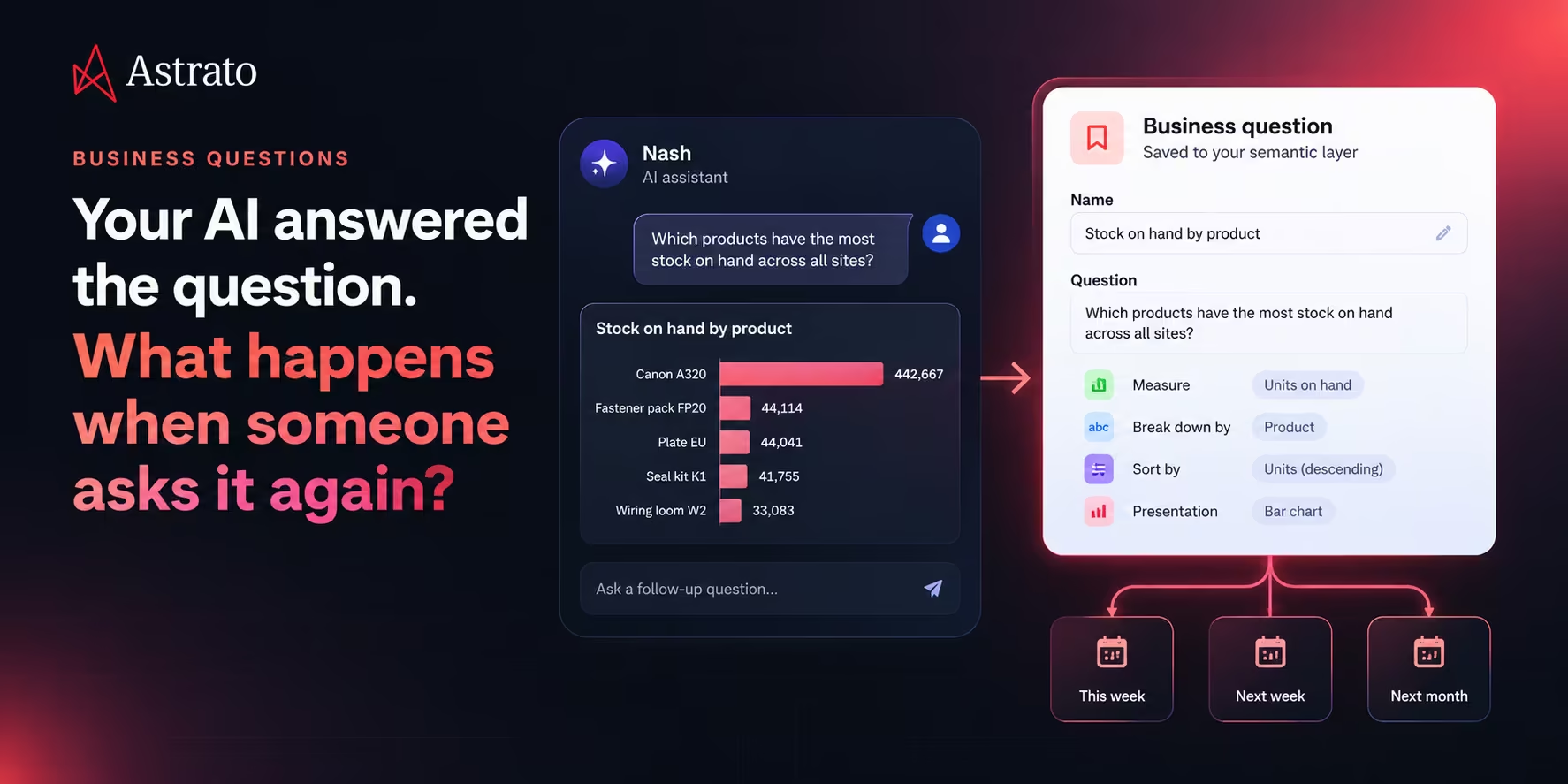
You ask an AI assistant which products have the most stock on hand.
It finds the relevant data, produces a chart and shows you that one product holds significantly more inventory than the rest.
Useful. You have your answer.
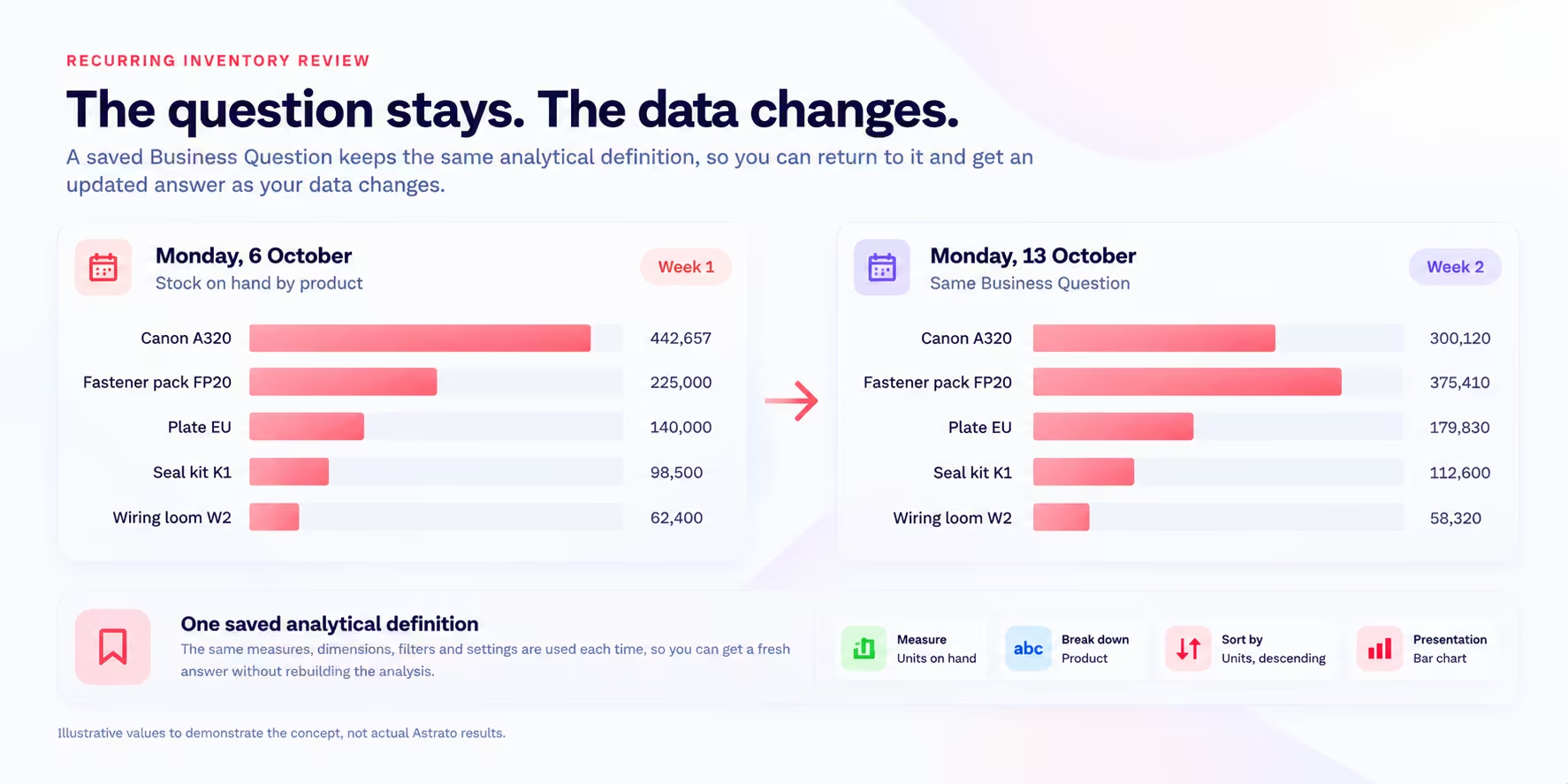
A week later, you need to check the same thing again.
The stock figures have changed, as you'd expect. But the question hasn't. You still want to compare products by units on hand, rank them from highest to lowest and identify where inventory is concentrated.
So why should you have to reconstruct the analysis?
This is a problem that gets less attention as AI becomes part of business intelligence. We've become much better at generating answers on demand. We're not necessarily getting better at retaining the analytical work behind those answers.
And for questions businesses ask repeatedly, that work is worth keeping.
An AI answer is useful. The analysis behind it may be worth more.
Consider a typical inventory review.
An operations manager wants to know which products have the most stock on hand across the business. They might ask an AI assistant, open an existing report or build the analysis directly in their analytics platform.
Regardless of how they start, the question requires several choices.
Which measure represents stock on hand? Should the results be broken down by product or category? Should the highest quantities appear first? Should products with zero stock be included?
The final chart might look simple: products along one axis, units on hand along the other.
But someone, or something, had to make those analytical choices.
And the next time the business asks the question, most of them will still apply.
That's where the distinction between an answer and an analytical definition becomes important.
An answer tells you what the data shows at a particular moment. An analytical definition retains how you asked the data to show it.
The answer may change tomorrow. The definition can remain useful.
The hidden work behind a recurring business question
Let's make this concrete.
In an Astrato inventory example, the question is:
"Which products have the most stock on hand?"
The resulting analysis uses:
The analysis ranks products by their current inventory quantities.
In this example, Canon A320 leads with 442,657 units, followed by other products with substantially lower quantities.
That difference immediately gives the inventory team something to investigate.
Why is so much stock concentrated in one product? Is it expected? Is demand keeping pace? Does the business need to look at stock by site or identify products approaching their reorder points?
Those are valuable follow-up questions.
But before exploring them, notice what the original analysis already contains: a selected measure, a dimension, sorting rules and a presentation choice.
These are not just visual preferences. They determine how the question is answered.
If the team returns to the same question next week, rebuilding that configuration adds little new analytical value. The important thing is to evaluate the same question against the latest available data.
The same pattern appears throughout a business.
Finance teams revisit revenue by reporting period. Sales teams monitor customer performance. Operations teams track inventory and demand. Commercial leaders return to margin analysis.
The data changes, but many of the analytical decisions remain relevant.
Business Questions: Save the analysis, not just the answer
Astrato Business Questions give recurring analyses a reusable definition in the semantic layer.
Instead of treating a question as something that exists only inside an individual chart, workbook or AI conversation, a Business Question retains its analytical configuration as a named entity.
That can include the selected measures, dimensions, filters, sorting and supported analytical settings.
For our inventory example, the saved Business Question has a recognizable name:
Stock on hand by product
And a plain-language question:
Which products have the most stock on hand?
Behind that name is the configuration needed to produce the analysis.
The important distinction is that a Business Question doesn't simply preserve the original chart as a static snapshot.
It retains the analytical definition. When the question is executed against live warehouse data, the results can reflect changes in the underlying inventory.
If stock levels change, the ranking can change too.
The business keeps the question and its analytical setup without assuming the answer will always be the same.
What does a Business Question actually contain?
In Astrato, the definition can be inspected through the Business Question editor.
For the stock-on-hand example, that means seeing the selected units measure, the product breakdown, the sorting configuration and the presentation settings.
The editor also exposes areas such as filters, formulas and other supported configuration options.
This matters because a reusable analysis shouldn't depend on someone remembering what an AI assistant did during a previous conversation.
The analytical choices have a place where they can be reviewed.
Business Questions also have revision history, allowing teams to see the current version and previous revisions of a question.
That gives recurring analysis a more maintainable form than an isolated answer in a conversation history.
From a Nash conversation to a reusable Business Question
One of the more interesting applications is what happens when an analysis begins with AI.
Astrato's AI assistant, Nash, helps users explore business data through natural-language questions.
An inventory manager might ask:
"Which sites hold the most stock value?"
Nash can return an analysis using the relevant business data and definitions.
In an illustrative inventory example, the results show stock value across four sites:
Rotterdam holds the highest stock value.
That may answer the immediate question. But perhaps the operations team wants to review this breakdown every week, not just once.
When Nash offers a supported analysis for saving, the user can choose Save as business question.
The resulting analytical definition is retained in the semantic-layer draft, where it can be reviewed and the required definitions published before use in saved-question execution.
The workflow changes what happens after a useful AI interaction.
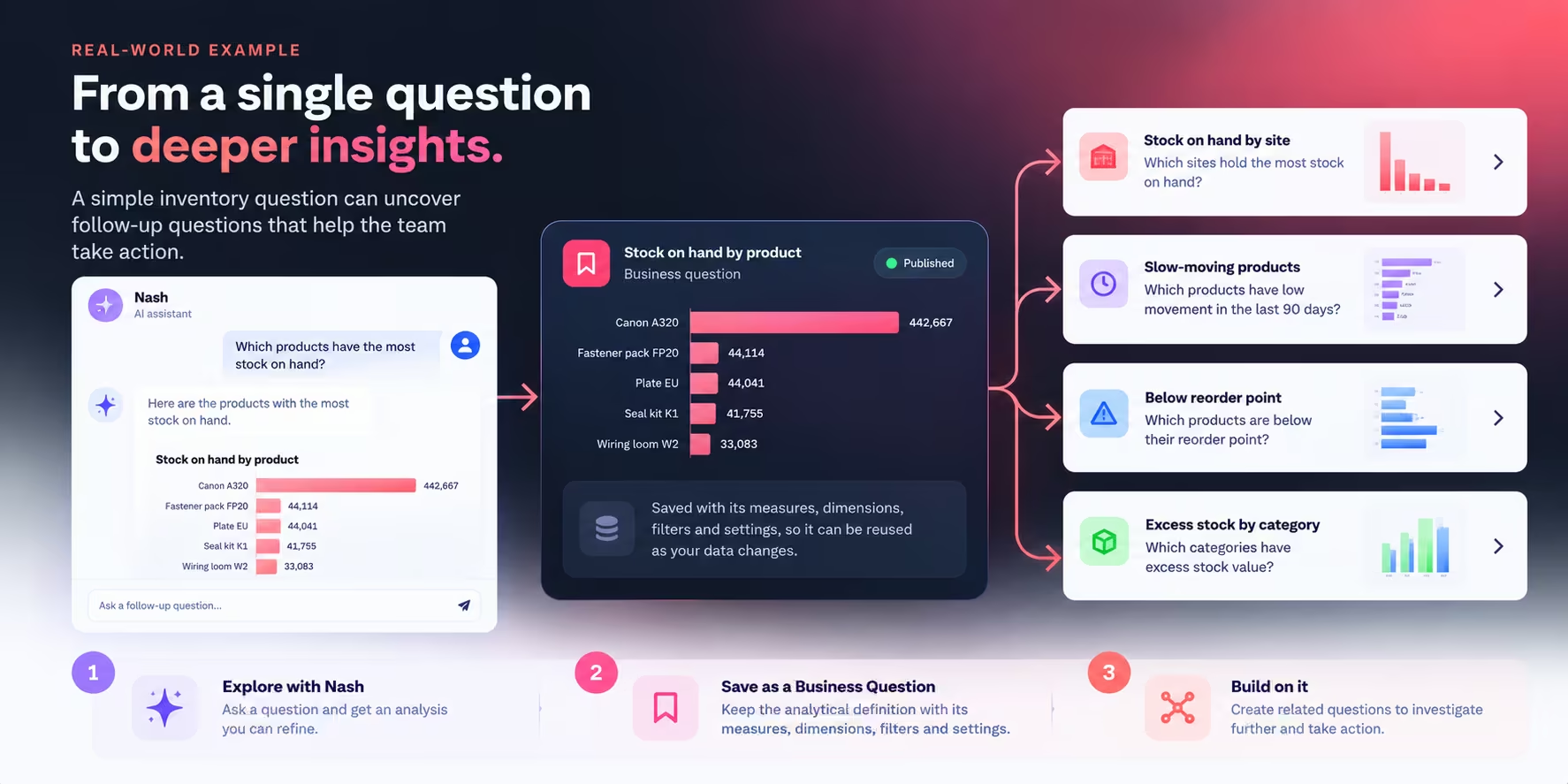
Instead of leaving the analytical setup behind in a conversation, the user has a way to retain it as a defined piece of analytical work.
Explore with Nash. Save the Business Question. Return to the analysis when you need it again.
AI helps people arrive at a useful analysis. The semantic layer provides a managed place to keep the work behind it.
Reuse is only the beginning. The next question matters too.
Business analysis rarely stops with the first answer.
Suppose an inventory manager discovers that one product accounts for a disproportionate amount of stock.
The next questions might be:
- Which sites are holding that product?
- How much of the inventory is slow-moving?
- Which products are below their reorder points?
- How does stock compare with expected demand?
Each question investigates a different part of the same business problem.
This is why recurring analytical questions are more useful when they're treated as related business knowledge rather than disconnected requests.
Astrato supports the creation of related Business Questions, allowing follow-up analyses to be linked to an existing question.
For example, an excess-stock question might lead to further questions about below-reorder quantities by category or the products with the greatest reorder exposure.
The aim isn't to replace the analyst's judgment or automatically determine what the business should do.
It's to make useful analytical work easier to retain, revisit and extend.
The original question provides a starting point. Related questions help the team investigate further.
Over time, that creates a more structured way to work through recurring analytical problems.
What does the business gain from keeping these definitions?
The immediate benefit is straightforward: less need to reconstruct analytical setup that has already proved useful.
But there are broader implications.
1. Less repeated analytical work
When an analysis needs the same measures, breakdowns and sorting every week, repeatedly configuring them adds effort without necessarily improving the decision.
A saved Business Question retains that configuration for supported reuse.
This doesn't mean every analysis becomes automatic or that every question can be answered without further work. It means the business has a defined starting point instead of always beginning again.
2. More visibility into how questions are answered
A chart can show that stock is concentrated in one product.
A reusable analytical definition can also show which measures, dimensions and settings produced that view.
For teams responsible for maintaining analytics, that visibility matters.
It makes the analytical choices easier to inspect, discuss and update.
3. More lasting value from AI-assisted exploration
AI can accelerate the process of finding useful analyses.
But if every useful configuration remains confined to its original conversation, the business may need to repeat work it has already done.
Retaining supported Nash-generated analysis as a Business Question gives that work a longer useful life.
This doesn't guarantee that an AI-generated analysis is correct. Teams still need to review the definitions and logic before relying on them.
The value is in making useful analytical work retainable and manageable, rather than treating each interaction as disposable.
The bigger opportunity: From recurring questions to business workflows
There's a reason to think beyond the saved question itself.
An inventory manager doesn't ask which products have the most stock simply to admire a chart.
They want to understand where inventory is concentrated, whether that concentration is justified and what the business should do next.
A sales leader investigating declining customer margins has a similar goal. The answer is part of a larger decision.
Business Questions help retain the analytical definitions behind these recurring investigations.
And that creates an important foundation for what comes next.
Astrato is developing Data Apps that will bring analytical context into richer, decision-oriented business workflows.
Data Apps are not part of the Business Questions release. But the direction is significant: moving from asking a question, to retaining the analysis, to building applications around the recurring business problems people need to solve.
The question becomes more than a temporary interaction with data.
It becomes something the business can build on.
Don't start from scratch every time the question comes back
The most useful business questions tend to return.
Which customers need attention? Where is inventory accumulating? How is performance changing? Which products or markets are falling behind?
AI makes it easier to ask those questions.
But the real opportunity isn't just producing another answer faster. It's keeping the analytical decisions that make the answer useful.
With Astrato Business Questions, teams can retain the measures, dimensions, filters and settings behind recurring analysis, inspect their definitions and return to them as the underlying data changes.
And when exploration starts with Nash, supported analyses can become reusable Business Questions instead of ending with the conversation.
The answer may change. The analytical work doesn't have to disappear.
Explore Business Questions in Astrato and see how recurring analysis can become something your team uses again.
Ready to experience next-gen analytics?
See how Astrato runs natively in your warehouse.