
AI in BI: What It Actually Does for Analysts Today
AI in BI splits into AI that answers vs AI that builds. Here's where AI genuinely helps analysts today — and where it still falls short.

Ask ten vendors what AI in BI means and you'll get ten demos of someone typing a question and watching a chart appear.
It looks like magic. It also sets a trap.
The promise on stage is an AI agent that replaces the analyst: ask it anything about your business, get the right answer back. The reality, for almost every team shipping today, is narrower and far more useful than that pitch lets on.
Here's the honest version. Generative AI has changed how fast you can build analytics. It has barely moved how safely you can trust an AI to analyze your data on its own. Those are two different problems, and confusing them is why so many AI business intelligence projects stall after the demo.
This piece is a map of where AI in BI actually earns its keep right now, where it doesn't yet, and how to tell the difference before you buy.
TL; DR
The phrase "AI in BI" hides two different jobs: AI that answers your data and AI that builds your analytics.
Only the building side is reliable enough to ship today, because its output is checkable — you can see whether a generated dashboard used the approved measure, while an AI "answer" hides its assumptions inside a sentence.
On raw, ungoverned data, AI produces plausible wrong answers; the semantic layer is what makes it trustworthy. So the real wins right now are in killing boilerplate (modeling, dashboard generation, reformatting, migration), not autonomous analysis.
Keep humans in the lead on interpretation and judgment. Nash is a deliberately scoped example: it accelerates the people who build analytics — it is not a BI agent you can ask to analyze your business.
The autonomous-analyst myth
The dream sold by most AI-powered BI tools is a system you can point at raw data and ask a business question in plain language. "Why did revenue dip in EMEA last quarter?" The AI reasons over your tables and hands back the answer.
The problem is that in enterprise analytics there's usually only one correct answer, and it depends on definitions the AI can't invent.
What counts as revenue? Bookings or recognized?
Which customers are "active"?
When AI algorithms analyze raw warehouse tables with no agreed business context, they produce something that reads like an answer and is often subtly wrong. A plausible number with the wrong filter applied is more dangerous than no number at all, because someone will act on it.
This is the gap traditional BI tools spent twenty years closing with governed models and certified metrics. Bolting generative AI onto raw data skips that work and reintroduces the exact ambiguity that governance existed to remove. Speed without trusted definitions isn't analytics. It's confident guessing at scale.
It helps to split AI in business intelligence into two jobs that often get lumped together:
- AI that answers — you ask a business question, the AI interprets your data and tells you what's happening or why. This is the conversational, agentic vision. It's improving fast, but on ungoverned data it's still unreliable enough that no serious team ships its decisions on it unsupervised.
- AI that builds — the AI does the construction work of BI: modeling data into a semantic layer, generating dashboards, writing measures, reformatting visuals, translating logic from one platform to another. The output is structured, reviewable, and grounded in definitions a human already approved.
The second job is where AI delivers today, and it's not close. The reason is structural: building tasks have a checkable output. A generated dashboard either uses the certified "net revenue" measure or it doesn't, and you can see which. An AI-generated business answer hides its assumptions inside a sentence. One you can audit. The other you have to trust on faith.
Why the semantic layer changes the math
The thing that makes "AI that builds" safe is the same thing that's quietly become the center of modern BI: the semantic layer. It's the place where your team defines what each metric means, how tables join, which numbers are finance-approved, and who's allowed to see what.
When an AI-powered BI tool works through that layer instead of around it, two things happen.
First, every measure it writes and every chart it lays out inherits definitions your team already trusts, so it can't quietly invent its own version of gross margin.
Second, governance comes along for free: row-level security and access controls still apply, so the AI can only ever surface data the user was already cleared to see.
The semantic layer turns generative AI from a liability into a power tool, because it grounds the AI in your business rather than its training data.
This is also why "AI in BI" looks so different across vendors. Some are racing toward the autonomous answer and accepting the accuracy risk. Others, including where the smart money in enterprise analytics is heading, are using AI to compress the building work and keep a human in the loop on judgment.
The second path ships value now without betting the business on a model's interpretation of an ambiguous question.
Where AI in BI still falls short
An honest map has to mark the swamp. A few places where AI in business intelligence is still oversold:
- Open-ended analysis: "Tell me what's interesting in this data" produces confident narratives that are hard to verify and easy to over-trust. Useful as a prompt for human curiosity, not as a finding.
- Causal questions: "Why did churn rise?" requires reasoning about the world, not just the table. AI can surface correlations; it can't yet be trusted to assign cause without an analyst checking the logic.
- Undefined metrics: If the business definition doesn't exist anywhere, the AI will happily fabricate one. Garbage governance in, confident garbage out.
- Design judgment: AI can lay out a dashboard fast, but the last 10 to 20 percent — what to emphasize, what story the page tells an executive — is still human work. That refinement is what separates a gimmick from a tool people actually use.
None of these are reasons to wait. They're reasons to scope AI to the building work it's good at, and keep analysts in the lead on interpretation.
The model that works: human in the lead
The most productive teams aren't asking whether AI replaces analysts. They're using AI to delete the tedious half of the analyst's job.
Modeling a new dataset, scaffolding a dashboard, restyling forty charts to a new brand spec, porting years of logic off a legacy platform — this is slow, repetitive, technical work that has nothing to do with insight.
Hand it to AI and the analyst gets hours back to spend on the part only a human can do: validating the numbers, shaping the story, deciding what matters.
That's the shape of AI in BI that's real today. Not an agent that thinks for you. A copilot that does the boilerplate, shows its work, and hands you something you can review, edit, and ship under your own name.
What this looks like in practice
Astrato's built-in assistant, Nash, is a deliberately scoped example of the building approach. It's worth being precise about what it is and isn't, because the distinction is the whole point of this article.
Nash is not a full BI agent. You can't open it and ask it to analyze your business or tell you why revenue moved.
Nash accelerates the people who build analytics.
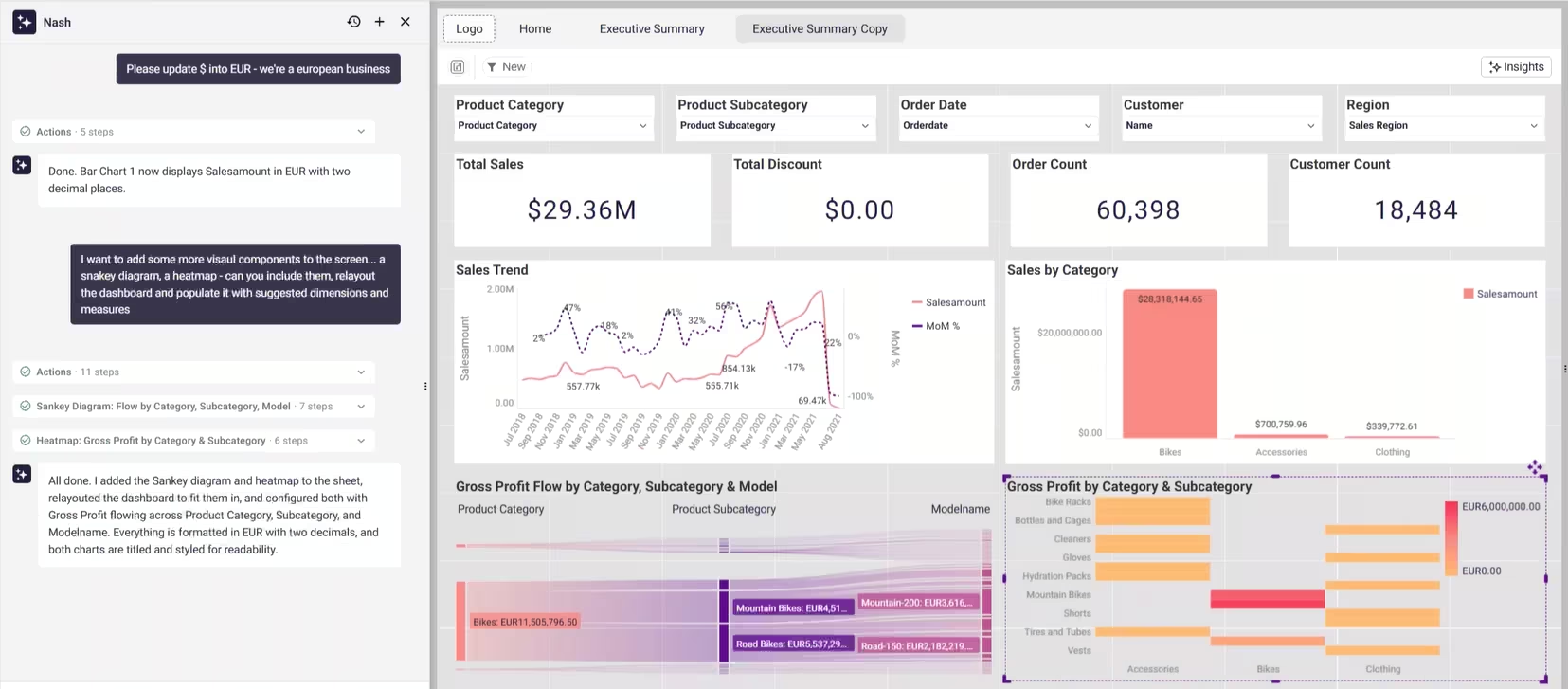
Tell it what you want in plain language and it reads your semantic model, asks a couple of focused questions, and assembles the dashboard — layout, filters, KPI cards, charts — grounded in measures your team already defined.
Ask it to switch every visual from dollars to euros and it makes the change across the whole dashboard in one action.
Ask for a Sankey diagram or a heatmap by name and it places and configures the chart against the right dimensions without you specifying them.
It works on the modeling side too. Point it at a warehouse and it walks the schema, proposes joins, and drafts the dimensions and measures worth tracking.
Ask it to describe an unfamiliar semantic model and a new analyst can understand the data structure in under a minute instead of a day.
Paste in a Power BI DAX measure or a Qlik expression and it translates the logic into a governed definition that lives in the shared layer, not buried in one workbook.
Every one of those is a building task with a checkable output, run through the governed semantic layer, with the analyst reviewing and refining before anything ships.
That's not the autonomous-analyst fantasy. It's the version of AI in BI that survives contact with a real enterprise.
Who actually benefits first
Vendors love to say their AI empowers "everyone," and eventually that's the goal. But the building approach has a clear first beneficiary, and naming it sets expectations correctly.
The people who gain most today are data and BI teams, because the work AI is genuinely good at is their work: modeling schemas, standardizing measures, scaffolding dashboards, migrating logic off a legacy platform.
A business user never does any of that and doesn't know it's slow. An analyst loses days to it every week.
Business teams benefit too, but more indirectly for now. They get analytics delivered faster because the bottleneck — the small specialist team everyone else waits on — can suddenly produce far more.
True self-service BI, where a non-technical user describes a question and gets a governed answer back unsupervised, is the direction of travel, not the current reality. The honest framing is that AI in BI doesn't yet remove the data team from the loop. It multiplies them. That's a less flashy claim than "analytics for everyone," and it has the advantage of being true.
For leaders evaluating the space, this reframes the buying question. You're not purchasing an answer machine for your business users. You're buying throughput for the team that builds everything those users depend on. Measured that way, the return shows up fast and you avoid the credibility hit that comes from promising autonomy the technology can't deliver.
Where to start
If you're weighing AI for your BI stack, resist the demo that promises an answer machine and look for the tool that compresses your team's building work without touching their judgment.
Audit your semantic layer first — the AI is only as trustworthy as the definitions it runs on. Then put a real task in front of it: have it model a dataset you know well, or rebuild a dashboard you've built by hand, and check whether you'd actually ship what it produces.
That test tells you more than any keynote. AI in business intelligence is ready to make your analysts faster today. It's not ready to replace their judgment, and the teams that get the most out of it are the ones that know exactly where that line sits.
Ready to experience next-gen analytics?
See how Astrato runs natively in your warehouse.