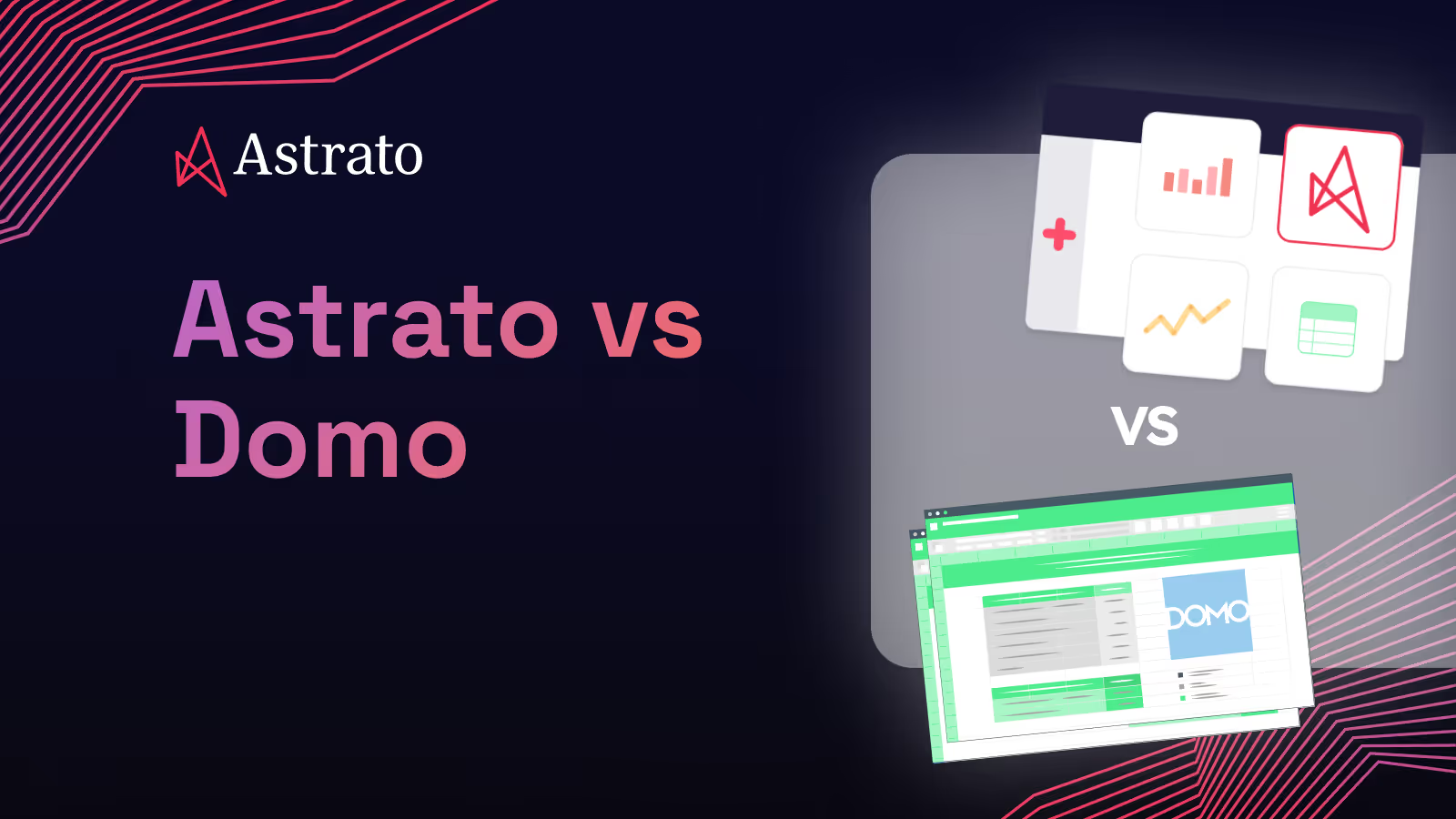
Astrato vs Domo: Warehouse-Native BI vs Extract-First Platform
Domo vs Astrato compared: architecture, pricing, embedded analytics, and vendor lock-in. Find the best Domo alternative for warehouse-native BI in 2026.

The question isn't whether Domo can visualize your data. It's whether you should be paying twice to store it.
A seven-year Domo customer received their renewal notice two months before it was due. The price had increased 1,120% — same number of users, lower data consumption than the prior year. Domo's public response on G2 was polished and sympathetic. The customer's reply: they were rushing a migration.
That review isn't an outlier. It's a pattern that shows up across G2, TrustRadius, and Reddit whenever Domo users talk about renewals. The consumption credit model that replaced per-seat pricing in mid-2023 produces bills that compound — every ingestion, every ETL transformation, every AI query burns through a pre-purchased pool with no hard caps. Double-billed for ETL input and output. Overages that accumulate silently until end of quarter.
This article is for analytics leaders, data engineers, and SaaS product teams who have Snowflake, BigQuery, or Databricks already established as their source of truth — and are asking whether Domo is the right BI layer to sit on top of it. The answer depends on what you actually need. Here's an honest comparison.
TL;DR
Astrato is the right fit if:
- Your data already lives in a cloud data warehouse and you want live queries — not scheduled refreshes or copies
- You're building customer-facing analytics or embedded dashboards and don't want to negotiate a separate add-on license
- You need native writeback that goes directly to the warehouse, not through a vendor's proprietary system
- Your team wants predictable, transparent pricing — no consumption credits, no surprise renewal escalations
- You're using Snowflake, BigQuery, Databricks, Redshift, ClickHouse, or PostgreSQL and want a BI layer that stays within that ecosystem
- You're tired of building in proprietary languages (Magic ETL, Beast Mode) that create lock-in with no migration path
Domo may still be the right call if:
- Your data is genuinely fragmented across 50+ SaaS tools and you don't have a central data warehouse — Domo's 1,000+ pre-built connectors are a real differentiator here
- Your executive team wants polished mobile dashboards and KPI views on their phones — Domo's mobile-first experience is 15 years deep
- You need an all-in-one platform (ETL + transformation + BI + apps + embedded) from a single vendor and want to avoid assembling a stack
- Your workforce is field-based or operations-heavy and needs simple, touchscreen-friendly dashboard access without SQL expertise
Quick comparison: Astrato vs Domo
|
Capability |
Domo |
Astrato |
|
Architecture |
Data extracted into proprietary Data Vault; federated query available as secondary mode |
✓ Live-query, warehouse-native — pushdown SQL, no data movement or duplication |
|
Data freshness |
Scheduled refreshes burn credits; federated mode gives 15-min live pulls |
✓ Always current — live on every interaction, no refresh schedule required |
|
Warehouse support |
Snowflake, BigQuery, Databricks via native connectors + Cloud Amplifier federated |
✓ Native live — Snowflake, BigQuery, Databricks, Redshift, ClickHouse, PostgreSQL |
|
Embedded analytics |
Domo Everywhere — iFrame, SDK, APIs; separately priced add-on from ~$3,000/month |
✓ Built for embedded first — pixel-perfect white-label, no separate add-on license |
|
Writeback |
Bi-directional via Data Vault connectors, ODBC, APIs — not direct warehouse write |
✓ Native writeback — syncs directly to the warehouse in real time |
|
AI / GenAI |
Domo.AI — NLQ, Agent Builder, Agent Catalyst, MCP server — Dresner #1 Agentic AI |
✓ AI-native — Snowflake Cortex, Gemini, OpenAI — grounded in semantic layer |
|
Governance / RBAC |
Personalized Data Permissions, custom roles, GDPR/HIPAA/SOC 2 compliant |
✓ Warehouse-inherited — defined once in warehouse, enforced everywhere automatically |
|
Pricing model |
Undisclosed; credit-based consumption; $30K–$500K+/year; renewal escalation risk |
✓ Transparent — per-user, usage-based, or hybrid; no hidden credit consumption |
|
Vendor lock-in |
Magic ETL + Beast Mode + Data Vault = full platform rebuild required to migrate |
✓ Standard SQL, open architecture — no proprietary language lock-in |
|
Scheduled reporting |
PDF Report Builder, email scheduling, mobile push, in-app alerts — mature feature |
✓ Automated branded reports — Excel, PDF, PPT delivered to email or Slack |
What is Astrato?
Astrato is a warehouse-native BI platform that connects directly to cloud data warehouses — Snowflake, BigQuery, Databricks, Redshift, ClickHouse, and PostgreSQL — and runs every query live against the warehouse. There are no extracts, no data copies, no refresh schedules. When you pull data in Astrato, you're querying the warehouse in real time with pushdown SQL.

The product serves three core use cases: guided self-service BI for business users who need to explore data without writing SQL, customer-facing embedded analytics for SaaS companies that want to surface analytics inside their own products, and data apps with native writeback that sync changes directly back to the warehouse. The common thread is that Astrato treats the warehouse as the analytics layer — not a source to extract from.
Row-level security, role-based access, and data governance are all inherited from the warehouse itself. Define access controls once; they apply everywhere, automatically.
What is Domo?
Domo is a cloud-based business intelligence and data products platform founded in 2010 by Josh James, previously the founder of Omniture. It's publicly traded on NASDAQ and counts 2,600+ customers across retail, healthcare, financial services, and media. With over 1,000 pre-built data connectors and a mobile-first experience that executives have used since the iPhone era, Domo built genuine momentum solving a real problem: fragmented data across dozens of SaaS tools, with no easy way to surface KPIs to non-technical users.
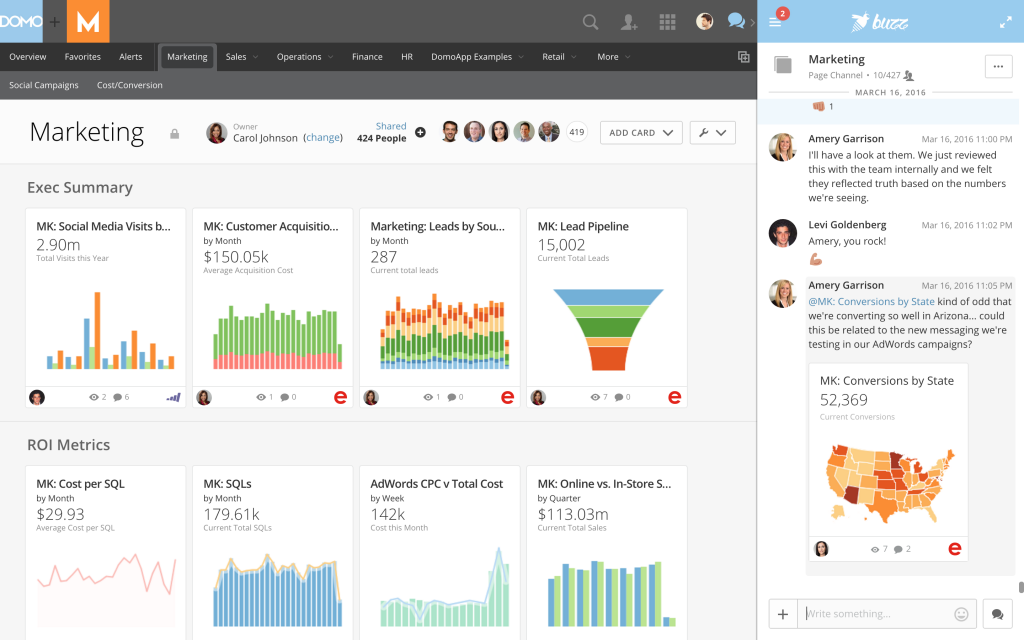
The platform covers the full stack — data ingestion, ETL (via Magic ETL), transformation (via Beast Mode formulas), dashboarding, embedded analytics (via Domo Everywhere), and now an AI platform (Domo.AI) that includes natural language query, an Agent Builder, and an MCP server announced for 2026. For organizations without a central data warehouse and with a heavily field-based or mobile workforce, Domo remains one of the few platforms that delivers all of this from a single vendor.
Where it gets complicated is the underlying architecture — and what happens at renewal.
The architectural difference that actually matters: live query vs extract-first BI
Domo's default mode is extraction. When you connect a data source, Domo pulls that data into its proprietary Data Vault — its own managed storage layer — before any query runs. That was a reasonable design choice in 2010, when cloud data warehouses didn't exist and data lived in Salesforce, Google Sheets, and on-premise SQL servers. If you wanted analytics, you needed somewhere to put the data first.
The problem in 2026 is that most enterprise data teams have already solved this problem. They have Snowflake, BigQuery, or Databricks. Those platforms were built specifically to store and query data at scale, with sophisticated access controls, semantic layer support, and optimized compute. Paying Domo to copy that data into a second proprietary store means paying for duplicate storage, maintaining two separate governance layers, and losing data freshness — all while burning Domo credits every time that copy is refreshed.
Domo does offer federated queries via Cloud Amplifier for Snowflake and Databricks, but this is a secondary mode. The default architecture is still extract-and-store. Astrato has no such extraction step. Every query is live pushdown SQL against your cloud data warehouse — no intermediate storage, no duplication, no credits consumed for refreshes that shouldn't be necessary.
Astrato wins
Live warehouse queries — no Data Vault copy, no dual storage costs, no credit burns for refreshes
Domo wins
If you don't have a warehouse yet — 1,000+ connectors plus built-in ETL means Domo can be your first analytics layer
Embedded analytics: Domo Everywhere vs Astrato's native embedding
Both platforms support embedded analytics — surfacing dashboards inside a third-party product. The differences are in architecture and in price.
Domo Everywhere provides iFrame embedding, an SDK, public and private access URLs, and row-level security. It works, and it's mature. The issue is that Everywhere is a separately priced add-on that starts around $3,000 per month and goes up based on usage. If you didn't price embedded analytics into your original Domo contract, you're heading into a new negotiation when the product team asks for it.
Astrato treats embedded analytics as a first-class output, not an add-on. Every Astrato workspace supports pixel-perfect white-label dashboards, SSO, and row-level security out of the box. The same license that powers internal analytics powers customer-facing analytics. You don't need a separate conversation about access.
Astrato wins
Embedded analytics included natively — no separate add-on, no extra license negotiation
Domo wins
More mature embedding with PDP (Personalized Data Permissions), app marketplace, and AI features inside embedded contexts
Writeback: Domo Beast Mode vs Astrato native writeback
Writeback — the ability to push data changes from the BI layer back to the underlying data source — is where the architectural gap is most visible.
Domo's writeback happens through its Data Vault. You write to a Domo dataset, and that dataset can then flow out to an external destination via connectors, ODBC, or API. It's not a direct write to your warehouse. Data has to pass through Domo's infrastructure, which means governance controls, audit trails, and latency are all mediated by Domo rather than inherited from your warehouse.
Astrato writes directly back to the warehouse. A business user updates a value in a data app; that update commits to Snowflake, BigQuery, or Databricks immediately. The warehouse stays the single source of truth. Access controls defined in the warehouse apply automatically — you don't need a parallel security model in the BI layer.
Astrato wins
Direct warehouse writeback — changes go straight to Snowflake/BigQuery/Databricks without passing through a vendor layer
Domo wins
Broader connector ecosystem — writeback to 100+ destinations, not just warehouses
Pricing: consumption credits vs transparent per-user
Domo replaced its per-seat licensing model with a consumption credit model in mid-2023. The intent was to align cost with actual usage. The practical result, based on what users report on G2 and Reddit, has been significant.
Every data operation in Domo burns credits. Ingestion burns credits. Magic ETL transformation burns credits (both input and output). AI queries burn credits. The pool is pre-purchased. Overages accumulate. There are no hard caps. Renewal discussions happen when credits run low — and the annual price for the same usage can increase dramatically, as the 1,120% renewal case above illustrates.
Astrato's pricing is transparent and predictable. No consumption credits, no hidden compute charges, no separate fees for embedded analytics. The pricing model is disclosed — per-user, usage-based, or hybrid — and doesn't have mechanics designed to grow the invoice at renewal time.
Astrato wins
Transparent pricing — no consumption credits, no surprise renewal escalations, no add-on fees for embedded analytics
Domo wins
Flexible credit pooling can work in your favour if usage is genuinely variable and you have hard caps negotiated
Migration and lock-in
Domo's platform is deeply integrated. Magic ETL is a proprietary visual transformation tool with its own logic that doesn't export to SQL. Beast Mode is a proprietary formula language. Data lives in the Data Vault. If you decide to leave Domo, you're not migrating dashboards — you're rebuilding pipelines and transformations from scratch.
Astrato is built on standard SQL. Semantic layer definitions, queries, and data models are exportable. There's no proprietary formula language or transformation layer to untangle. If you outgrow Astrato or your requirements change, you leave with your data logic intact.
Bottom line
Domo is a good platform for organisations that don't yet have a central data warehouse and need a single vendor to handle ingestion, ETL, BI, and embedded analytics in one place. It has real strengths in mobile delivery, pre-built connectors, and an increasingly capable AI layer.
But if you already have Snowflake, BigQuery, or Databricks — and most enterprise data teams do — Domo's extract-first architecture means you're paying twice to store data that your warehouse already holds. You're maintaining two governance layers, waiting for refresh schedules instead of querying live, and facing a pricing model that compounds at renewal time.
Astrato is built for that environment. No extraction. No credit burns. No add-on fees for embedding. No proprietary lock-in. If your source of truth is a cloud data warehouse, Astrato is designed to stay inside that ecosystem rather than sit on top of it as an additional layer.
Ready to experience next-gen analytics?
See how Astrato runs natively in your warehouse.