Qlik vs. Snowflake Architecture: What Actually Changes
Moving analytics from Qlik's in-memory engine into a cloud warehouse like Snowflake changes four things. A plain-language guide for BI leaders.

A plain-language guide for BI managers and CIOs to the architectural shift that happens when analytics moves from Qlik's in-memory engine into a cloud data warehouse — and why it changes everything downstream.
Search for "Qlik vs. Snowflake architecture" and you've already half-asked a question with a hidden assumption inside it. Qlik and Snowflake aren't competitors. Qlik is a business intelligence platform — it builds dashboards and lets people explore data. Snowflake is a cloud data warehouse — it stores and processes data at scale. You don't choose one instead of the other. Plenty of organizations run Qlik directly on top of Snowflake.
So why is "Qlik vs. Snowflake architecture" the right thing to be thinking about?
Because the phrase captures a real and consequential shift, even if it names it imprecisely. The shift is this: for two decades, the dominant model of BI put the data inside the BI tool. Qlik's architecture is the best-known example — you extract data from source systems, load it into Qlik's engine, and Qlik becomes the place the data lives and the place the analysis happens.
The modern model inverts that. The data lives in a cloud warehouse like Snowflake, and the BI tool reads from it. The "vs." isn't Qlik against Snowflake. It's the BI-tool-owns-the-data architecture against the warehouse-owns-the-data architecture.
That shift is what this article is about. By the end, you'll understand it well enough to explain it to your CTO, scope its implications for your team, and recognize why it changes far more than which dashboards your analysts open in the morning.
For the full migration playbook this architecture sits inside, see the Complete Guide to Migrating from Qlik to Snowflake. This piece goes deeper on the architecture itself.
TL;DR
Qlik's architecture loads data into a proprietary in-memory engine where exploration is fast but the data is a periodically-refreshed copy of the real thing.
A cloud warehouse architecture keeps the data in the warehouse and has the BI tool query it live. The shift from one to the other changes four things: where data lives, where business logic lives, how data refreshes, and how security is enforced.
Each shift has implications for cost, speed, team skills, and risk.
Understanding the architectural difference — not just the feature difference — is what separates a migration that modernizes from a migration that recreates the old problems in a new place.
The two architectures, in plain language
To understand what changes, you have to understand what each architecture was designed to do. They were built for different worlds, and both were good answers to the questions of their time.
Qlik's architecture: bring the data to the engine
Qlik is built around an in-memory associative engine. The mental model is straightforward once you see it. You extract data from your source systems — your ERP, your CRM, your databases — and load it into Qlik.
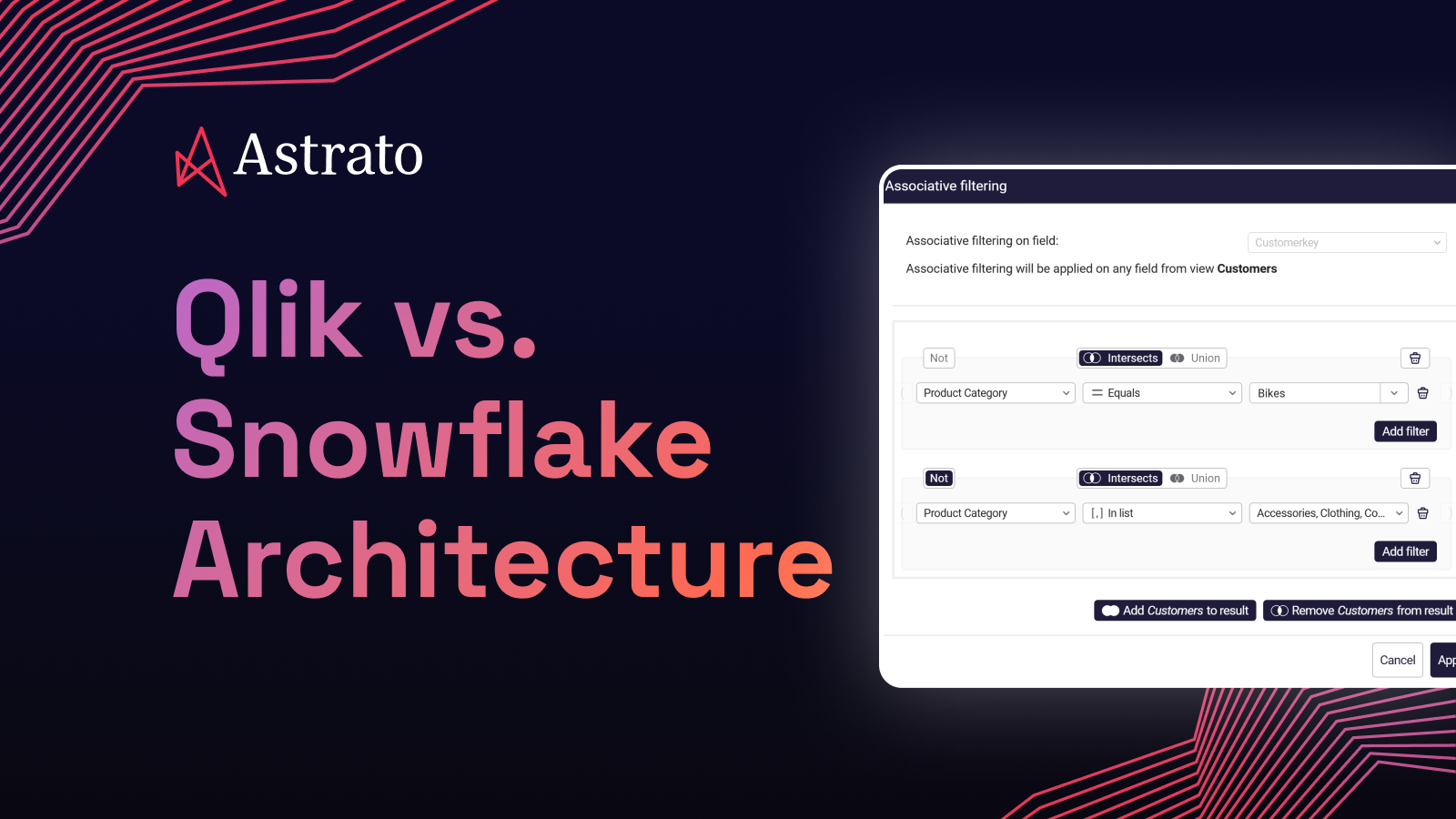
Qlik holds that data in memory, compressed, with every field indexed and associatively linked to every other field. When a user clicks on a value, Qlik instantly shows what's related and what's excluded across the entire dataset, because the whole model is sitting in RAM, pre-linked.
This is genuinely powerful, and it's worth being honest about why Qlik won so much of the market. In-memory associative exploration was, for a long time, the fastest way to let a business user roam freely through data.
No waiting for queries. No SQL. Click, and the whole model responds.
For the hardware and database realities of 2008 to 2015, putting the data inside the BI tool's own optimized engine was the right architecture. Databases were slower, more expensive to query repeatedly, and not built to handle hundreds of business users running ad-hoc exploration all day.
The cost of that architecture is that the data in Qlik is a copy.
To get data into the engine, you run a reload — a scheduled job that extracts from the sources, transforms the data, and rebuilds the in-memory model.
Between reloads, the data is as old as the last reload.
And because the data lives inside Qlik, so does the logic that shapes it. The transformations, the business rules, the derived fields — they're written in Qlik's load script and they live nowhere else.
The warehouse architecture: bring the engine to the data
A cloud data warehouse like Snowflake inverts the model.
Instead of copying data into the BI tool, you keep the data in the warehouse and query it where it sits. Snowflake's architecture separates storage from compute — data sits in cheap cloud storage, and you spin up compute power on demand to query it, then spin it back down. It's columnar, like Qlik's engine, so analytical queries are fast. But unlike Qlik, it's designed from the ground up to be the single source of truth for all of an organization's data, queried by many tools, governed in one place.
The reason this architecture has become dominant isn't fashion. It's that cloud warehouses got dramatically cheaper and more powerful at exactly the time organizations were consolidating all their data into them anyway — for data science, for AI, for operational analytics.
Once all your data already lives in Snowflake, the case for copying a subset of it into a separate BI engine, on a delay, with its own logic and its own security, starts to look like duplicated effort. Why maintain two homes for your data when the warehouse can be the only one?
That's the architectural shift in a sentence: the data stops living in the BI tool and starts living in the warehouse, and the BI tool changes from being a place where data lives into a window onto data that lives somewhere else.
Everything else follows from that single change. Here are the four shifts it produces.
Shift one: where data lives
Before: In Qlik, the working data for analytics lives in QVD files — Qlik's proprietary binary format — and in the in-memory model built from them. The QVD layer is effectively a parallel data warehouse, one that exists only to feed Qlik. Your data engineering team manages the real data sources; your Qlik team manages the QVD layer; the two are connected by reload jobs but otherwise separate.
After: The data lives in Snowflake. There is no QVD layer. The data your dashboards read is the same data sitting in the warehouse that everything else in the organization reads — the same tables governed by the same access policies and refreshed by the same pipelines.
Why it matters: The "two data warehouses" problem disappears. Most organizations running Qlik on extracted data don't realize how much effort goes into keeping the QVD layer synchronized with reality — until it's gone. When the BI tool reads directly from the warehouse, there's one copy of the truth, one place to govern, one pipeline to maintain. The duplication that had become invisible turns out to have been expensive.
Shift two: where business logic lives
Before: Qlik's load script is where transformation happens. It joins tables, derives fields, applies business rules, and shapes the data into the model the dashboards use. A mature Qlik deployment contains a decade of accumulated logic in these scripts — and that logic lives only inside Qlik. If you want the same "net revenue" calculation in another tool, you rebuild it there. The logic is locked to the platform.
After: Logic moves into the warehouse, typically expressed in dbt models or SQL views. The semantic layer — the definitions of your metrics and dimensions — becomes part of the data platform rather than part of the BI tool. Any tool that reads from the warehouse reads the same logic. It can be tested, version-controlled, and reused.
Why it matters: This is the shift with the largest downstream consequences, and it's the one most teams underestimate. When logic lives in the warehouse, the BI tool becomes a thin presentation layer that can be changed, supplemented, or replaced without rebuilding your business logic. When logic stays locked in the BI tool, you've simply moved your lock-in from one vendor to another. The decision about where logic lives is, in practice, the most important architectural decision in any migration — covered in depth in the migration readiness checklist.
Shift three: how data refreshes
Before: Qlik refreshes through reloads — scheduled jobs that rebuild the in-memory model from the sources. Between reloads, the data is static. Most organizations reload overnight, which means the business looks at yesterday's data all day. Reloads also fail, run long, and require ongoing engineering attention to keep working as data volumes grow.
After: The BI tool queries Snowflake live. There is no reload cycle. When a user opens a dashboard, the tool queries the warehouse and returns current data. The data is as fresh as the warehouse is — which, in a modern pipeline, can mean minutes old rather than a day old.
Why it matters: Two costs disappear, and most teams have only ever counted one of them. The visible cost is the engineering time spent maintaining reloads — fixing failures, optimizing slow jobs, tuning incremental loads — which in a mature environment can consume one to two full-time-equivalents a year.
The invisible cost is larger: the entire category of decisions the business never makes because the data is always stale, the questions people stopped asking because they assumed the answer would take until tomorrow. Live query doesn't just save engineering hours. It changes what the business can do with its data.
Shift four: how security is enforced
Before: Qlik controls who sees what through section access — a security model tied to Qlik's own user identity, applied inside the Qlik application. It works, but it's a security model that exists only in Qlik, parallel to whatever governs the rest of your data. And in deployments that have run for years, section access tends to accumulate exceptions and special cases until it's difficult to reason about.
After: Security moves to the warehouse. Snowflake's row access policies enforce who sees what at the data layer, governed by the same identity system that controls every other data asset in the organization. The BI tool inherits this rather than implementing its own.
Why it matters: One security model instead of two. When access control lives in the warehouse, a person's data permissions are consistent whether they're looking at a dashboard, running a query, or using any other tool that touches the warehouse.
This is both simpler to manage and easier to audit — a real advantage in regulated industries, where being able to prove who could see what is not optional.
The migration is also a rare opportunity to rebuild a security model that may have drifted over years, rather than carrying the accumulated exceptions forward.
Why this shift is happening now
It's worth asking why this architectural change is happening across the industry now, rather than five years ago or five years from now. The answer isn't that Qlik's architecture was wrong. It's that the conditions that made it the right answer have changed.
When Qlik's in-memory model rose to dominance, cloud data warehouses either didn't exist or weren't capable of serving interactive BI workloads affordably. Querying a database repeatedly, all day, for hundreds of users, was slow and expensive.
Putting the data into a dedicated in-memory engine was the sensible architecture. It traded data freshness and a separate copy of the data for speed and exploration — a good trade given the constraints of the time.
Three things changed. Cloud warehouses became fast enough to serve interactive queries directly, removing the original reason to copy data into a separate engine. They became cheap enough that the cost calculus flipped.
And organizations consolidated their data into those warehouses for reasons that had nothing to do with BI — data science, machine learning, AI, operational analytics — which meant the data the BI tool needed was already sitting in the warehouse.
Once that was true, maintaining a separate, delayed, separately-governed copy inside the BI tool became hard to justify.
This is the honest version of the story. Qlik's architecture was a good answer to its era's constraints. The era changed. The architecture that fits 2026 keeps the data in the warehouse and treats BI as a layer on top — which is what the move to Snowflake represents.
For the broader treatment of how legacy and cloud-native BI differ across more than just architecture, see Legacy BI vs. Cloud-Native BI: What's Actually Different.
What it means for your stack
If your organization is moving data into Snowflake and still running Qlik against extracts, you're operating across two architectural eras at once — modern storage, legacy consumption. That's a workable interim state, but it's not the endpoint, and recognizing the architectural mismatch is the first step in planning past it.
The practical implication is that when you evaluate what comes after Qlik, the question that matters most isn't which tool has the nicest charts.
It's which tools are built for the warehouse-owns-the-data architecture — querying Snowflake live, pushing logic into the warehouse, inheriting warehouse-native security — versus which ones recreate the bring-the-data-to-the-engine model with a different vendor's name on it.
A BI tool that copies your Snowflake data into its own engine on a refresh schedule has reproduced the exact architecture you're migrating away from.
Warehouse-native platforms are the category built for this architecture.
Astrato is one of them — it queries Snowflake live with no extracts, keeps logic in the warehouse, and inherits warehouse-native governance — alongside other options like Sigma and Looker that share the warehouse-native approach.

The right choice depends on your context, but the architectural filter narrows the field quickly: does the tool fit the warehouse-owns-the-data world, or does it pull you back into the previous one?
To pressure-test your own readiness for this shift, the Qlik to Snowflake migration readiness checklist turns these architectural questions into a concrete audit. To see how warehouse-native analytics works in practice, Astrato's Snowflake integration is a place to start.
Frequently asked questions
Are Qlik and Snowflake competitors?
No. Qlik is a business intelligence platform; Snowflake is a cloud data warehouse. They operate at different layers of the stack, and Qlik can run on top of Snowflake. The reason "Qlik vs. Snowflake" is a common search is that moving to Snowflake often prompts a re-evaluation of whether the in-memory BI architecture Qlik represents still fits — but the comparison is really between two architectural models, not two products.
Can I just run Qlik on top of Snowflake instead of migrating?
Yes, and many organizations do during a transition. Qlik can connect to Snowflake and query it. But unless you change how Qlik uses the data, you often end up extracting from Snowflake into Qlik's engine anyway — which reintroduces the reload cycle and the separate copy of data. Running Qlik against Snowflake is a viable interim state, not an architectural endpoint.
What is the single biggest architectural difference?
Where the data lives. In Qlik's model, the working data lives inside the BI tool as a periodically-refreshed copy. In the warehouse model, the data stays in the warehouse and the BI tool queries it live. Almost every other difference — refresh, logic, security — follows from that one.
Does the warehouse architecture mean slower dashboards?
Not necessarily, and often the opposite at scale. Modern cloud warehouses are columnar and built for fast analytical queries. With appropriate warehouse sizing and query design, live-query dashboards perform well. The trade-off is different: instead of paying for speed with a separate in-memory copy and stale data, you pay for compute when queries run. For most organizations consolidating on a warehouse, the economics and the freshness both favor the warehouse model.
Do we lose our Qlik investment when we migrate?
Most of the business logic is portable. Transformations and derived fields translate to SQL and dbt models; the calculations move into the warehouse rather than disappearing. What doesn't carry over is the logic that existed only to work around Qlik's architecture — and that logic represents work you no longer need to do. The migration is an opportunity to keep what serves the business and retire what only served the tool.
Ready to experience next-gen analytics?
See how Astrato runs natively in your warehouse.