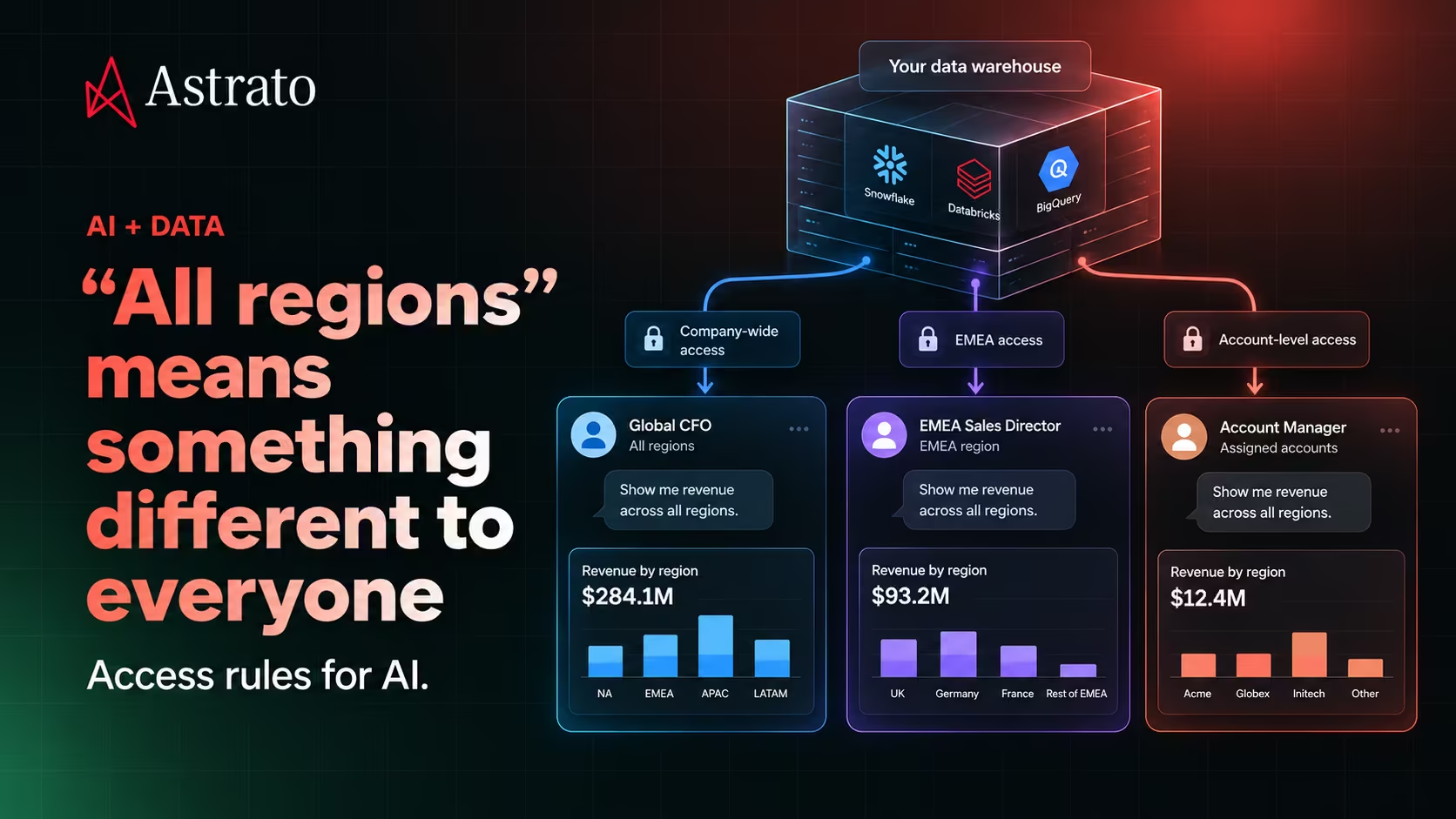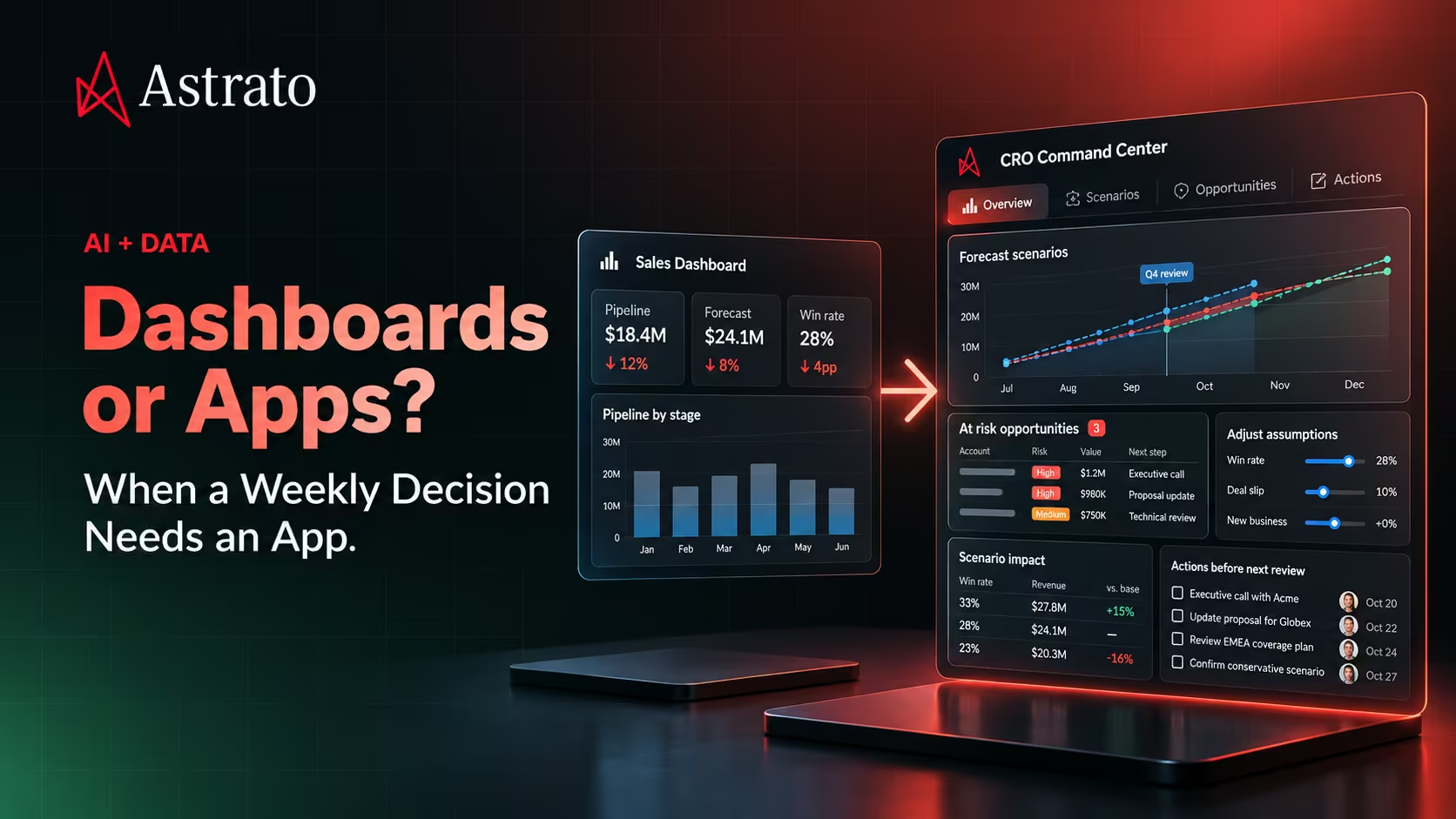
9 Best ThoughtSpot Competitors and Alternatives for 2026
Looking for ThoughtSpot competitors in 2026? Compare the 9 best ThoughtSpot alternatives including Astrato, Power BI, Tableau, Sigma, Hex, and more.


ThoughtSpot spent a decade owning the clearest AI-first story in business intelligence. Type a question, get an answer. That pitch pulled enterprise buyers away from dashboard-heavy legacy tools and set the template every AI-powered analytics platform has chased since. For mid-market and enterprise organizations on cloud data warehouses like Snowflake, BigQuery, and Databricks, ThoughtSpot was the tool that made natural language querying feel credible.
Between late 2025 and early 2026, that story got rewritten. Three times. ThoughtSpot rebranded from "AI-Powered Analytics" to "Agentic Analytics Platform" across every press release and executive keynote. It launched a full Spotter agents portfolio — Spotter 3, SpotterViz, SpotterModel, SpotterCode, and Spotter Semantics — while simultaneously pushing upstream into data prep with Analyst Studio and SpotCache, putting ThoughtSpot in direct competition with dbt and Tableau Prep. And the $200M Mode Analytics acquisition from July 2023 still sits unfinished, with industry analysts noting integration challenges remain. All of this plays out against a $4.2B valuation that hasn't moved since 2021.
If you're evaluating ThoughtSpot at renewal, watching your Spotter Pro query cap trigger overage charges, or wondering whether the agentic pitch justifies the expanded platform surface, this guide covers the real ThoughtSpot alternatives in 2026 and which one fits your specific data architecture, team, and use case.
Why Teams Look for ThoughtSpot Alternatives
Comparison at a Glance
Before the deep dives, here's the at-a-glance view of how each ThoughtSpot alternative stacks up across the dimensions that matter most — architecture, ease of use, embedded analytics capability, writeback, AI features, and pricing. Use it to narrow the field to two or three contenders, then read the deep dives for fit against your specific situation.
The deep dives follow in this order: Astrato first (with an expanded treatment), then the strongest direct competitors to ThoughtSpot on AI and enterprise positioning, then the specialist and niche picks for specific buyer scenarios. Each section names where the tool genuinely beats ThoughtSpot — and where it doesn't.
1. Astrato — Best for warehouse-native BI with AI grounded in the semantic layer
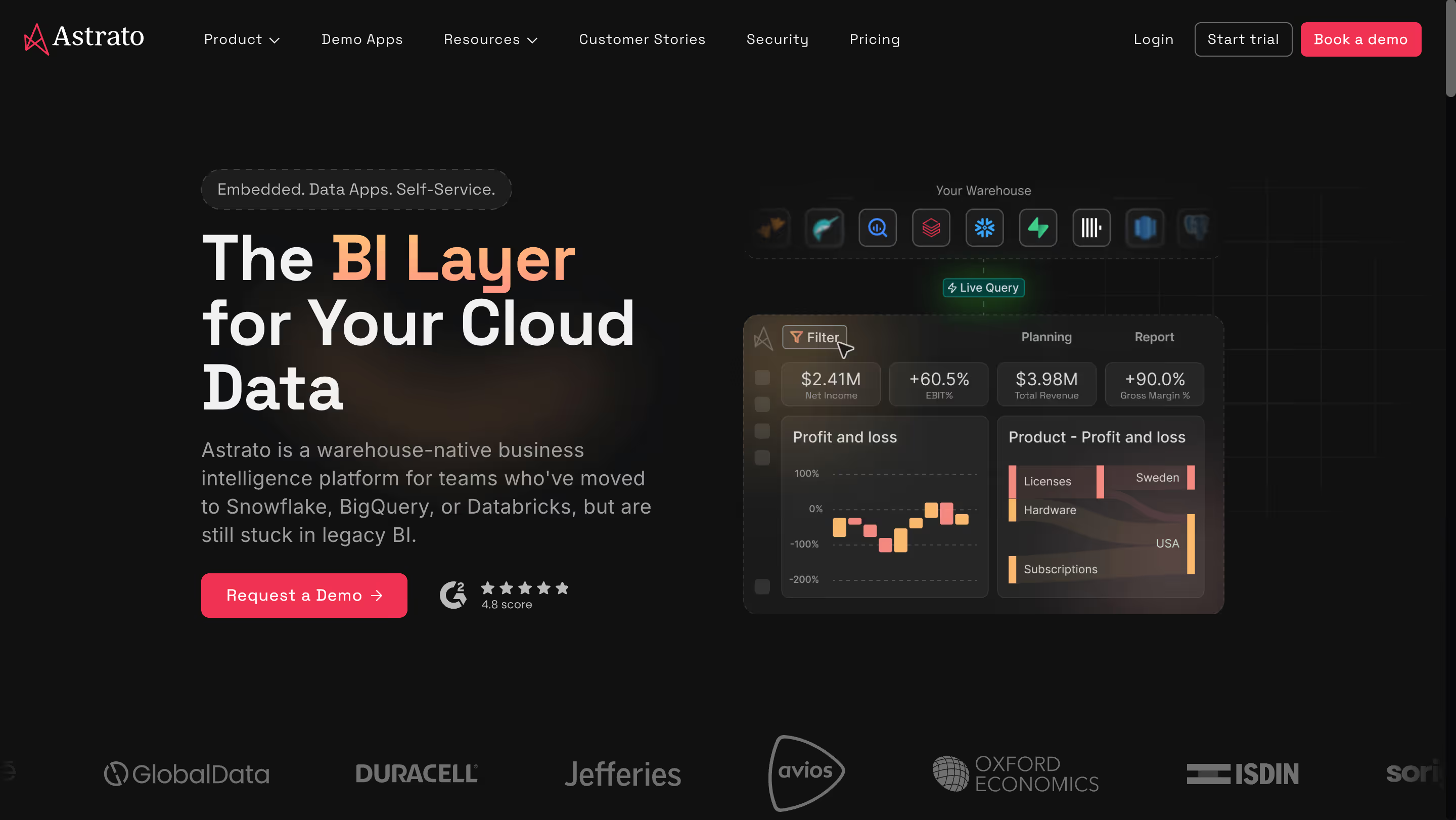
Astrato is a warehouse-native business intelligence platform that queries your cloud data warehouse directly — no extracts, no pre-modeling ritual to make AI search work, no acquired-product integration tensions. It's purpose-built for teams on Snowflake, BigQuery, Databricks, ClickHouse, Redshift, or PostgreSQL who want modern BI with AI capability grounded in a governed semantic layer. Every dashboard executes live against your existing data warehouse, with full cost transparency on query pushdown. For organizations evaluating alternatives to ThoughtSpot because the expanding Spotter agents portfolio doesn't match how their team actually wants to work, Astrato offers a focused BI product rather than a platform migration.
Why Astrato?
- Warehouse-native live query — no extracts, no data duplication. Every Astrato dashboard executes live against Snowflake, BigQuery, Databricks, or your other cloud data warehouses. No pre-calculated extracts to maintain, no cache invalidation headaches, no "did the data refresh?" questions. Your warehouse stays the source of truth, with full query cost transparency for data teams managing compute spend.
- AI grounded in a governed semantic layer. Where ThoughtSpot's Spotter AI depends on extensive upfront search-token modeling to work accurately, Astrato connects AI features to your semantic layer natively. The result: less time spent building tokens and modeling, more time getting accurate AI-powered insights. Business users get natural language processing against governed metrics from day one, not after a six-month modeling project.
- Pixel-perfect visualizations for executive and customer-facing output. ThoughtSpot's auto-generated visuals are consistently rated the platform's weakest area in G2 reviews. Astrato produces presentation-ready, customizable dashboards fit for board decks and customer-facing embedded analytics — without the manual workflow ThoughtSpot reviewers describe as tedious. Design flexibility matters when the dashboard is the product.
- Embedded analytics with usage-based pricing. Astrato's usage-based pricing is built for customer-facing analytics serving thousands of end users — no per-seat compounding, full white-labeling included, multi-tenant row-level security built in, no premium upsell for logo removal. Where ThoughtSpot Everywhere is capable but priced by consumption in ways that surprise SaaS customers at scale, Astrato's pricing model is embedded-first by design.
- Native writeback for operational workflows. ThoughtSpot has no native writeback — workflows requiring user input (budgets, approvals, forecasts) need to route through external tools. Astrato turns dashboards into operational data apps: users update data directly, changes sync back to the warehouse under full governance, with built-in conflict handling. This is a structural capability difference, not a feature ticked on a comparison sheet.
- Focused BI product, not a platform expansion target. ThoughtSpot is expanding into data prep (Analyst Studio), semantic layers (Spotter Semantics), embedded dev tools (SpotterCode), and agent-building frameworks. Astrato is a focused BI product. For organizations that want to fix their BI layer without being sold a full data platform migration, the focus matters — at renewal and beyond.
Astrato's Edge Over ThoughtSpot
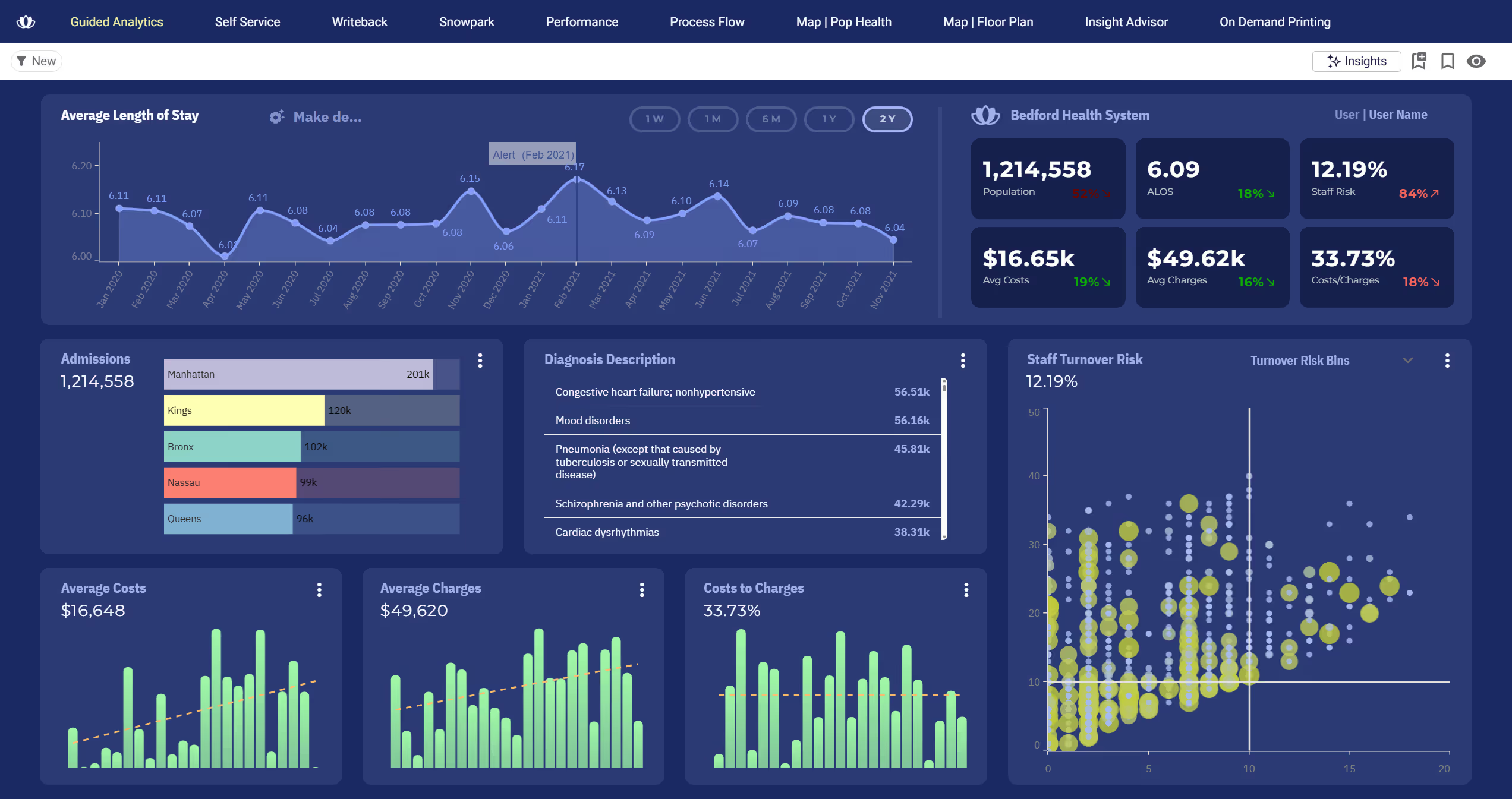
Astrato attacks four specific gaps ThoughtSpot's 2026 repositioning has opened. Each one maps to a buyer conversation you've probably already had internally.
First, semantic-layer-grounded AI vs. search-first AI that requires upfront modeling. ThoughtSpot's Spotter AI is production-mature, but it depends on extensive search-token modeling and data preparation to work accurately. Astrato's AI is grounded in the semantic layer from day one, meaning less specialized data engineering work before business users get accurate answers. The contrast matters more in 2026 because of how ThoughtSpot positions Spotter Semantics — a newer offering that acknowledges the modeling gap ThoughtSpot has always had.
Second, the focused BI product vs. the expanding platform surface. ThoughtSpot is pushing upstream into data prep, mid-stream into dashboard generation, and outward into agent-building frameworks. Astrato stays focused. For organizations that want a clear-scoped BI tool, Astrato avoids the "what is ThoughtSpot trying to be now?" question that keeps surfacing in procurement reviews.
- Embedded and customer-facing analytics at scale. ThoughtSpot Everywhere is capable but consumption-priced in ways that penalize high-volume embedded deployments. Astrato's usage-based pricing, full white-labeling, and pixel-perfect output make it a genuinely better fit for SaaS companies embedding dashboards into customer applications.
- Visualization depth for real use cases. ThoughtSpot's auto-generated visualizations are consistently the platform's weakest dimension in G2 reviews. For executive dashboards, client reporting, and customer-facing embedded analytics where dashboard quality drives adoption, Astrato's presentation-ready output is a tangible capability difference.
- Native writeback vs. read-only architecture. ThoughtSpot is fundamentally read-only — operational workflows require external integration. Astrato's native writeback turns dashboards into applications, with real-time updates, conflict handling, and warehouse governance built in.
- Predictable pricing vs. per-query caps. Spotter Pro's 25-queries/user/month cap triggers overage costs for heavy AI users. Astrato's usage-based pricing has no AI query caps, no feature gating by tier, and one license type across creators and viewers.
What Users Are Saying
Organizations migrating to Astrato from legacy BI tools (Qlik, Power BI) and modern tools (Sigma, ThoughtSpot) consistently highlight the warehouse-native architecture, speed of dashboard deployment, and quality of embedded dashboards. Customers report 50–75% cost savings compared to legacy BI tools and 25–50% faster dashboard development. Teams evaluating Astrato alongside ThoughtSpot specifically cite the semantic-layer-grounded AI approach as a more natural fit for their existing data architecture, without the extensive search-token pre-modeling that ThoughtSpot requires.
"Astrato also goes beyond reporting by supporting interactive and embedded analytics, making it well suited for both internal teams and customer-facing applications. Overall, it's an incredibly strong choice for organizations looking for fast, reliable, and actionable analytics at scale."
Giuseppe L. — Enterprise Customer Success Manager
"The ability to write back to Snowflake and Databricks, and to change the semantic layer on the fly. Additionally, built in version control for dashboards saves so much time and work and allows us to quickly rollback to previous versions as needed."
Christopher A. — Founder
"Very flexible tool with a lot of potential to create new tools beyond simple dashboards. Application customization opens the possibility of building different types of data application allowing a new type of interactive analytics. Semantic layers are always useful and powerful in most cases."
Jose V. — Data Analytics Manager
Pricing
Usage-based, tied to warehouse compute consumption. One license type — no distinction between viewers, creators, and developers, and no feature gating across tiers. For organizations exhausted by ThoughtSpot's Essentials/Pro/Enterprise tiering and Spotter query caps, this simplicity is a structural improvement. Warehouse compute costs (Snowflake, BigQuery, etc.) are separate and transparent.
Astrato Is Best For
Astrato is best for teams with a cloud data warehouse who want AI-powered BI grounded in a governed semantic layer, pixel-perfect embedded dashboards for customer-facing use cases, and native writeback for operational workflows — particularly organizations evaluating ThoughtSpot who want a focused BI product rather than committing to ThoughtSpot's expanding platform across search BI, Analyst Studio, and Spotter agents.
Watch Out For
Astrato is purpose-built for cloud data warehouses — if your primary data sources aren't Snowflake, BigQuery, Databricks, ClickHouse, Redshift, or PostgreSQL, or if you specifically need a pure natural-language-search-first UX rather than a semantic-layer plus AI approach, ThoughtSpot's Spotter may fit better.
For a more comprehensive side-by-side comparison, here's our Astrato vs. ThoughtSpot review.
2. Microsoft Power BI — Best for Microsoft-first teams with existing Azure and 365 investments
The Microsoft-ecosystem business intelligence platform, Power BI is tightly integrated with Azure, Excel, Teams, and Microsoft 365. It offers dramatically lower per-user pricing than ThoughtSpot at $14/month, though real costs escalate through Fabric capacity requirements for full Copilot AI functionality.
Why Power BI?
- Massive cost advantage vs. ThoughtSpot. Power BI Pro at $14/user/month is less than Essentials ($25/user) and less than half of ThoughtSpot Pro ($50/user). For Microsoft 365 E5 customers, Power BI Pro is effectively bundled in existing licensing — making it $0 incremental for many enterprise companies.
- Deep Microsoft ecosystem integration. Power BI plugs natively into Excel, Teams, SharePoint, and Azure. For Microsoft-first organizations where the underlying data stack runs on Azure and productivity tools run on Microsoft 365, the integration depth across Microsoft data sources is a structural advantage ThoughtSpot cannot match.
- Copilot AI within Fabric. Microsoft's Copilot generates DAX measures, builds report pages, and produces narrative summaries from plain English prompts. Copilot is included within Fabric F64+ capacity or Premium Per User licensing — a credible counter to ThoughtSpot's Spotter for Microsoft-first organizations with existing Azure commitments.
Power BI's Edge Over ThoughtSpot
Power BI's edge over ThoughtSpot is cost economics and ecosystem gravity. Where ThoughtSpot's pricing assumes buyers value AI-first search enough to pay a premium, Power BI's pricing assumes Microsoft ecosystem lock-in and offers dramatic savings as the reward. For enterprise ThoughtSpot customers doing renewal reviews, "we could cut our BI spend by 60% moving to Power BI, and we already pay for it" is a hard question to avoid.
The Microsoft community and talent market is also far larger than ThoughtSpot's. DAX developers are more available than ThoughtSpot search-token specialists. Power BI has far more learning content, more third-party extensions, more community templates. For organizations planning a five-year BI hiring horizon, this is a meaningful structural advantage.
The risk against Power BI is architectural and AI-capability. Power BI's import mode default creates data duplication that ThoughtSpot's live-query architecture avoids. Copilot requires Fabric F64+ capacity (~$5,258/month) for full functionality, turning "included Copilot" into a $60K+/year commitment. For AI-first organizations whose mandate is "we need the best agentic BI available," Power BI's AI story is credible but less focused than ThoughtSpot's.
What Users Are Saying
Reviewers consistently highlight Power BI's integration depth across Microsoft tools and its accessibility for teams already using Excel and Teams. The flip side: DAX has a meaningfully steep learning curve, Power BI Desktop remains Windows-only, and permissions management for embedded reports can be complex. For many buyers, Power BI's price-per-seat is the headline attraction — but the total cost picture changes once Fabric capacity and Copilot licensing enter the conversation.
"I like power BI because I use Power Automate to link MS List so it can show real time dashboards. What's critical for me is the ease of integration. Sometimes it's slow to load. Also, everyone should have license to view and edit, it's quite expensive."
"For people who are just starting to use this tool for business reporting or who have little experience in data analysis, there may be a very slow learning curve associated with mastering Power BI. At first I found it a little difficult to handle."
Aneurys Nicanor A. — Project Manager
"There is nothing that I dislike, but managing user permissions can be complex and then unintentionally denies access to embedded reports for authorized team members."
Ramy S. — Analytics Team Manager
Pricing
Power BI Pro: $14/user/month (raised from $10 in April 2025). Premium Per User: $24/user/month (raised from $20). Microsoft Fabric capacity starts at F2 (~$263/month) and scales to F64+ (~$5,258/month), which is required for full Copilot functionality. Gotcha: both creators and viewers need paid licenses unless you invest in Premium capacity, and DAX has a meaningful learning curve that offsets the low per-seat price.
Power BI Is Best For
Power BI is best for Microsoft-first ThoughtSpot shops where the organization already has Microsoft 365 E5 licensing, Azure infrastructure, and Teams/Excel-based workflows — and where cost savings vs. ThoughtSpot's per-user pricing is a primary migration driver.
Watch Out For
Power BI's import mode default duplicates warehouse data into a separate engine, Copilot requires expensive Fabric F64+ capacity for full functionality, Power BI Desktop remains Windows-only, and DAX has a learning curve that offsets the low headline pricing for teams without existing Microsoft expertise.
3. Tableau — Best for visualization-heavy teams prioritizing dashboard polish
Now positioned as "the world's first agentic analytics platform" via Tableau Next, Tableau is the Salesforce-owned BI platform built on Salesforce Hyperforce with Agentforce AI integration. It offers industry-leading visualization quality and cross-platform authoring including Mac — directly addressing ThoughtSpot's most consistently cited weakness in G2 reviews.
Why Tableau?
- Industry-leading visualization quality. ThoughtSpot's auto-generated visualizations are the platform's weakest dimension — consistently rated basic, sluggish, and not suitable for presentation-ready reports in G2 reviews. Tableau remains the benchmark for visual polish, custom chart types, design flexibility, and dashboard aesthetics. For teams where dashboard quality drives executive adoption, the difference is decisive.
- Cross-platform authoring, including Mac. Tableau Desktop runs natively on both Windows and macOS. ThoughtSpot is browser-based, which is fine — but for organizations that want analyst authoring alongside rich local development, Tableau's desktop flexibility is a genuine capability difference.
- DataFam community and talent ecosystem. Tableau's DataFam is the largest active BI community globally, with thousands of community-shared dashboards on Tableau Public. For organizations hiring BI talent, Tableau expertise is far more available than ThoughtSpot expertise at comparable cost — a structural hiring advantage.
Tableau's Edge Over ThoughtSpot
Tableau's edge over ThoughtSpot is tied directly to ThoughtSpot's most cited weakness: visualization quality. Read any ThoughtSpot G2 review honestly, and "visualizations feel basic" appears consistently. Tableau's output quality is the gold standard — presentation-ready, custom-chart-type flexibility, design depth that Spotter's auto-generated visuals don't match. For teams where the dashboard is the product (executive reporting, client deliverables, customer-facing embedded analytics), Tableau's visual quality justifies the licensing premium.
The agentic analytics story also creates a legitimate AI counter-narrative. Tableau Next's Agentforce integration provides agentic AI capabilities comparable to Spotter, with the added Salesforce ecosystem advantage for customers already on Salesforce Data Cloud. For organizations where AI-first BI is the mandate but visualization polish still matters, Tableau Next delivers both.
The risk against Tableau is cost and Salesforce ecosystem drift. Tableau Creator at $75/user/month is more expensive than ThoughtSpot Essentials at $25/user or Pro at $50/user. And Tableau's post-2023 Salesforce pivot is aligning the roadmap with Salesforce customers in ways that may not serve non-Salesforce organizations.
What Users Are Saying
Reviewers praise the drag-and-drop simplicity for building clean, professional visualizations that help decision-makers understand trends quickly. Complex calculations and table calculations are cited as the steeper learning curve areas, and cost is a recurring concern for smaller teams and individual users.
"I like Tableau's drag-and-drop feature, which is very convenient for creating visualizations. It helps me directly create visualizations by allowing me to just pull and place charts."
Sivakumar N. — Reviewer
"One thing that could be improved is the learning curve for advanced features. While basic charts are easy to make, trying to learn complex calculations or Level of Detail (LOD) expressions can be really overwhelming. It feels like there is a huge jump in difficulty between 'beginner' and 'intermediate' tasks."
Saurabh S. — Reviewer
"Tableau was fantastic pre Salesforce takeover. The community was thriving and the product was accelerating at a rate you would expect. However despite a promise during the takeover that Tableau would remain untouched the inevitable happened and it became diversified, lost its identity and ultimately lost its user base / community."
Gartner Peer Insights reviewer — Verified Reviewer
Pricing
Creator: $75/user/month (billed annually). Explorer: $42/user/month. Viewer: $15/user/month. Enterprise Creator up to $115/user/month. Tableau+ (which includes Tableau Next and Agentforce capabilities) is licensed separately. Tableau Cloud adds hosting; Tableau Server requires separate server licensing.
Tableau Is Best For
Tableau is best for ThoughtSpot organizations with trained data analysts prioritizing visualization depth and cross-platform authoring — particularly creative industries, consulting firms, and companies where dashboard aesthetics directly influence stakeholder adoption, as well as Salesforce ecosystem organizations where Tableau Next's Agentforce integration matters.
Watch Out For
Tableau's per-user pricing is higher than ThoughtSpot's (Creator $75 vs. ThoughtSpot Pro $50), 60–80% of analyst time still gets spent on data preparation outside Tableau, and the post-Salesforce Tableau Next pivot is aligning the roadmap with Salesforce ecosystems in ways that may not serve non-Salesforce organizations.
4. Sigma Computing — Best for spreadsheet-native analysts on cloud data warehouses
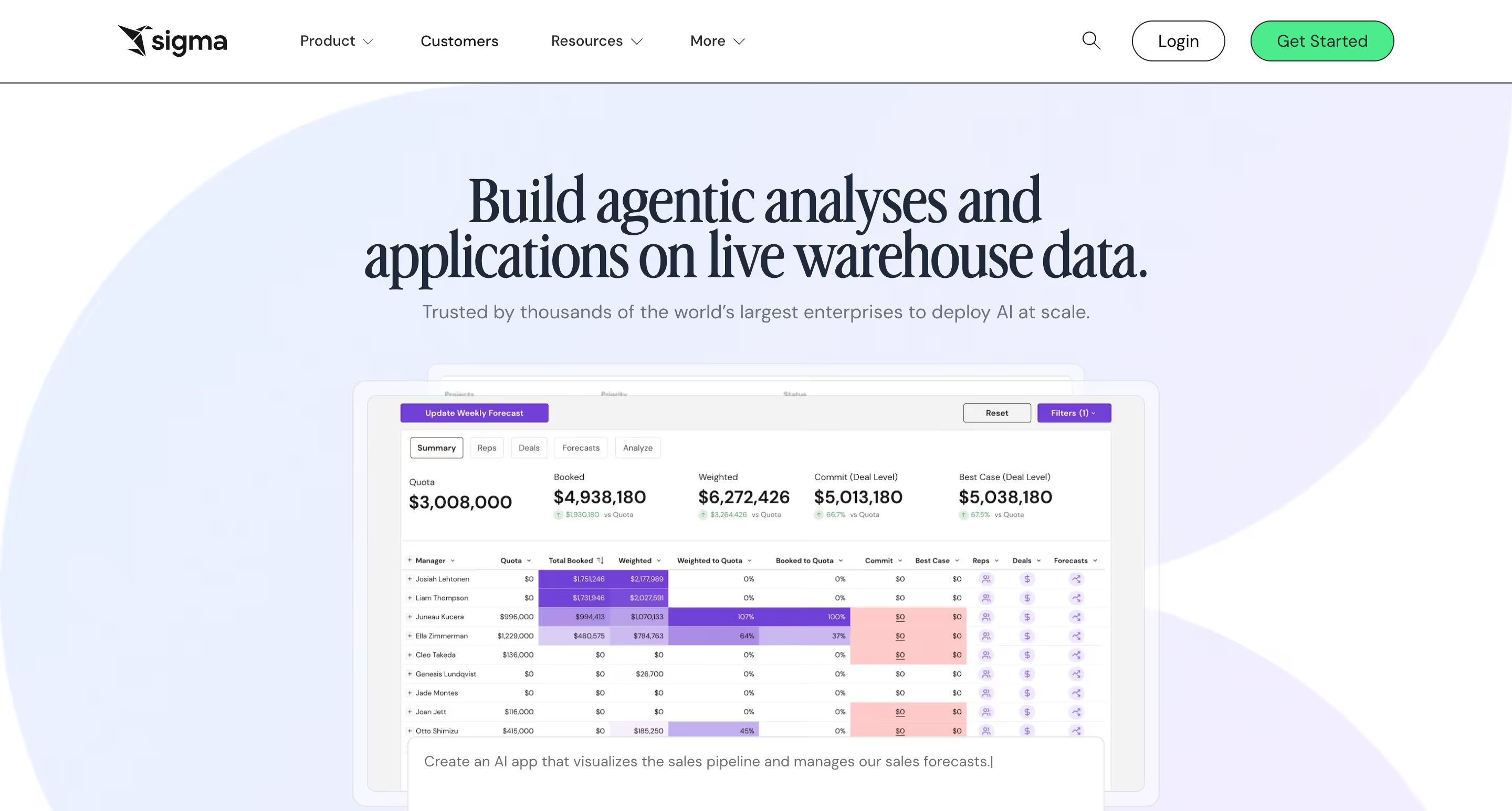
Founded in 2014 and built around a spreadsheet-first interface, Sigma Computing is a warehouse-native BI platform that lets business analysts explore live cloud warehouse data using Excel-style formulas. It sidesteps the extensive upfront data modeling that ThoughtSpot requires to make natural-language search accurate.
Why Sigma Computing?
- Spreadsheet-native UX eliminates modeling overhead. ThoughtSpot's Spotter AI requires extensive search-token modeling and data preparation to work accurately. Sigma's spreadsheet UI sidesteps that requirement — business users write Excel-exact formulas against live warehouse data, and the tool generates SQL underneath. For organizations without dedicated analytics engineering capacity, Sigma's time-to-value is shorter.
- Input tables enable native writeback. Users can edit data directly in dashboards via input tables, with changes syncing back to the warehouse. ThoughtSpot has no native writeback — operational workflows require external tooling. Sigma's writeback is first-class, without requiring Mode notebook integration or external action APIs.
- Strong embedded analytics with full white-labeling. Sigma's embedded offering includes full white-label customization, multi-tenant architecture, and usage-based pricing for high-volume scenarios — competitive with ThoughtSpot Everywhere for customer-facing SaaS analytics.
Sigma's Edge Over ThoughtSpot
Sigma wins the ThoughtSpot buyer who wants warehouse-native BI but doesn't want to commit to ThoughtSpot's AI-first modeling overhead. ThoughtSpot's value is tied to natural-language search working accurately, which requires significant upfront data modeling that many organizations underestimate. Sigma's spreadsheet UX sidesteps that requirement — business users are productive immediately, without extensive search-token development.
The architectural alignment is similar: both platforms are warehouse-native, query-pushdown tools targeting cloud data warehouses. The difference is UX philosophy — Sigma's spreadsheet metaphor vs. ThoughtSpot's search metaphor. For spreadsheet-heavy domains (finance, operations, RevOps, retail), Sigma's UX is naturally aligned with how users already think, and the time-to-productivity advantage shows in adoption metrics.
The risk against Sigma is product ambiguity and AI maturity. Sigma's recent "AI Apps Platform" pivot has blurred the product's positioning — it's being sold as BI, as an app builder, and as an analytics platform simultaneously. For organizations that specifically want AI-first analytics, ThoughtSpot's focused Spotter story is cleaner than Sigma's multi-product pitch.
What Users Are Saying
Sigma reviewers consistently highlight the familiar spreadsheet interface and live connection to warehouses like Snowflake, making onboarding fast for teams without SQL knowledge. Performance with very complex workbooks and advanced features can require a learning curve.
"I like how user-friendly Sigma is. I'm not a data analyst but work with data, and it makes it really easy to pull in data and work with it in complicated ways that don't require coding. "
"Sometimes I run into errors with certain code during updates, and I’ve had a few update-related issues overall. I’ve also noticed that performance can slow down when working with large datasets."
Nicola M. — Business Data Analyst
"Sigma's literal data handling approach can lead to substantially higher cloud warehouse costs if not managed carefully. The platform requires more compute resources to execute operations compared to alternatives."
Cooper S. — Data Analyst
Pricing
Essentials tier starts at $300/month base with unlimited viewers. Pro and Enterprise tiers are custom-priced by user licenses, features, and embedded deployment. Third-party data indicates typical annual contracts range $15,000–$250,000+. Gotcha: live queries push compute costs to your warehouse — Snowflake or BigQuery bills can spike with heavy usage.
Sigma Computing Is Best For
Sigma Computing is best for ThoughtSpot buyers who want warehouse-native BI without the upfront modeling overhead of getting Spotter to work accurately — particularly finance, operations, retail, and RevOps teams where business users already think in spreadsheets.
Watch Out For
Sigma requires a cloud data warehouse to function (no on-premises option), live queries can inflate warehouse compute bills under heavy load, and Sigma's AI Apps Platform pivot has created product-positioning ambiguity that ThoughtSpot's focused AI-first story avoids.
5. Hex — Best for data teams needing code-first collaborative notebooks
Built around SQL plus Python plus no-code notebooks with Magic AI and the Notebook Agent, Hex is a collaborative AI analytics platform — the cleaner code-first answer for data teams than ThoughtSpot's still-incomplete Mode Analytics integration. It targets the segment Mode was acquired to serve, without the philosophical tension between search-first and code-first workflows.
Why Hex?
- Collaborative SQL + Python notebooks with pull-request-style reviews. Hex combines SQL, Python, and no-code tools in a single collaborative canvas, with Git-style review workflows that serious data teams use for important analysis. For data scientists and analytics engineers, Hex is the focused notebook product Mode was meant to be — without acquired-product integration tension.
- Notebook Agent — agentic AI for data people. Hex's Notebook Agent writes queries, builds visualizations, joins tables, and uses window functions when needed, all while letting users follow the agent's logic. Magic AI assists with SQL debugging, Python package discovery, and chart generation. For teams wanting agentic AI for technical workflows (not just natural-language search), Hex's approach is purpose-built.
- Free Community tier and clear per-editor paid pricing. Hex Community is free for individual use. Paid tiers use a per-editor pricing model with Medium compute included — much simpler than ThoughtSpot's row-count caps, query caps, and tiered feature gating. For data teams wanting predictable licensing without AI query overages, Hex's structure is straightforward.
Hex's Edge Over ThoughtSpot
Hex's edge over ThoughtSpot is the cleaner code-first notebook experience for data teams. ThoughtSpot acquired Mode Analytics in July 2023 for $200M specifically to add this capability — and 2.5 years later, industry analysts observe that integration challenges remain. For teams whose data scientists and analytics engineers need serious collaborative notebooks, Hex is a focused product purpose-built for that audience.
The agentic AI story also works differently. ThoughtSpot's Spotter is search-first, designed for business users asking questions in plain English. Hex's Notebook Agent is designed for data people, writing actual SQL and Python code, showing its work. For organizations where the analytics team wants AI assistance inside their technical workflow (not a separate search UI for business users), Hex's integration is architecturally better fit.
The risk against Hex is non-technical user adoption and visualization depth. Hex is deliberately code-forward — great for data teams, less suitable for business users who just want dashboards. And native visualization capability is solid but not Tableau-level. For organizations where the primary goal is enabling non-technical users to self-serve, ThoughtSpot's Spotter UX is more accessible.
What Users Are Saying
Reviewers value the SQL-plus-Python flexibility for building dashboards and HTML outputs that go beyond what traditional BI tools allow. Performance can lag on very large datasets, and native visualization tools aren't always the most intuitive. The overall theme: Hex closes the gap between querying, analyzing, and presenting data in one place.
"I think the Hex apps could be a little more efficient, especially in how AI accesses data from apps. It would be helpful if cached data could be utilized instead of running the warehouse query again and again."
vaibhav g. — Senior Analytics Engineer
"I think Hex is still figuring out the enterprise use case in general. I tried to use Hex's semantic features, but even though it was supposed to be in my plan, I was not able to access it until very recently."
Deeksha Singh V. — Computer Software
"What I like most about Hex is how seamlessly it combines SQL, Python, and visualization in a single collaborative environment. It’s very intuitive to use, and collaboration features (shared projects, comments, and version history) make it easy to work cross-functionally."
Diya S. — Applied ML Scientist Co-op
Pricing
Community: Free (single user, limited features). Paid tiers use a per-editor pricing model with Medium compute included. Team and Enterprise tiers add larger compute profiles, AI features, and GPU options — all billed by the minute. Published starting price around $24/editor/month on third-party sources, though Hex's pricing page emphasizes custom contracts for Team and Enterprise. Gotcha: Magic AI, GPU compute, and larger compute profiles are pay-as-you-go on top of seat costs — usage can drive bills above base licensing.
Hex Is Best For
Hex is best for ThoughtSpot customers whose primary notebook need has been left unmet by the Mode integration — particularly data science and analytics engineering teams that want collaborative SQL + Python notebooks with agentic AI assistance integrated into technical workflows.
Watch Out For
Hex is deliberately code-forward and less suitable for non-technical users than ThoughtSpot's Spotter UX, performance can lag on very large datasets, native visualization quality is solid but not presentation-ready-level, and compute pricing for AI features and GPU workloads can create unpredictable costs above base seat pricing.
6. Qlik Sense — Best for enterprises needing associative exploration and deployment flexibility
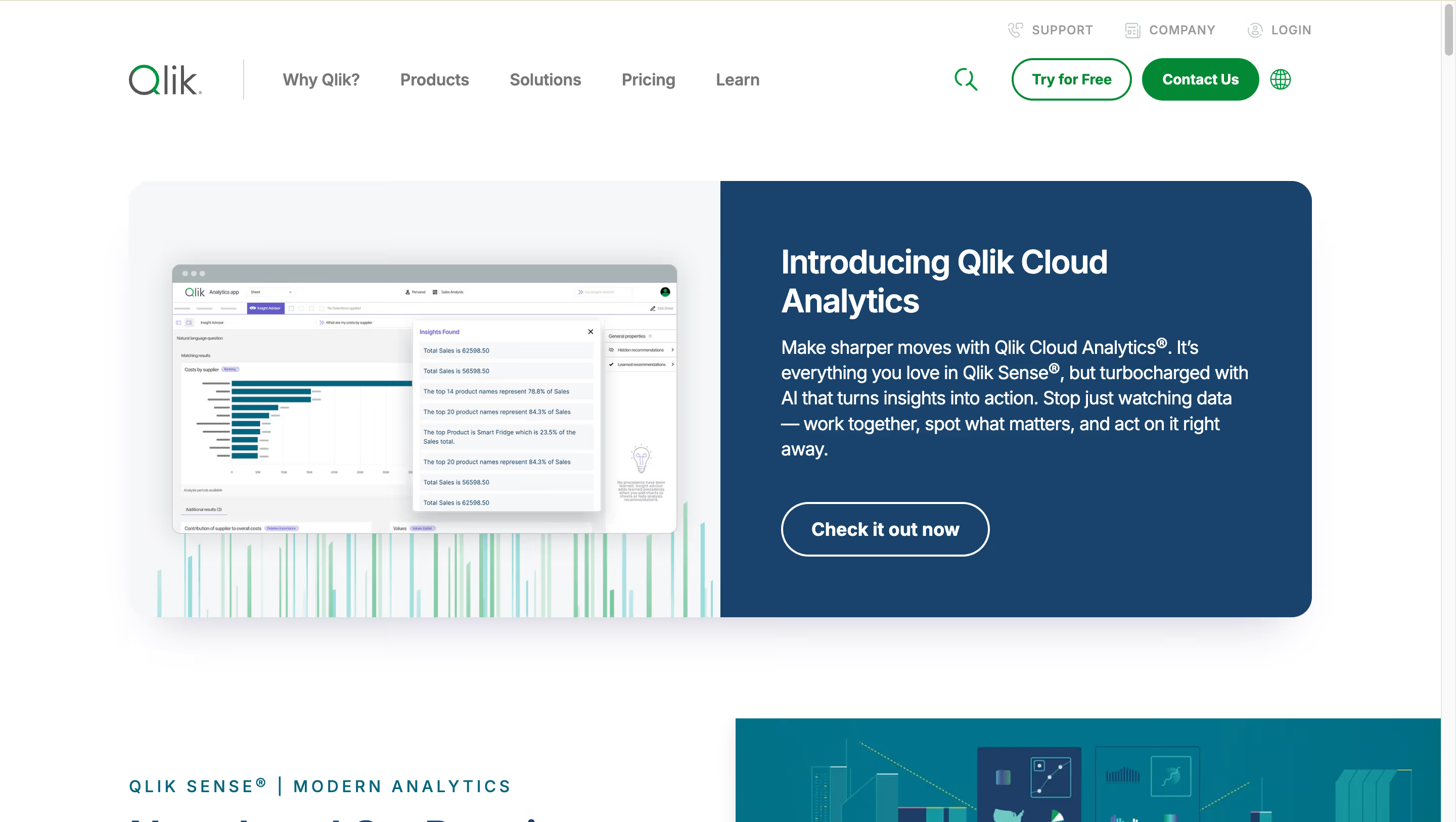
Qlik Sense is Qlik's enterprise BI platform, built around the patented associative engine and now positioned as the agentic analytics layer within Qlik's unified analytics experience. It offers Qlik Answers as a direct agentic AI counter to Spotter, with deeper deployment flexibility (SaaS, on-premises, hybrid) than ThoughtSpot's cloud-first architecture.
Why Qlik Sense?
- Associative engine for free-form data exploration. Where ThoughtSpot's paradigm is "ask a question, get an answer," Qlik Sense's paradigm is "click any data point and explore relationships." The associative engine reveals what's related and what's not across your entire data model, surfacing data insights query-based tools miss because query-based tools only answer what users thought to ask.
- Qlik Answers — production-mature agentic AI. Qlik Answers provides conversational agentic AI over structured and unstructured data, directly comparable to ThoughtSpot's Spotter. The March 2026 Qlik Connect conference positioned the "Agentic Enterprise" with a specialised-agent portfolio orchestrated through Qlik Answers — a parallel strategy to ThoughtSpot's Spotter agents, but with stronger enterprise deployment history.
- Multi-cloud and on-premises deployment flexibility. Qlik Sense deploys on SaaS (Qlik Cloud), on-premises (Client-Managed Qlik Sense), or hybrid. ThoughtSpot is cloud-first with limited on-premises options. For regulated industries (healthcare, finance, government) and organizations with strict data privacy requirements, Qlik's deployment flexibility is a material advantage.
Qlik Sense's Edge Over ThoughtSpot
Qlik Sense's edge over ThoughtSpot is exploration depth and enterprise deployment flexibility. The associative engine is a genuinely differentiated architecture — for complex data across multiple data sources, Qlik surfaces relationships that ThoughtSpot's query-based Spotter model misses because Spotter only answers what users know to ask. For power users doing deep multidimensional analysis, the associative engine delivers real exploration capability that natural-language search doesn't replicate.
The deployment flexibility is the second major edge. ThoughtSpot is cloud-first; Qlik Sense supports SaaS, on-premises, and hybrid at feature parity. For regulated industries and sovereign-data requirements, this is decisive. And Qlik Answers' agentic AI is production-mature — competitive with Spotter, not a distant second.
The risk against Qlik Sense is cost economics and in-memory architectural overhead. Qlik Sense Business at $30/user is comparable to ThoughtSpot Essentials at $25; Enterprise SaaS at $70/user is more expensive than ThoughtSpot Pro at $50. And Qlik's in-memory associative engine requires RAM provisioning and QVD management that ThoughtSpot's live-query architecture avoids. For warehouse-first organizations, ThoughtSpot's architecture aligns more naturally with modern cloud data stacks.
What Users Are Saying
Reviewers praise the associative model and extensive set of functions for handling large datasets. Complaints cluster around performance during update windows and the initial learning curve, with some users noting documentation gaps around data modeling best practices.
"There are several features in Qlik Sense which makes it stand out among BI tools specially while handling large dataset such as its associative model, wide variety of functions to transform data and set analysis to handle the data which is going to be displayed in UI."
Anubhav K. — Technology Analyst
"Sometimes there are loading issues, especially when business intelligence is running updates. It can be an issue, usually on Mondays, from morning into late afternoon, when all my data is pulling in at once. I feel like at times additional resources could be allocated."
Terrance M. — Human Resources Manager
"Initial steep learning curve to get up to speed. More design guidance to ensure best data modelling practices are being adhered to would be very helpful — I found it a bit live and learn based initially until I found some good guidance notes on their online community."
Paul N. — Data Analyst
Pricing
Qlik Sense Business: $30/user/month (billed annually). Qlik Sense Enterprise SaaS: $70/user/month (Professional) or $41.25/user/month (Analyzer). Enterprise (Client-Managed/on-premises): custom quotes. Capacity-based Qlik Cloud licensing starts at approximately $2,500–$5,000/month for teams with large viewer populations. Gotcha: Qlik's in-memory architecture means RAM requirements scale with data volume — large deployments can get resource-intensive.
Qlik Sense Is Best For
Qlik Sense is best for ThoughtSpot buyers in regulated industries needing on-premises or hybrid deployment, enterprises valuing associative exploration depth for complex multi-source data, and organizations where Qlik's broader platform (Talend, Qlik Answers, Qlik Data Integration) fits the overall data strategy.
Watch Out For
Qlik Sense's in-memory architecture requires RAM provisioning and QVD management that ThoughtSpot's live-query model avoids, pricing is generally higher than ThoughtSpot's Essentials tier, and Qlik's recent platform expansion (Talend acquisition, Qlik Answers, Qlik Automate, Qlik Data Integration) creates bundle-pricing pressure similar to ThoughtSpot's Analyst Studio plus Spotter expansion.
7. Looker — Best for Google Cloud teams needing proven semantic governance
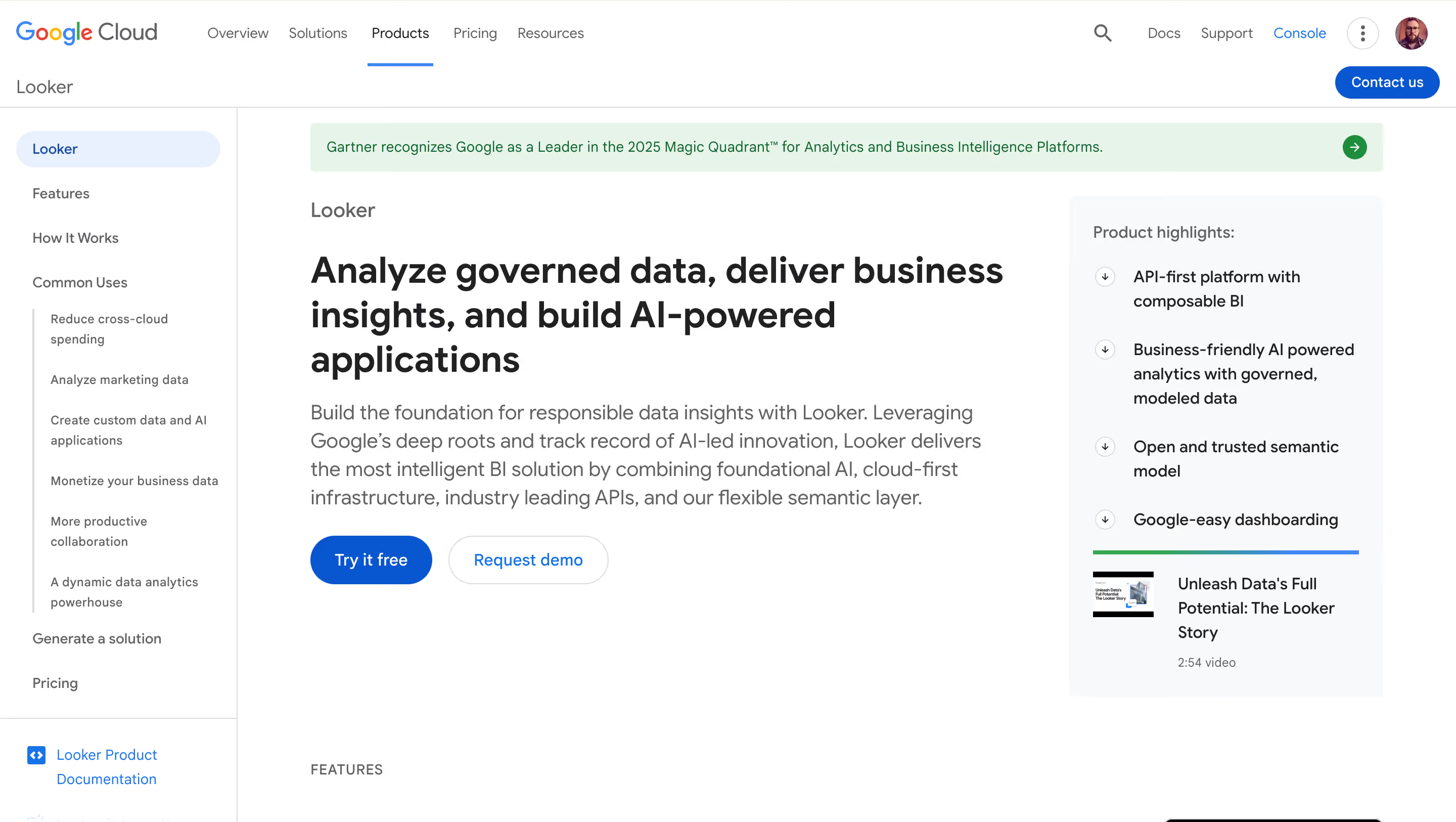
Google Cloud's enterprise BI platform, Looker is built around LookML — the industry's longest-standing governed semantic layer — and delivers Gemini AI for conversational analytics. It provides a proven alternative to ThoughtSpot's newer Spotter Semantics offering, with a twelve-year head start on governed metric definitions.
Why Looker?
- LookML — the proven governed semantic layer. LookML has been defining metrics in version-controlled code since 2012. ThoughtSpot's Spotter Semantics (launched March 2026) is newer and explicitly positioned as an alternative to text-to-SQL using ThoughtSpot's patented search-token architecture — but Looker has a twelve-plus year head start on governed semantic modeling. For data-mature organizations prioritizing metric governance and data consistency, Looker's maturity is a genuine advantage.
- In-database architecture against BigQuery. Looker queries BigQuery (and other supported warehouses) directly — no extracts, no in-memory engine, always current data. For BigQuery-first organizations, the native integration depth exceeds ThoughtSpot's.
- Gemini in Looker for AI-powered BI. Conversational Analytics, LookML Assistant, Formula Assistant, and Visualization Assistant — all grounded in Looker's semantic model. For Google Cloud customers, Gemini in Looker is the natural AI-BI path with GCP ecosystem alignment that ThoughtSpot can't match. This is where natural language querying meets governed metrics in the Google stack.
Looker's Edge Over ThoughtSpot
Looker's edge over ThoughtSpot is the proven governed semantic layer. ThoughtSpot launched Spotter Semantics in March 2026 as "the industry's leading agentic semantic layer" — a bold claim given Looker has been shipping LookML for over a decade. For data-mature organizations where "we have hundreds of metrics across our BI deployment and we need governance" is the core problem, Looker's established LookML ecosystem (thousands of implementations, strong partner network, proven enterprise deployments) is a less risky choice than ThoughtSpot's newer offering.
Google Cloud ecosystem alignment also creates distinct positioning. Same way Microsoft shops default to Power BI, GCP shops default to Looker. For ThoughtSpot customers whose broader infrastructure is on Google Cloud, Looker offers first-party BI with deeper BigQuery integration and native Gemini AI — a structural alignment ThoughtSpot cannot replicate without ecosystem investment.
The risk against Looker is the specialist-developer problem and embedded pricing. LookML requires dedicated analytics engineering expertise — equivalent to ThoughtSpot's search-token modeling work, just in a different language. And Looker's viewer licensing (~$400/user/year) makes embedded analytics economically unfeasible for most customer-facing SaaS scenarios where ThoughtSpot Everywhere is more cost-effective.
What Users Are Saying
Reviewers appreciate the visual flexibility for exploring data inside dashboards and the ability to compare metrics quickly without rebuilding reports. The common friction: LookML concepts like views, explores, and joins require training, and dashboard customization sometimes requires developer support.
"What I like most about Looker is how flexible it feels once you're inside a dashboard. Creating charts, applying filters, and adjusting dimensions happens visually, which makes experimentation easy. I can quickly compare metrics like sales, quantity, and cost without rebuilding reports from scratch."
Priyanka T. — Software Engineer
"While self-service aspect is strong onboarding non-technical users still required training: concepts like 'views', 'explores', 'joins' are slightly abstract and some stakeholders got frustrated with what does this drop-down actually mean, moments."
Avyan S. — Software Developer
"While Looker is powerful, its reliance on LookML can have a steep learning curve for new users, especially those without a technical background. Customizing complex dashboards sometimes requires developer support, which can slow down quick changes."
Karthik K. — Application Engineer
Pricing
Custom enterprise pricing, contact sales. Third-party data indicates starting costs of $35,000–$60,000/year for small deployments, scaling into six figures for enterprise. Viewer, Standard, and Developer user types range roughly $30 to $125/user/month, with viewer licenses cited at around $400/year.
Looker Is Best For
Looker is best for ThoughtSpot customers on Google Cloud with dedicated data engineers who prioritize centralized metric governance via LookML and want a proven semantic layer rather than ThoughtSpot's newer Spotter Semantics offering.
Watch Out For
Looker's LookML learning curve rivals ThoughtSpot's search-token modeling complexity, viewer licensing around $400/year makes embedded analytics economically unfeasible for most customer-facing SaaS scenarios, and Google Cloud dependency deepens with every Gemini-in-Looker release.
8. Omni Analytics — Best for modern data teams wanting warehouse-native + LookML compatibility

Built by former Looker executives in 2022, Omni Analytics is a warehouse-native BI platform offering a hybrid point-and-click plus SQL workflow with LookML-compatible semantic models. It's the focused modern-data-stack alternative for ThoughtSpot buyers who want warehouse-native BI without committing to an expanding agentic platform — or to Google Cloud lock-in.
Why Omni Analytics?
- LookML-compatible semantic models without Google Cloud lock-in. Omni was founded in 2022 by former Looker executives who understand LookML's strengths. Omni's semantic modeling is LookML-compatible — teams can migrate existing LookML data definitions directly into Omni without the GCP ecosystem dependency Looker requires. For organizations with LookML investment but a multi-cloud strategy, Omni is the bridge.
- Hybrid UX — point-and-click for business users, SQL for analysts. Omni's interface lets business users build dashboards visually while analysts drop into SQL for complex logic. This hybrid approach sidesteps ThoughtSpot's "either learn search-token modeling or don't get accurate AI answers" tradeoff — business users can self-serve immediately, while analysts retain control over complex queries.
- Warehouse-native with live-query architecture. Omni queries Snowflake, BigQuery, Databricks, and Redshift directly — no extracts, no in-memory engine. For organizations that have invested in a cloud based BI platform approach and want BI that matches without the ThoughtSpot modeling overhead, Omni's architecture is aligned.
Omni's Edge Over ThoughtSpot
Omni's edge over ThoughtSpot is the focused modern-data-stack product for teams that want warehouse-native BI without platform expansion pressure. Where ThoughtSpot is pushing into data prep (Analyst Studio), semantic layers (Spotter Semantics), agent building, and code generation (SpotterCode), Omni is a focused BI tool with a clear scope: warehouse-native BI with LookML-compatible semantic modeling.
For teams currently using dbt for transformation and wanting BI that aligns with their modern data stack without requiring ThoughtSpot's search-token modeling work, Omni hits a specific sweet spot. The hybrid point-and-click plus SQL UX means business users are productive immediately, while analysts retain depth.
The risk against Omni is market presence and AI maturity. Omni is a newer entrant with less brand recognition than ThoughtSpot, and its AI capabilities are less developed than Spotter's multi-agent portfolio. For organizations whose primary mandate is "AI-first BI," ThoughtSpot's AI story is more mature and production-proven.
What Users Are Saying
“Omni gives us the very sweet spot between providing good Governance for the data team to maintain some order within metrics, but also enough flexibility to allow ad hoc versions for users.”
Carolina A. — Data Analyst
“I think that it's not intuitive how to set up topics. I think topics are the hardest part of topic curation. It is the most challenging thing. I think the other thing I would change is that there could be more attention given to the schedules and deliveries feature, like being able to notify when things change in the dashboard.”
“When large datasets are imported and the dashboard has many charts, it lags a bit. right now, it does not support multiple dashboards in a single file feature like in tableau. it also does not support a lot of the chart types and we need to create them separately using code.”
Rohit S. — Analytical Consultant
Pricing
Custom enterprise pricing, contact sales. Third-party indicators suggest typical annual contracts in the $40,000–$100,000 range, scaling with user count and feature tier.
Omni Analytics Is Best For
Omni Analytics is best for ThoughtSpot customers in modern-data-stack environments (dbt plus cloud warehouse) who want LookML-compatible semantic modeling without the Google Cloud ecosystem dependency Looker requires, and who prefer a focused BI product over ThoughtSpot's expanding platform surface.
Watch Out For
Omni is a newer entrant with less market presence than ThoughtSpot, Omni's AI capabilities are less mature than Spotter's multi-agent portfolio, custom pricing makes budget planning less predictable than ThoughtSpot's published tiers, and Omni's G2 review base is smaller than competitors — making third-party evaluation signals thinner.
9. Metabase — Best for budget-conscious teams and developer-led organizations
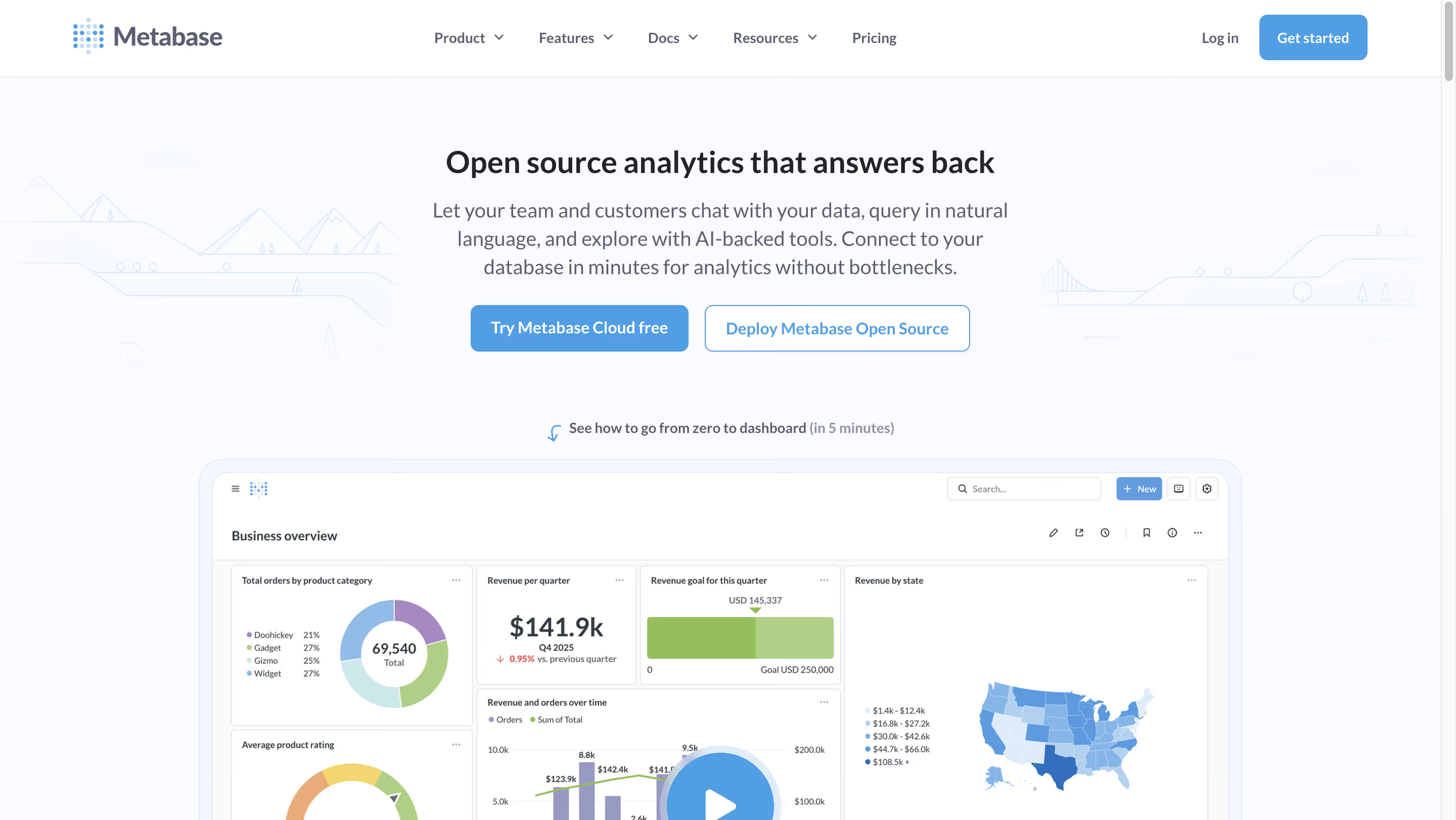
Metabase is the open-source business intelligence platform that prioritizes simplicity and accessibility, offering a free self-hosted edition alongside managed cloud tiers. It's the natural "what if we just migrated to something much simpler and cheaper?" option for ThoughtSpot customers whose AI-first pitch doesn't justify the per-user pricing.
Why Metabase?
- Free open-source edition. Self-host Metabase for free under AGPL v3 with full core BI functionality — no artificial limits on dashboards, charts, or connections. For teams where ThoughtSpot Essentials at $25/user is hard to justify for simple internal BI, Metabase's $0 licensing is a structural change in cost economics.
- Intuitive interface for non-technical users. Metabase's Question feature lets non-SQL users explore data and build dashboards through a point-and-click interface. For ThoughtSpot customers whose Spotter AI hasn't delivered accessibility to business users (often because the modeling work wasn't done), Metabase's no-code question builder offers similar accessibility without the upfront investment.
- 60+ database connectors. Metabase connects to PostgreSQL, MySQL, BigQuery, Snowflake, Redshift, and most production data sources. For teams where ThoughtSpot's connector breadth exceeds actual needs and the AI premium isn't justified, Metabase covers common cases at dramatically lower cost.
Metabase's Edge Over ThoughtSpot
Metabase and ThoughtSpot sit at opposite ends of the BI sophistication-and-cost spectrum, and that's the angle. ThoughtSpot's pricing assumes the buyer values agentic AI enough to pay a premium. Metabase inverts that: the $0 self-hosted tier is the simplest possible counter for organizations where "we don't actually need agentic analytics — we just need simple dashboards and SQL queries" is the underlying reality.
For departmental ThoughtSpot deployments where per-user licensing is hard to justify (ten-person teams with basic analytical needs), Metabase's economics are decisive. Free self-hosted edition or $100/month Cloud Starter replaces ThoughtSpot seats that would cost thousands annually for functional coverage at the simple-BI level.
The risk against Metabase is capability ceiling and AI maturity. Metabase is deliberately simple — no agentic AI, no search-token architecture, no multi-step analysis. Metabot AI (Metabase's $100/month AI add-on) is useful but nowhere near Spotter's advanced analytics features. For ThoughtSpot power users who genuinely need multi-step agentic analysis, Metabase will feel like losing 80% of the capability, even if most users never used the advanced features.
What Users Are Saying
Metabase reviewers consistently highlight the no-code Question feature as a standout for making data analysis accessible to non-technical users. Scale limitations and the absence of deep AI assistance are the recurring complaints — exactly as you'd expect from a tool that prioritizes simplicity over platform depth.
"I love the Question feature of Metabase, which allows for the creation of no-code SQL queries that can be easily and intuitively answered even by non-technical users."
Tobias S. — Sr. BI Manager
"Working with bigger teams might be difficult due to the absence of fine-grained access constraints. If you don't optimize at the database level, performance may suffer while searching massive datasets."
Sampath K. — Security IAM Engineer II
"I find that Metabase could benefit from having an AI assistant that understands the databases and assists in building queries. This feature would significantly ease the process of creating data consultations without any SQL knowledge."
matias d. — CRM & Lifecycle Manager
Pricing
Open Source: Free (self-hosted under AGPL v3). Cloud Starter: $100/month plus $6/user (5 users included). Cloud Pro: $575/month plus $12/user (10 users included; adds SSO, row-level security, interactive embedded dashboards). Enterprise: custom, approximately $20,000+/year. Metabot AI add-on: $100/month for 500 requests. Gotcha: the jump from Starter ($100) to Pro ($575) is steep — if you need SSO or row-level security, there's no intermediate tier.
Metabase Is Best For
Metabase is best for small teams, departmental ThoughtSpot deployments, and developer-led organizations that want simple BI without enterprise complexity or ThoughtSpot's AI-first licensing premium — particularly engineering teams comfortable with self-hosting where basic dashboard and SQL capabilities are all that's actually needed.
Watch Out For
Metabase hits real walls for sophisticated analytical patterns ThoughtSpot power users rely on (no agentic AI, no search-token architecture, Metabot AI is basic), the free version requires engineering maintenance time, and the jump from Starter ($100/month) to Pro ($575/month) is steep for organizations needing SSO or row-level security.
Key Takeaways: Which ThoughtSpot Alternative Fits?
Every ThoughtSpot alternative on this list wins a specific buyer scenario. Here's the map.
Frequently Asked Questions
What is the best ThoughtSpot alternative in 2026?
The best ThoughtSpot alternative depends on your priority. For warehouse-native BI with AI grounded in a governed semantic layer, Astrato leads. For dramatic cost savings in Microsoft ecosystems, Power BI. For visualization depth, Tableau. For spreadsheet-native UX without upfront data modeling, Sigma Computing. For code-first collaborative notebooks, Hex. For associative exploration and deployment flexibility, Qlik Sense. For Google Cloud semantic governance, Looker. For LookML-compatible warehouse-native BI, Omni Analytics. For open-source budget-conscious teams, Metabase. There's no universal winner — the right choice depends on your data architecture, AI requirements, and whether you need ThoughtSpot's specific search-first UX or prefer alternative approaches.
Is ThoughtSpot worth the price in 2026?
ThoughtSpot is worth the price for organizations where AI-first natural language search is a specific mandate and where the team has the analytics engineering resources to invest in the upfront data modeling required for Spotter to work accurately. For organizations without dedicated modeling capacity, for teams where visualization quality is the primary success metric, or for cost-conscious buyers comparing against alternatives like Power BI at $14/user, ThoughtSpot's $25–$50/user pricing becomes harder to justify — particularly with the Spotter Pro query cap of 25 queries/user/month creating overage risk.
What is ThoughtSpot's Spotter and how does it compare to competitors?
Spotter is ThoughtSpot's agentic AI platform — a suite of specialized agents including Spotter 3 (natural language search), SpotterViz (dashboard generation), SpotterModel (semantic modeling), SpotterCode (embedded analytics code), and Spotter Semantics (agentic semantic layer, launched March 2026). Spotter's direct competitors in 2026 are Power BI Copilot, Tableau Next with Agentforce, Qlik Answers, Gemini in Looker, and Sigma AI. All are credible production-mature agentic AI offerings — the choice comes down to UX philosophy (search-first vs. dashboard-first vs. notebook-first), ecosystem alignment, and how much upfront modeling your team can invest.
What's the best ThoughtSpot alternative for embedded analytics?
For customer-facing embedded analytics, Astrato is the strongest alternative — usage-based pricing that doesn't penalize scale, full white-labeling, multi-tenant row-level security, and pixel-perfect visualizations purpose-built for embedded use cases. Sigma Computing is the second-strongest option for spreadsheet-native embedded scenarios. ThoughtSpot Everywhere is capable but reviewer concerns about visualization quality and consumption-based pricing at scale make Astrato and Sigma more compelling for many embedded analytics decisions.
Is ThoughtSpot hard to use?
ThoughtSpot's natural language search UX is genuinely simpler for end users than traditional dashboards — the core pitch "just type a question" holds up. However, making Spotter work accurately requires significant upfront data modeling (search tokens, relationships, aggregations) that falls on data teams. G2 reviews consistently mention access-workflow complexity and modeling overhead as friction points. For teams without dedicated analytics engineering resources, the "ease of use" promise often breaks down in implementation.
What happened with ThoughtSpot's Mode Analytics acquisition?
ThoughtSpot acquired Mode Analytics for $200 million in July 2023 to add code-first SQL notebook capabilities for data teams. As of early 2026, industry analysts note that integration challenges remain as ThoughtSpot works to unify user experiences between search-first ThoughtSpot and code-first Mode. The acquisition hasn't delivered a unified product experience — which creates an opening for dedicated notebook tools like Hex and Deepnote to serve the data team segment Mode was meant to address.
Why are companies leaving ThoughtSpot in 2026?
The most common reasons teams evaluate ThoughtSpot alternatives are: visualization quality that consistently falls short of Tableau and traditional BI alternatives; upfront modeling overhead required to make Spotter work accurately; cost pressure as ThoughtSpot's platform expands into Analyst Studio, Spotter agents, and SpotCache; Spotter Pro's 25-queries/user/month cap creating unpredictable overage costs; incomplete Mode integration leaving notebook workflows awkward; and platform surface-area confusion as ThoughtSpot competes simultaneously against dbt (upstream), Tableau (visualization), and Sigma (warehouse-native BI).
How does ThoughtSpot compare to Power BI?
ThoughtSpot is AI-first and natural-language-search-centric, with premium pricing ($25–$50/user) justified by agentic capabilities. Power BI is Microsoft-ecosystem-first and dramatically cheaper ($14/user, often bundled in M365 E5), with Copilot AI capabilities requiring Fabric F64+ capacity for full functionality. The choice typically comes down to: Are you in a Microsoft ecosystem where Power BI is effectively bundled? Then Power BI's cost structure is hard to beat. Is AI-first natural language search your specific mandate? Then ThoughtSpot's focused Spotter story is more mature. For most enterprise buyers, the comparison is really "Power BI value plus adequate AI vs. ThoughtSpot AI leadership plus premium pricing."
Ready to See What Focused, Warehouse-Native BI Looks Like?
Picking a ThoughtSpot alternative isn't about finding the cheapest option or the longest feature list. It's about fit with how your team actually works and where your data architecture is heading. Every tool on this list wins a specific buyer. The question is which buyer is you.
If your team is running Snowflake, BigQuery, or Databricks, needs AI that works against a governed semantic layer without a six-month modeling project, and values a focused BI product over a platform expansion target, Astrato is built for that situation. Pixel-perfect visualizations for customer-facing embedded analytics. Native writeback for operational workflows. Usage-based pricing that scales with compute, not per-seat compounding.
Book a demo with the Astrato team and see how warehouse-native BI works with your actual data.
Ready to experience next-gen analytics?
See how Astrato runs natively in your warehouse.