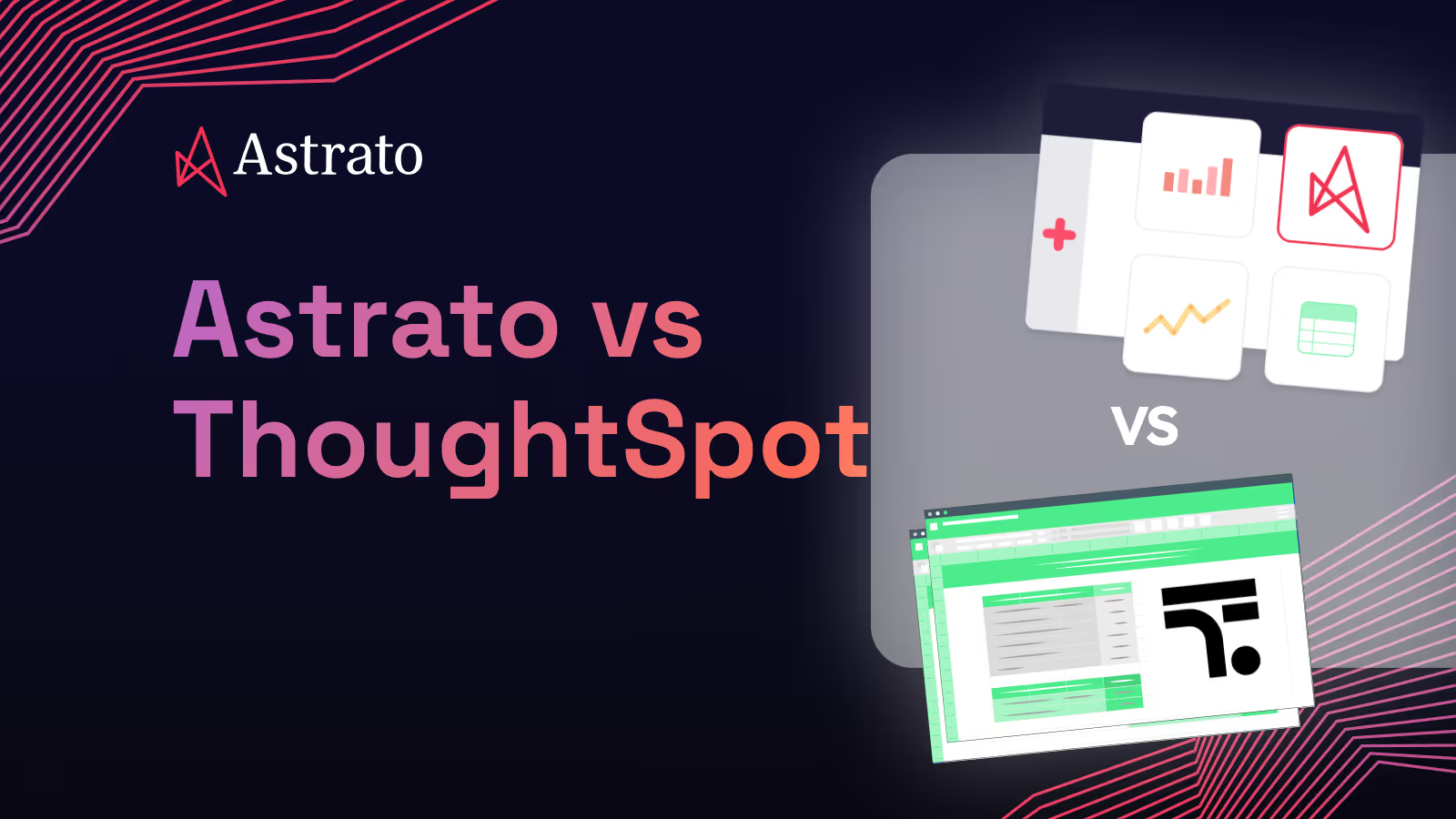
Astrato vs ThoughtSpot: Warehouse-Native BI vs Search-First Analytics
Comparing Astrato vs ThoughtSpot? See how architecture, writeback, embedded analytics, and pricing differ — and which platform fits your team in 2026.

ThoughtSpot is a Gartner Magic Quadrant Leader. It has raised $674 million, counts NVIDIA and Capital One among its customers, and built what is genuinely one of the most impressive natural language search engines in the BI market. It is, by any reasonable measure, a serious product.
It is also, for a growing number of data teams, the most expensive way to let business users type questions into a search bar.
This is the tension at the heart of the astrato vs thoughtspot comparison. Both platforms query data live from your warehouse. Both have semantic layers. Both offer AI-powered analytics and some form of embedded dashboards. But they were built for different buyers, and the gap between them is widest exactly where it hurts most: pricing at scale, embedding without engineering overhead, and the ability to write data back to the warehouse from inside a dashboard. This article covers all of it.
TL;DR
Astrato is the right fit if:
- Your data lives in Snowflake, BigQuery, or Databricks and you want a BI layer built natively on that foundation — not layered on top of it
- You are building customer-facing analytics and need white-label dashboards your customers experience as part of your product, not a third-party tool
- Your team needs writeback — updating forecasts, approving budgets, logging decisions — directly from inside dashboards
- You want self-service BI your business users will actually use, not a search bar that requires a well-modeled semantic layer to return trustworthy answers
- Your budget is mid-market and you cannot justify a $140K average annual contract for internal analytics, plus a separate contract for embedding
ThoughtSpot may still be the right call if:
- You are a Fortune 500 organization with a mature data team, a dedicated BI budget, and no embedded analytics requirement
- Natural language search is your primary use case and you want the most sophisticated, deterministic NLQ engine in the market
- You have already standardized on ThoughtSpot's TML modeling language and rebuilding your semantic layer is not an option
Quick comparison: Astrato vs ThoughtSpot
|
Capability |
ThoughtSpot |
Astrato |
|
Architecture |
Live query via warehouse — no extracts, pushdown SQL |
✓ Live-query, warehouse-native — pushdown SQL, no data movement |
|
Data freshness |
Live queries; SpotCache adds optional caching layer |
✓ Always current — live on every interaction, no caching required |
|
Warehouse support |
Snowflake, BigQuery, Databricks, Redshift natively |
✓ Native — Snowflake, BigQuery, Databricks, Redshift, ClickHouse, PostgreSQL |
|
Embedded analytics |
SDK + iFrame; retrofitted from internal BI; complex setup |
✓ Built for embedded first — pixel-perfect white-label via single iframe |
|
Writeback |
Not available — roadmap item only |
✓ Native writeback — syncs directly to warehouse in real time |
|
AI / GenAI |
Spotter AI Agent; 25 query/user/month cap on Pro |
✓ AI-native, grounded in semantic layer — Snowflake Cortex, Gemini, OpenAI |
|
Governance / RBAC |
SAML/OIDC, SOC 2, HIPAA — row-level security defined per app |
✓ SAML/OIDC, SOC 2, HIPAA, row-level security — inherited from warehouse, defined once, enforced everywhere |
|
Pricing model |
Consumption-based; average contract ~$140K; dual-product cost for embedded |
✓ Flexible — per-user, usage-based, or hybrid; no dual-product penalty |
|
Vendor lock-in |
Proprietary TML language; cloud-agnostic on warehouses |
✓ No proprietary language — no ecosystem lock-in |
|
Scheduled reporting |
Basic export; no branded multi-format delivery system |
✓ Automated branded reports — Excel, PDF, PPT delivered to email, Slack, Teams, S3, Google Drive or SharePoint |
What is Astrato?
Astrato is a warehouse-native BI platform built for teams that have already committed to a cloud data warehouse as their single source of truth. It connects directly to Snowflake, BigQuery, Databricks, Redshift, ClickHouse, and PostgreSQL — and runs every query live. There is no extract layer, no data copy sitting in a proprietary engine, no scheduled refresh to manage.
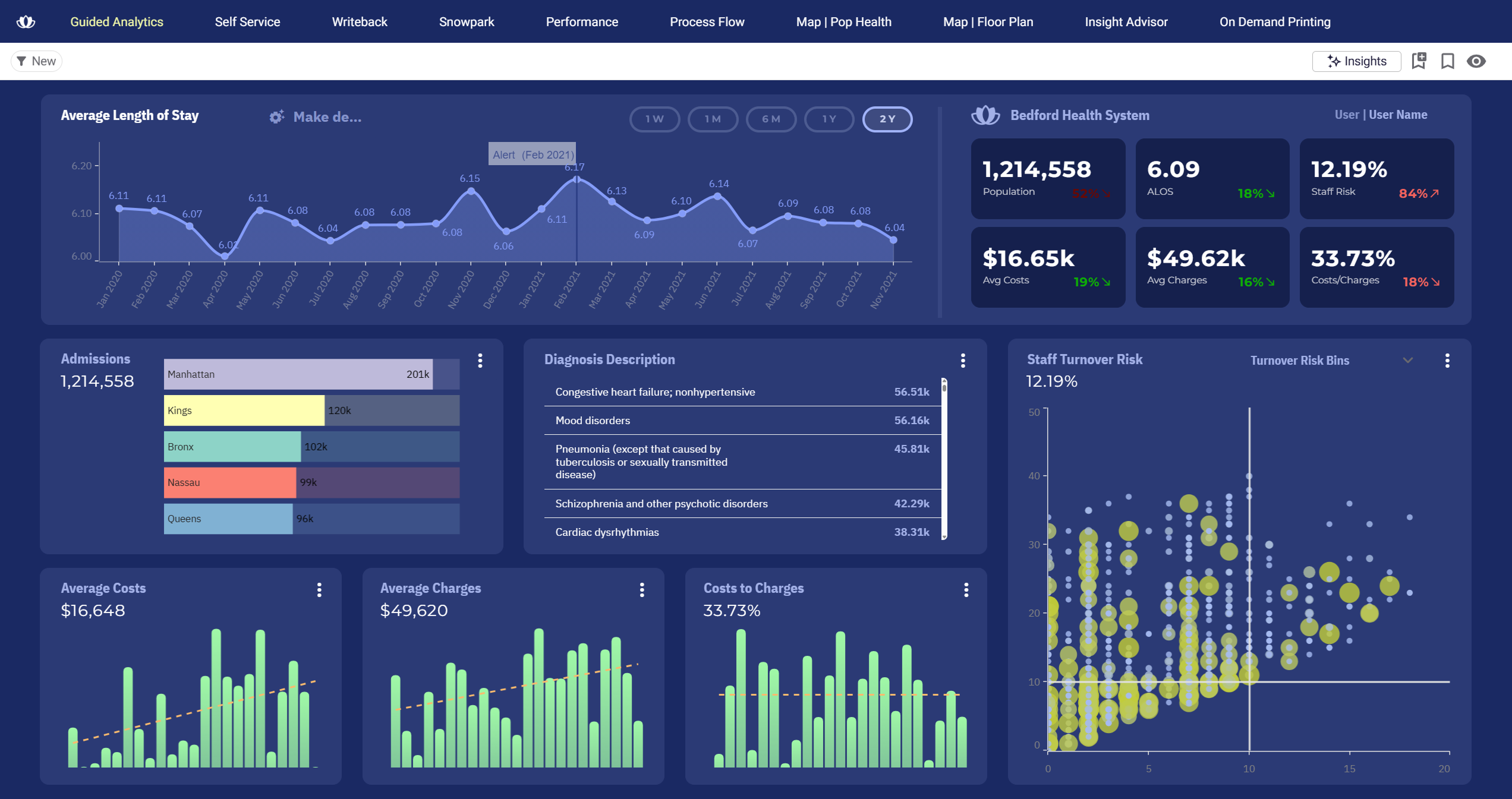
The platform is built around three use cases:
- Guided self-service BI for internal teams who want to explore data without waiting on analysts
- Customer-facing analytics for product teams embedding dashboards into their applications
- Data apps with native writeback for teams that need analytics to drive operational decisions, not just observe them.
Governance stays in the warehouse. Row-level security, RBAC, and metric definitions are inherited from your data cloud and enforced automatically across every dashboard, embedded view, and AI query. When permissions change upstream, Astrato reflects them immediately.
What is ThoughtSpot?
ThoughtSpot is an AI-powered analytics platform founded in 2012, backed by $674 million in funding, and positioned as an "Agentic Analytics Platform" for enterprise data teams. Its core capability is Spotter — a natural language search engine that lets users ask questions in plain English and receive answers as interactive visualizations, without writing SQL. It is a genuinely impressive piece of technology, and Gartner's recognition as a 2025 Magic Quadrant Leader is earned.
ThoughtSpot connects natively to Snowflake, BigQuery, Databricks, and Redshift via live query — there is no import cycle and no extract pipeline. The platform also offers an embedded analytics product, ThoughtSpot Embedded, built on SDK and iFrame integration, and a data preparation environment called Analyst Studio for SQL and Python workflows.
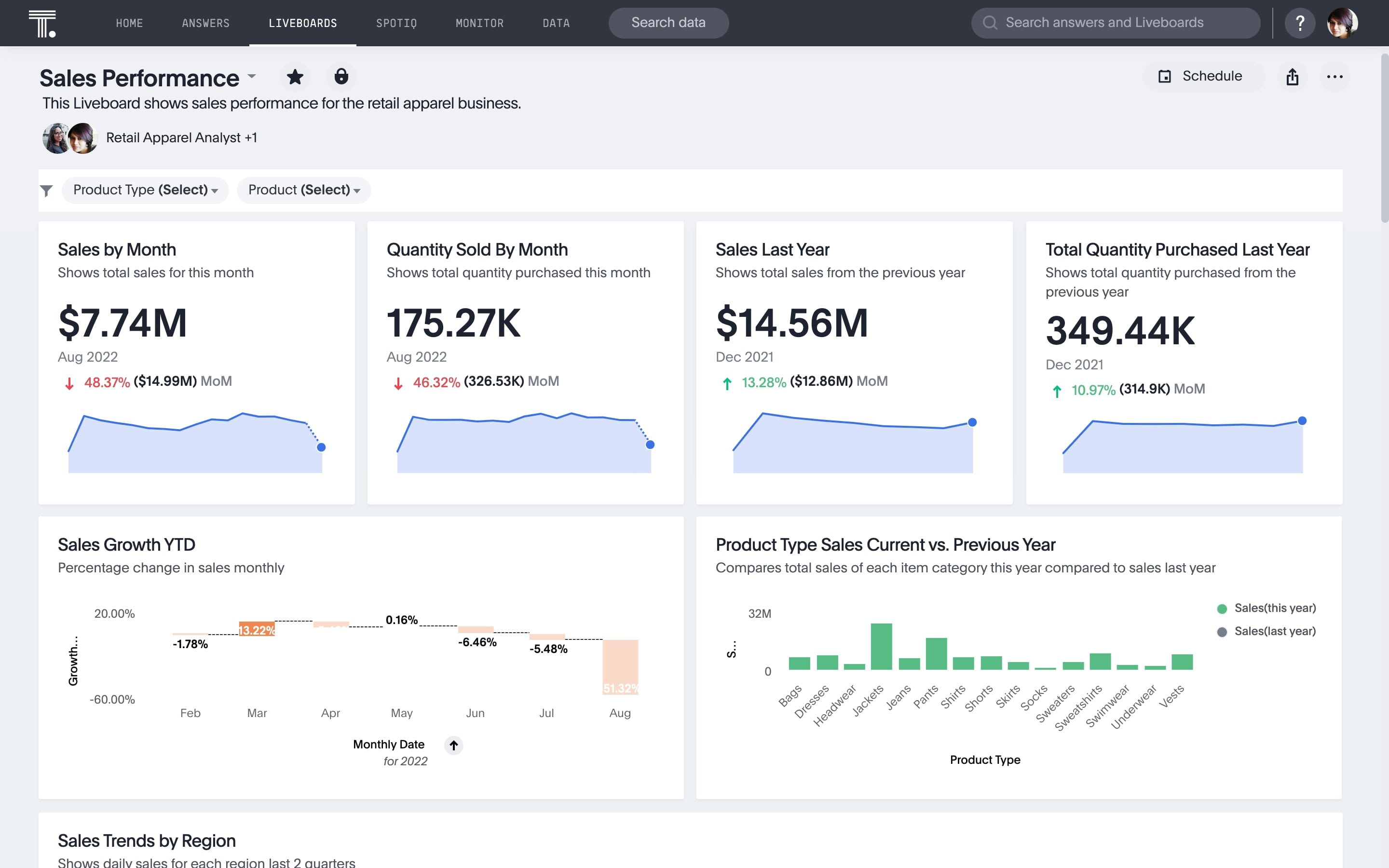
Where ThoughtSpot is strongest: enterprise teams that need deterministic, governed NLQ at scale, with deep Snowflake or Databricks integration and the budget to support an average annual contract of around $140,000. Where it runs into friction is with teams that need writeback, pixel-perfect embedded design, or mid-market pricing — none of which ThoughtSpot was originally built for.
Same architecture, different philosophy: where the real divergence starts
On the surface, both platforms look similar. Live queries, warehouse-native connections, semantic layers, AI analytics. Evaluating them on a feature checklist, you could reasonably call it a tie across most rows.
The divergence is in philosophy. ThoughtSpot was built as an enterprise AI search product first — a tool for making data analysis accessible to business users through conversational interfaces. Embedding, writeback, and data apps were added later, as the market demanded them. Astrato was designed from day one around three specific jobs: self-service BI, embedded analytics, and operational data apps. The order of priorities shows in every product decision.
ThoughtSpot's Spotter AI uses a patented search-token architecture that generates deterministic SQL — more reliable than standard text-to-SQL implementations. That is a real technical differentiator.
But Astrato's semantic layer grounds every AI query, every NLQ result, and every dashboard in the same governed metric definitions your data team has certified. Business users in both platforms get answers. In Astrato, those answers are always consistent with your business logic — because the AI works from the same semantic layer as every other query on the platform.
"Astrato acts as the shop window for everything happening in Snowflake, while all computation and governance remain in code within our data warehouse. That means anyone can access insights without relying on complex BI tools."
Chanade Hemming
Head of Data Products — IAG Loyalty
Previously used Tableau
Embedded analytics: built for it vs. bolted on
This is the sharpest difference between the two platforms, and the one that matters most for product teams and SaaS companies.
ThoughtSpot Embedded is a capable product. It supports SDK integration with React, Angular, and plain JavaScript, allows white-label customization of colors, logos, and fonts, and handles row-level security for multi-tenant deployments at the Enterprise tier. Teams have shipped real customer-facing analytics products using it.
"The ease of implementation and integration to our Snowflake platform allowed us to go from design to a fully operational SaaS platform within 60 days."
David Beto
Co-Founder & CEO — Impensa
Previously used Power BI
The problem is cost and complexity. ThoughtSpot separates its Analytics product from its Embedded product — they are different SKUs with different contracts. If you need both internal BI and customer-facing dashboards, you pay for both. Embedded contracts typically start at $200,000 annually and scale with consumption: every query your end-users fire counts toward billing, reaching $5–6 per dashboard load per active user at scale. For a SaaS company with thousands of customers, that math gets uncomfortable fast.
Astrato's embedded analytics was not designed as an afterthought. It is one of the three primary use cases the platform was built around. Full white-label, pixel-perfect dashboards embed via a single iframe. Multi-tenancy is built in — per-customer data isolation does not require an enterprise tier upgrade or custom configuration. And there is no dual-product pricing penalty: your internal BI and embedded analytics run from the same plan, the same semantic layer, the same live connection to your cloud data warehouse.

Writeback: the capability ThoughtSpot put on a roadmap
In March 2026, ThoughtSpot announced Spotter Semantics — an agentic semantic layer update that included a public roadmap commitment to writeback for actionable analytics. The announcement confirmed what many evaluators had already discovered: as of today, ThoughtSpot has no native writeback capability. Data in ThoughtSpot flows one way — from warehouse to dashboard.
That matters because analytics without writeback is read-only by definition. Your team sees the data, forms a decision, then leaves the dashboard to act on it elsewhere — in a spreadsheet, a form, a separate application. The decision and the data stay disconnected.
Astrato's native writeback closes that loop. Users update forecasts, approve budgets, log operational decisions, and trigger workflow actions directly from inside the dashboard. Changes sync to the cloud data warehouse in real time. The analytics experience and the operational record are the same thing — not two separate tools that someone has to reconcile later.
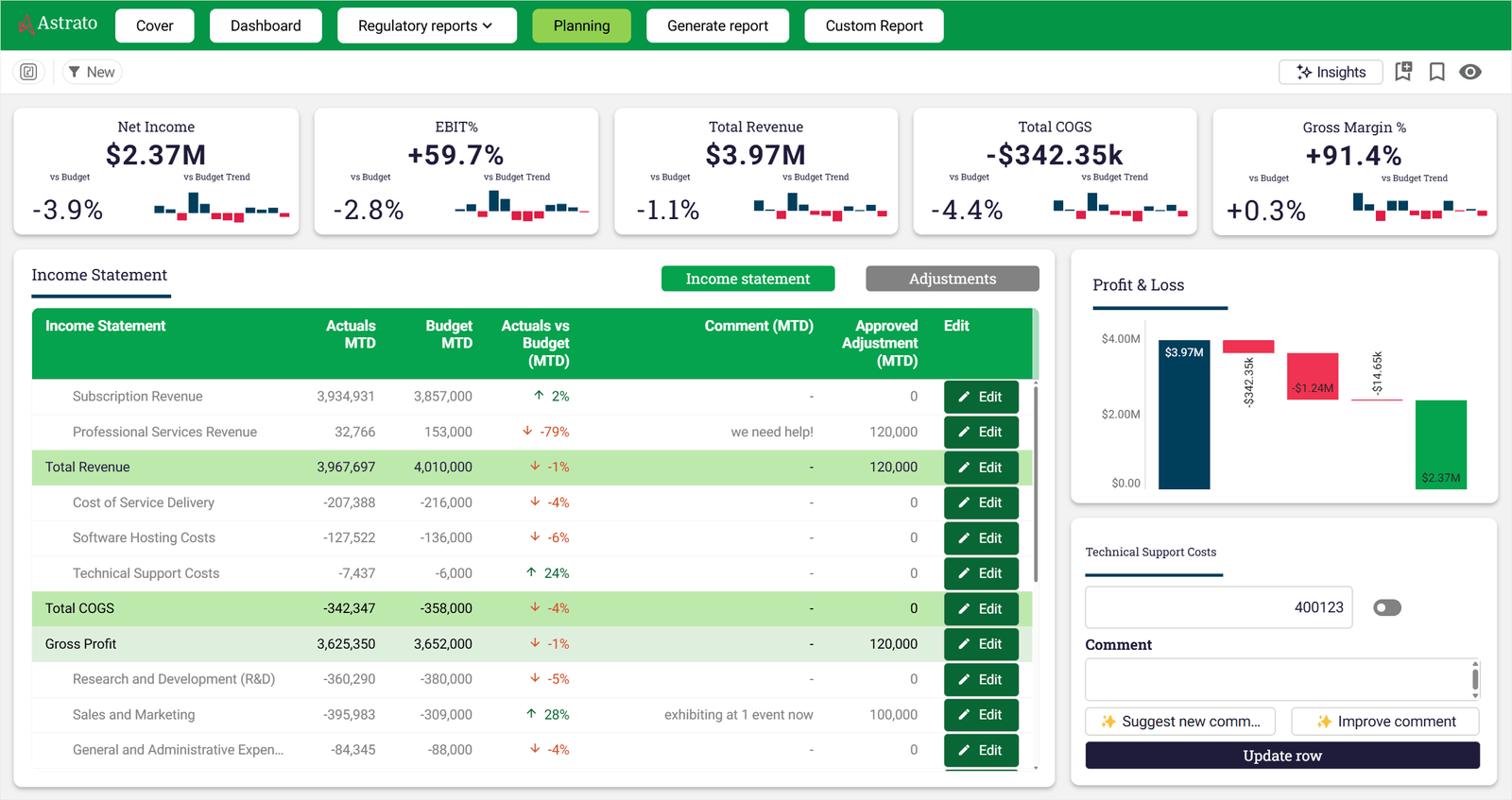
For finance teams running budget cycles, sales teams updating pipeline values, or ops teams assigning and resolving incidents, this is not a minor feature gap. It is a fundamentally different relationship between analytics and action.
Self-service that business users actually use
ThoughtSpot's natural language search is its most genuinely impressive capability. Type a question in plain English, get a visualization back in seconds, without writing SQL. For technical users and data analysts who want fast ad-hoc exploration, it is an excellent experience.
The reality for most deployments is more complicated. Non-technical business users tend to view the Liveboards that analysts build rather than explore data independently. The search interface that feels intuitive for a data professional requires a well-modeled semantic layer to return trustworthy answers — and building that layer takes time, expertise, and ongoing maintenance. When the model isn't right, the answers aren't right, and trust in the tool breaks down quickly.
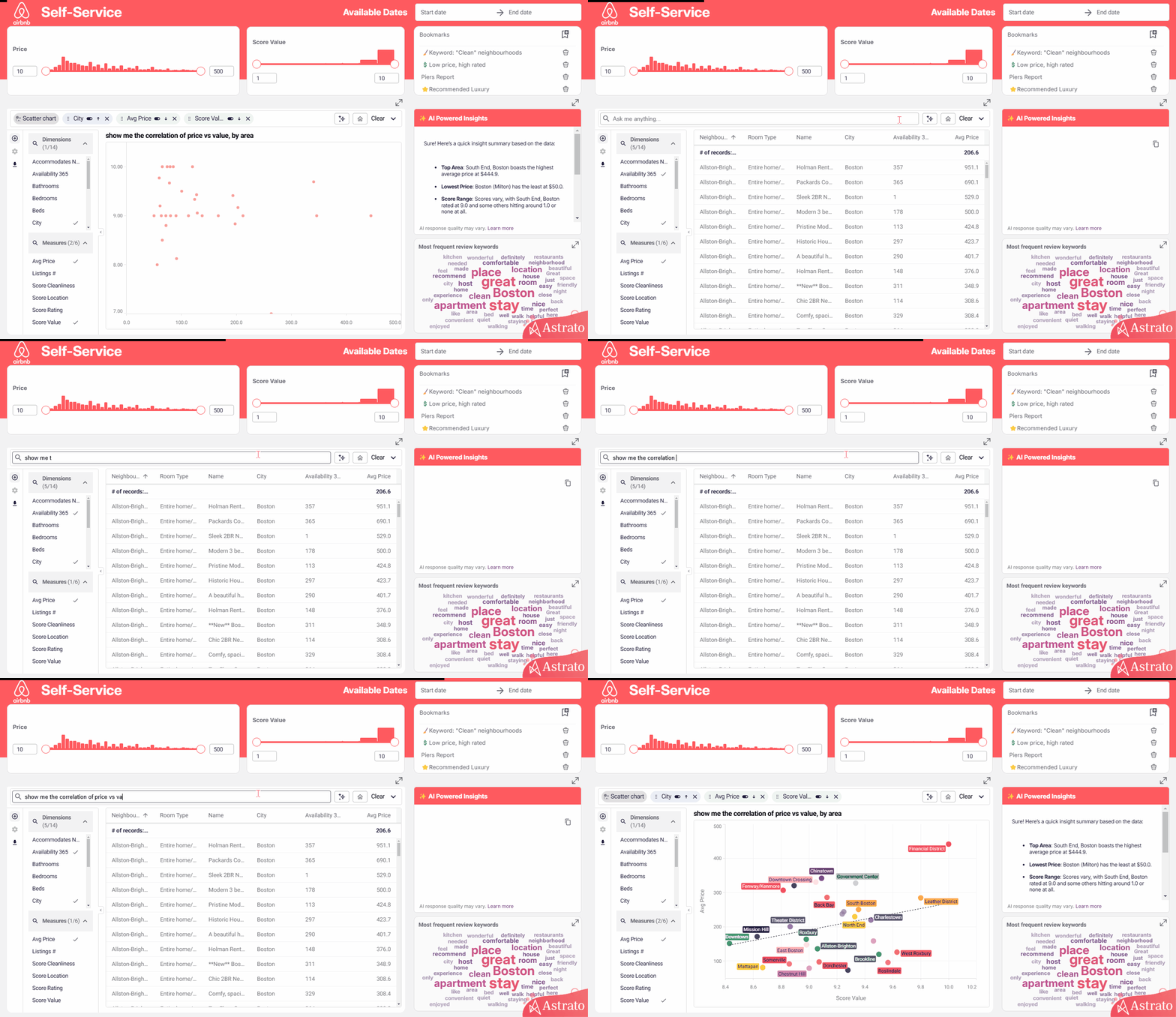
Astrato's approach to guided self-service starts from the same semantic layer but wraps it in a no-code drag-and-drop interface that business users in Finance, Marketing, and Operations can navigate without training. The AI-powered insights available through Astrato's GenAI capabilities are grounded in the same certified metric definitions as every dashboard on the platform. When a non-technical user asks a question in plain English, the answer they get is consistent with what the data team has certified — not an approximation based on raw column names.
Gartner Peer Insights
★★★★☆
"It's still a steep learning curve for most business users to actually explore ThoughtSpot, despite the complexity being hidden behind a 'simple' interface. What most users tend to do is simply view liveboards that analysts have built."
Verified reviewer
Gartner Peer Insights · ThoughtSpot Analytics
AI-powered analytics: grounded vs. capped
ThoughtSpot's Spotter AI is the platform's headline capability, and it earns the attention. The patented search-token architecture is deterministic — it generates SQL from natural language inputs using structured tokens rather than freeform text-to-SQL, which makes it more reliable than most NLQ implementations. For enterprise teams that need consistent, explainable AI-powered insights, that reliability has real value.
The practical limitation is the pricing model. On the Pro plan, Spotter AI is capped at 25 queries per user per month. Every query beyond that costs extra. For teams building analytics into daily workflows — where data analysis is something users do continuously, not occasionally — a per-query cap reframes the tool from an analytical platform into a metered service.
Astrato's AI-powered analytics are grounded in the semantic layer and uncapped. Users generate chart summaries, ask questions in natural language, and build measures using AI assistance without watching a query counter. The platform integrates with Snowflake Cortex, Google Gemini for BigQuery, and OpenAI — or bring your own LLM. Every AI response draws on the same certified metric definitions as the rest of the platform, ensuring that AI-generated answers reflect actual business logic rather than raw database structure.
Pricing: what you actually pay
ThoughtSpot's pricing has two structural quirks that surface late in every evaluation. First, the published tiers are significantly cheaper than what most teams actually pay. The Essentials plan starts at $25 per user per month, but Vendr data puts the average annual ThoughtSpot contract at approximately $140,000 — and that only covers internal analytics.
G2
★★★☆☆
"High and Opaque Pricing Policy: ThoughtSpot's custom-quoted pricing model can be a shock to BI budgets, particularly for those looking to embed or scale the platform, with costs exceeding $500K annually for large-scale deployments."
Enterprise reviewer
G2 · ThoughtSpot
Second, internal BI and embedded analytics are separate products with separate contracts. A team that wants Astrato vs ThoughtSpot for both use cases — dashboards for their analysts and embedded views for their customers — is negotiating two deals. Embedded contracts typically start at $200,000 annually, with consumption-based pricing that can reach $5–6 per dashboard load at scale. Background system queries, which ThoughtSpot runs automatically to maintain performance, count toward that consumption bill even when no user has triggered them.
Astrato's pricing covers both use cases under one plan. Per-user, usage-based, and hybrid pricing options are available without a mandatory license floor. There is no dual-product penalty, no consumption billing on background queries, and no surprise at contract renewal.
When to move from ThoughtSpot to Astrato
- If your ThoughtSpot contract renewal is approaching and the pricing conversation has become harder to justify to leadership, that is a signal worth acting on before you are locked into another year.
- If your team is building a customer-facing analytics product and the dual-contract model for internal BI plus ThoughtSpot Embedded is inflating your unit economics, Astrato covers both use cases under one plan.
- If business users are not exploring data independently and are still routing requests to analysts to build Liveboards, the self-service promise is not being delivered — and a different interface may close that gap.
- If you have requirements for users to update records, approve decisions, or log data directly inside dashboards, ThoughtSpot cannot meet that requirement today. Astrato ships native writeback now.
- If your data team is maintaining ThoughtSpot's TML semantic model in parallel with definitions in your warehouse, and the two are drifting, that is a governance problem that gets worse over time. Astrato inherits governance directly from the warehouse — one definition, zero reconciliation.
- If your Snowflake, BigQuery, or Databricks investment is the center of your data strategy and you want a BI layer that treats the warehouse as the single source of truth rather than a data source to query around, Astrato was built for exactly that architecture.
G2
★★★★★
"Astrato has given us speed and flexibility. Time-To-Market was really important to us. The no-code environment means we can meet constantly changing customer requirements without long development cycles. Whitelabeling and embedding are seamless, so our clients experience analytics as part of our platform. And the visuals are stunning — interactive dashboards that actually elevate our product experience."
Chris H., COO
Small Business · Oct 2025
FAQ
Is Astrato a ThoughtSpot alternative?
Yes. Astrato is a direct alternative to ThoughtSpot for teams running on Snowflake, BigQuery, or Databricks who need live analytics, embedded dashboards, and writeback — without the dual-product pricing structure or consumption-based billing model. The platforms share a warehouse-native architecture but were built for different primary use cases.
What is the main difference between Astrato and ThoughtSpot?
The most important difference is use-case priority. ThoughtSpot was built as an enterprise NLQ and AI search platform; embedded analytics, writeback, and operational data apps were added later. Astrato was designed from day one around all three: self-service BI, customer-facing embedded analytics, and native writeback. The second important difference is pricing — ThoughtSpot's average annual contract is approximately $140,000 for internal analytics alone, with embedded analytics requiring a separate contract starting at $200,000.
Why is ThoughtSpot so expensive?
ThoughtSpot's published pricing starts at $25 per user per month, but real-world contracts average around $140,000 annually according to Vendr transaction data. Several factors drive costs above the listed tiers: consumption-based billing that charges for background system queries users never trigger, Spotter AI capped at 25 queries per user per month on Pro with overage charges, Analyst Studio and cloud data source integrations billed as add-ons, and the requirement to purchase ThoughtSpot Embedded as a separate product for any customer-facing analytics.
Does ThoughtSpot support writeback?
Not as of April 2026. ThoughtSpot announced writeback as a future roadmap item in March 2026 as part of the Spotter Semantics announcement. It has not shipped. Astrato offers native writeback today — users can update records, submit decisions, and persist changes to the warehouse directly from inside any dashboard.
Does Astrato work with Snowflake and Databricks?
Yes. Astrato connects natively to Snowflake, Databricks, BigQuery, Redshift, ClickHouse, and PostgreSQL. Every query runs live against the warehouse — no data replication, no extract layer. Row-level security and governance defined in your warehouse are inherited automatically in Astrato.
Can Astrato replace ThoughtSpot for embedded analytics?
Yes, and for most mid-market and SaaS teams, it does so at a fraction of the cost. Astrato's embedded analytics are built into the platform — not a separate product. White-label dashboards embed via a single iframe, multi-tenancy is available without an enterprise tier upgrade, and there is no per-query consumption billing on embedded views. Teams have moved from ThoughtSpot Embedded to Astrato specifically to resolve the cost and complexity of ThoughtSpot's dual-product model.
Is ThoughtSpot good for small teams?
For small teams with limited budgets, ThoughtSpot is difficult to justify. The minimum effective entry point — Essentials at $1,250 per month for up to 20 users — provides no embedded analytics, no multi-tenancy, and community-only support. The next tier introduces consumption-based pricing where every query and background system operation counts toward billing. For small teams building real products, those constraints surface quickly.
What is ThoughtSpot Embedded and how does it work?
ThoughtSpot Embedded is a separate product that allows developers to integrate ThoughtSpot's search and Liveboard functionality into external applications via SDK or iFrame. It supports white-label customization and row-level security for multi-tenant deployments. Pricing is custom-quoted, consumption-based, and separate from ThoughtSpot's Analytics product — teams that need both pay for both. Enterprise contracts for embedded analytics typically start at $200,000 annually.
How does Astrato's pricing compare to ThoughtSpot?
Astrato offers per-user, usage-based, and hybrid pricing without a mandatory license floor. There is no separate embedded analytics product — internal BI and customer-facing dashboards run under the same plan. ThoughtSpot customers report 50–75% cost savings after moving to Astrato. The most common driver is the elimination of the dual-contract model: one Astrato plan replaces a ThoughtSpot Analytics contract plus a ThoughtSpot Embedded contract.
Which BI tool is better for SaaS companies — ThoughtSpot or Astrato?
For SaaS companies building customer-facing analytics products, Astrato is the stronger fit. It was designed for embedded use cases from day one, offers usage-based pricing that scales with your customer base rather than per-query consumption billing, and supports multi-tenancy without an enterprise tier requirement. ThoughtSpot Embedded can deliver similar results but requires more engineering investment, a separate contract, and careful management of consumption costs as your user base grows.
Final verdict: Astrato vs ThoughtSpot
ThoughtSpot is a serious product with a legitimate claim to enterprise BI leadership. Its Spotter AI search engine is genuinely differentiated — the search-token architecture produces more reliable NLQ results than most competitors, and the Gartner Magic Quadrant position reflects real capability at real scale. For a Fortune 500 organization with a mature data team, a dedicated BI budget, and no embedded use case or writeback requirement, ThoughtSpot is a defensible choice.
The structural problem is that ThoughtSpot was built for that buyer, and the market has moved. The fastest-growing segment of BI buyers today is mid-market data teams and SaaS companies who need analytics embedded in their products, writeback that closes the loop between insight and action, and pricing that scales predictably with their business. ThoughtSpot's product roadmap, pricing model, and dual-product architecture were not designed for this buyer — and retrofitting them onto it creates exactly the friction that drives teams to look for alternatives.
Astrato's clearest wins in this comparison are not close: native writeback today versus a roadmap promise; embedded analytics built into the core product versus a separate $200,000+ contract; governance inherited directly from the cloud data warehouse versus a parallel TML model that drifts. For teams that need all three, the gap is not a feature comparison — it is a different product category.
If your data lives in Snowflake, BigQuery, or Databricks and you are building analytics that your users need to act on — not just observe — Astrato is the stronger architectural choice. Book a demo and see how Astrato runs analytics directly on your warehouse.
Ready to experience next-gen analytics?
See how Astrato runs natively in your warehouse.