How Impensa Built a Healthcare Supply Chain Data Platform in 60 Days


When healthcare runs on spreadsheets, progress runs slow. One small team decided to fix that – and did it in two months.
In healthcare, data is supposed to save lives. But inside most hospitals, it mostly just sits in Excel. Purchase orders, invoices, and contracts live in silos, locked away in different systems. Nothing talks to anything else.
“Anybody that’s worked in this space knows it’s a mess,” says Dave Beto, co-founder and CEO of Impensa. “Bad data, incomplete data, siloed data. There’s no standardization, no transparency, no visibility.”
Beto and his partner Rob Corley have spent decades inside the healthcare supply chain. They’d seen how much time and money were lost to missing information. So they decided to start over. Their idea: build a master data platform that could clean, connect, and benchmark supply chain data at scale – and make it instantly usable by hospitals and consultants alike.
The result is CostCloud, a platform they spun up in just 60 days using Snowflake for data architecture and Astrato for analytics.
From spreadsheet to Semantic Layer
In most hospitals, supply chain data lives in chaos. One team tracks purchase orders in one system, contracts live in another, and spend analysis happens in an Excel sheet that is stale and inaccurate the moment it’s saved.
“The data is really about as good as the last Excel sheet you did,” Corley says. “People do amazing work, come up with insights, but it doesn’t live on. It dies in the spreadsheet.”
Impensa’s mission was to give that data permanence – to make it live, governed, and reusable.
Three Pillars of CostCloud
To do that, Impensa built a foundation of three components:
- A massive reference database: over 10 million medical supply and pharmacy items, standardized and categorized using the company’s proprietary iFlex schema.
- A data-matching engine: capable of linking messy hospital data (purchase orders, invoices, patient records, even FDA data) back to the master reference with a match rate in the high 90s.
- A benchmarking layer: giving hospitals and consultants instant visibility into cost variance, contract performance, and clinical outcomes.
“Given Astrato is 100 percent cloud-native live-query, tightly integrated with Snowflake’s speed and scalability, we can now process a customer’s data and build actionable analytics in hours instead of weeks,” Beto says. “We’re really an enabler. We enable supply chain product data for any use case – and there are many.”
Build vs. Buy – or maybe Build Smarter
For a bootstrapped company, the build vs buy debate was existential.
“When we started, we had data sitting in SQL databases and used Power BI and spreadsheets to share it,” Beto recalls. “We realized quickly that we needed a scalable SaaS application, not another reporting tool.”
That’s when a former client – now working with Astrato – called.
“He said, ‘I think you’re really going to like this,’” Beto laughs. “We jumped in, pulled some data in, and within days we could see how Astrato worked with Snowflake. It just clicked.”
The combination hit the sweet spot: live data, no code, and subscription pricing they could afford.
“For me, Astrato was perfect,” Beto says. “There’s no coding, it’s drag-and-drop, and it’s rich in functionality. We were trying to build an app that could spoon-feed the end user – and this let us do it ourselves.”
The Backbone: Snowflake + Astrato
Snowflake became the data engine behind CostCloud.
“Once we understood what Snowflake was compared to the tools we’d used in the cloud,” Corley says, “we realized it replaced the need for an application development team.”
They built a semantic layer directly in Snowflake, then connected it to Astrato for live analytics and embedded dashboards.
“It just opened our eyes,” he adds. “We could take the small set of resources we had – people who knew SQL – and start transferring everything we’d built in Azure right into Snowflake.”
The entire platform came together in roughly two months.
“One and a half people,” Beto says. “That’s all it took.”
Demo: When data starts talking
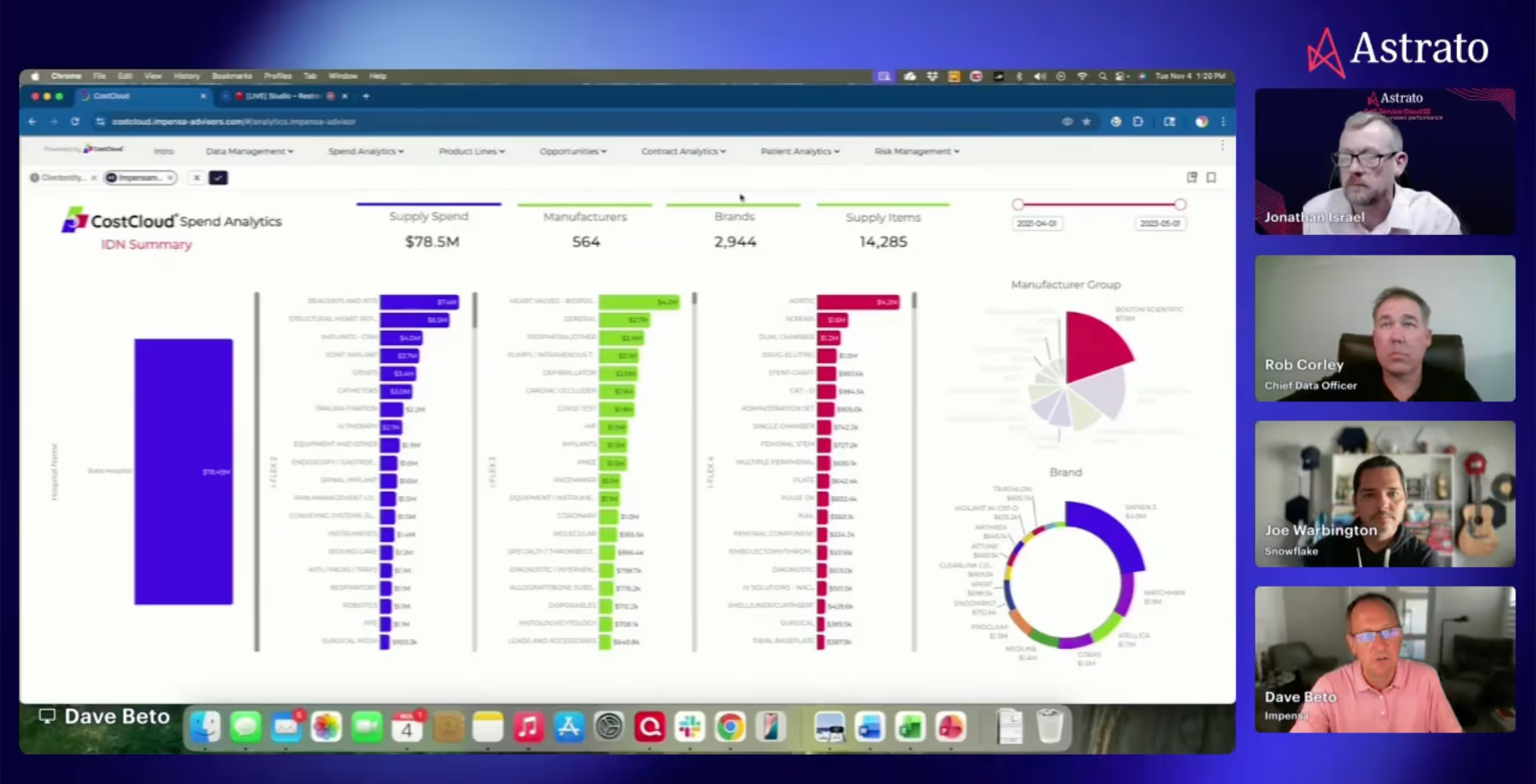
In the webinar demo, Beto clicks through a 10-hospital dataset with millions of rows. There’s no lag.
“This is completely impossible without categorizing and standardizing the data,” he says, filtering joint implant spend by manufacturer, brand, and surgeon.
The platform shows contract compliance, off-contract purchases, and savings opportunities across categories. Red cells flag risk. Green ones reveal best-price benchmarks.
“Being able to tie supply chain data into contracts, into patient data – that’s kind of the holy grail,” Beto explains. “It lets you compare cost per case by physician, see the bill of goods for each procedure, and understand where margin lives or leaks.”
Even with datasets approaching a billion rows, the dashboards remain responsive.
“Our technical guy came from Azure,” Beto says. “His comment was basically, ‘Holy smokes – this blows it away.’”
Corley agrees. “We can create databases for different customers, each with row-level security and their own sign-ons. It’s secure, it’s fast, and it scales easily.”
The bigger picture
Across the industry, a quiet shift is underway. Data teams are skipping heavy-lift development and going straight to composable, no-code analytics.
“There are people who’ve been doing this work for decades who wish they had this tool instead of countless tabs of Excel,” says Joe Warbington, Healthcare Industry Principal at Snowflake. “You might not be Mayo Clinic, but you can still negotiate smarter, keep your beds open, and stay profitable.”
For smaller health systems, that difference can mean survival.
“We’re partnering with a lot of folks trying to solve that,” Corley adds. “The pressure right now is enormous – labor costs, lost grants, shifting payer mixes. Getting this data together gives them a fighting chance.”
What’s next
Impensa is now exploring how to plug AI into CostCloud.
“AI is fine, but if you don’t have good data, forget it,” Beto says. “The great thing is – now we have good data.”
As for Astrato and Snowflake, both companies see Impensa’s build as proof of what’s possible when data stays live, governed, and open for innovation.
“It’s inspiring,” says Jonathan Israel, EVP of Sales at Astrato. “A small team, a clear goal, and the right stack – that’s all it takes to go from zero to platform in 60 days.”
🎥 Watch: How Impensa Built a Healthcare Supply Chain Data Platform in 60 Days
💡 Try Astrato → Start a free trial
❄️ Explore Snowflake → Start a free trial
🏥 Learn more about Impensa → https://www.impensa-advisors.com/
Ready to experience next-gen analytics?
See how Astrato runs natively in your warehouse.