Astrato vs. Amazon QuickSight: A Deep Dive into Modern BI and Data Apps
In the ever-evolving world of business intelligence, two tools—Astrato and Amazon QuickSight—offer distinct approaches to analytics. If you’re deciding between them, understanding their strengths and limitations is key, especially when considering self-service analytics, live writeback, and data science integration.


Astrato vs. Amazon QuickSight: A Deep Dive into Modern BI and Data Apps
In the ever-evolving world of business intelligence, two tools—Astrato and Amazon QuickSight—offer distinct approaches to analytics. Both aim to empower users, but their architectures, capabilities, and user focus reveal significant differences. If you’re deciding between them, understanding their strengths and limitations is key, especially when considering self-service analytics, live writeback, and data science integration.
Cloud Architecture and Compatibility
Amazon QuickSight: As part of the AWS ecosystem, QuickSight is tightly integrated with services like S3, Redshift, and Athena. While it supports other data sources, its full potential is realized within an AWS-centric infrastructure. Its reliance on SPICE (an in-memory engine) requires data extracts for optimal performance, which can introduce complexity when working across multi-cloud environments or large datasets.
Astrato: In contrast, Astrato is cloud-agnostic and optimized for leading cloud data warehouses like Snowflake and BigQuery. Its live-query architecture eliminates the need for data extracts, enabling businesses to work directly on live data across their ecosystem. This approach minimizes data duplication and ensures real-time insights, even in dynamic environments.
Real-Time Performance and Data Architecture
One of the core differences lies in how these platforms handle data:
- QuickSight relies on SPICE for fast performance but at the cost of real-time interactivity. Data must be ingested into SPICE for optimal use, limiting immediate access to live datasets.
- Astrato uses pushdown SQL, processing queries directly in the cloud warehouse. This ensures up-to-the-second data without compromising scale or performance.
For enterprises needing instant insights or operating across fast-changing datasets (e.g., financial markets or retail), Astrato’s architecture provides a significant advantage. For large datasets, Astrato leverages the power of your cloud data warehouse, to visualize data across billions of rows.

User Experience and Visualizations
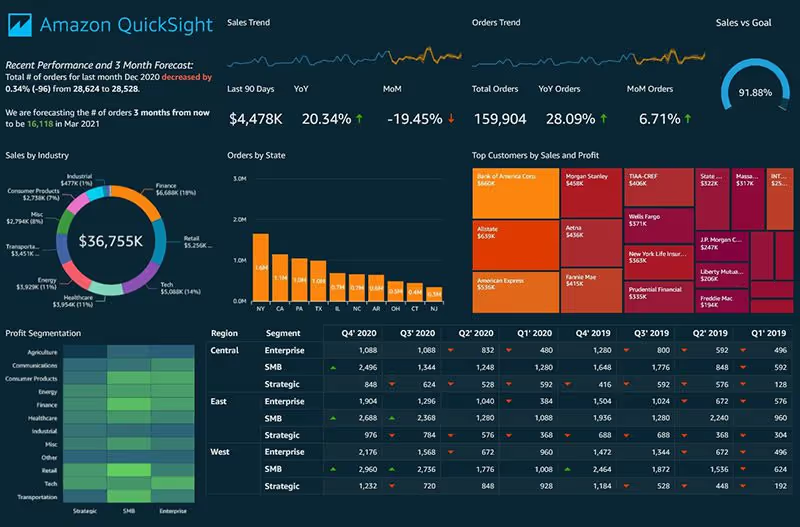
QuickSight: While QuickSight delivers basic dashboards with some customization, its visual experience is less flexible compared to leading BI tools. It works well for simple use cases but struggles with the advanced formatting or interactivity required by complex workflows. Even with some AI support, Quicksight still requires its propietary language to build measures.

Astrato: Astrato delivers highly customizable dashboards that support HTML and CSS for advanced formatting, making it a strong contender for presentation-grade analytics. Users can create rich, interactive dashboards that combine powerful visuals with seamless workflows—perfect for enterprises needing polished, actionable insights.

Writeback Capabilities
Writeback—the ability to update data directly within your analytics platform—has become a game-changer in modern BI.
- QuickSight: Limited writeback functionality. It focuses on visualization rather than interactive collaboration, leaving users reliant on external tools for updates or annotations.
- Astrato: Writeback is native to Astrato, enabling users to:
- Add or adjust data directly in dashboards.
- Save changes back to the cloud warehouse (e.g., Snowflake, BigQuery).
- Collaborate in real-time, transforming static dashboards into dynamic tools for planning, forecasting, and operational decision-making.
For example, a sales manager could update forecasts directly in an Astrato dashboard, immediately syncing changes across teams.

Data Science Integration
QuickSight: While QuickSight offers machine learning (ML) capabilities like anomaly detection and forecasting, these features rely heavily on Amazon SageMaker and lack the flexibility for deep interactivity. Adjusting ML models or running custom workflows often requires developer involvement.
Astrato: Astrato integrates seamlessly with ML workflows and empowers users to:
- Call predictive models directly within dashboards.
- Adjust parameters dynamically and see the immediate impact.
- Enable real-time collaboration between data scientists and business users.
This makes Astrato an excellent choice for teams that need business-friendly ML integration without technical bottlenecks.

Self-Service and Collaboration
QuickSight: Collaboration is limited to basic email sharing and embedding. It lacks features like comments, bookmarks, or role-based access that enable deeper teamwork.

Astrato: Built for collaboration, Astrato supports:
- Shared bookmarks and role-based sharing to align teams.
- Comments and live collaboration for annotating insights and tracking changes.
- Self-service customization that empowers business users to explore and interact with data independently, reducing dependency on IT.
Astrato’s focus on real-time teamwork makes it particularly effective in agile, fast-paced organizations.

Cost and Scalability
QuickSight: Its pay-per-session pricing can be economical for small teams or occasional users, but costs rise sharply with frequent usage or a large user base.
Astrato: Offers a transparent, predictable pricing model, scaling well for enterprises with heavy BI use. This makes budgeting straightforward, even for large teams, while providing the flexibility to grow without hidden costs.
The Astrato Advantage: Data Apps and Beyond
What truly sets Astrato apart is its ability to go beyond traditional dashboards with interactive data apps. Unlike QuickSight, Astrato enables users to:
- Build workflows, decision trees, and input forms directly within dashboards.
- Automate actions and create no-code/low-code solutions for unique business problems.
- Combine analytics and action seamlessly, empowering users to not just view data but drive decisions.
For example, an operations team can use Astrato to analyze inventory levels, adjust reorder points, and initiate procurement orders—all within the same app.
Who Should Choose Astrato?
For organizations seeking simple dashboards within AWS, QuickSight may suffice. However, businesses looking to futureproof by scaling analytics, enable self-service, and leverage real-time collaboration and writeback will find Astrato’s features unmatched.
Astrato empowers users to:
- Break down barriers between data exploration and action.
- Collaborate in real-time with live writeback and advanced workflows.
- Innovate faster by integrating ML models and interactive data apps.
If you’re ready to take your analytics beyond basic dashboards and unlock the full potential of cloud-native BI, Astrato is the answer. 🚀
Build faster, collaborate smarter, and act confidently with Astrato.
Ready to experience next-gen analytics?
See how Astrato runs natively in your warehouse.