Astrato vs Qlik Sense Enterprise: Infrastructure Limiting Your BI
Astrato vs Qlik Sense Enterprise: compare capabilitirs and see why warehouse-native BI is replacing the reload model for cloud data teams.

For years, Qlik Sense Enterprise on-premise was the right answer for data teams that needed serious analytics. The associative engine was genuinely innovative. Section Access handled complex row-level security requirements. QlikView customers had somewhere to migrate to. And for regulated industries where data residency was non-negotiable, the on-premise deployment model wasn't a concession — it was the requirement.
The problem isn't that Qlik Sense Enterprise got worse. The problem is that everything around it changed. Cloud data warehouses became the primary source of truth for the organizations that Qlik had spent decades winning. And a BI architecture built around extracting data, loading it into a proprietary engine, and refreshing on a schedule now has to justify itself in a world where the warehouse already does the hard computational work — and does it live, on every query.
This article is for the analytics leader approaching a contract renewal with a real question: renew on-premise, migrate to Qlik Cloud, or evaluate whether the architectural assumptions that made Qlik Sense the right choice five years ago still hold today.
TL;DR
Astrato is the right fit if:
- Your data already lives in Snowflake, BigQuery, Databricks, Redshift, ClickHouse, or PostgreSQL and you want BI that queries it live — no reload infrastructure to build or maintain
- Your team manages a reload pipeline at scale and the operational overhead has become a larger problem than the analytics itself
- You need native writeback without purchasing a third-party extension
- You're building customer-facing or embedded analytics and need white-label, multi-tenant deployment without complex custom configuration
- Your warehouse security model is the source of truth and you don't want to maintain a parallel Section Access setup
- You want AI-native analytics — natural language querying grounded in a semantic layer — today, not on the cloud migration roadmap
Qlik Sense Enterprise may still be the right call if:
- You operate in a regulated environment with strict data residency requirements that prevent any cloud involvement
- Your data primarily lives in on-premise databases — Oracle, SAP, SQL Server — and a cloud warehouse isn't in the near-term architecture
- You have complex multi-fact-table analysis requirements where the associative green/white/gray selection model is a genuine workflow differentiator for your business users
- You have a mature NPrinting setup distributing pixel-perfect reports to thousands of recipients and that distribution model is core to how your organization consumes analytics
- Your teams have deep QlikScript expertise and the migration cost of rebuilding load script logic outweighs the operational savings from eliminating the reload pipeline
Quick comparison: Astrato vs Qlik Sense Enterprise
|
Capability |
Qlik Sense Enterprise |
Astrato |
|
Architecture |
In-memory associative engine; data extracted via reload schedule |
✓ Live-query, warehouse-native — pushdown SQL, no data movement |
|
Data freshness |
Snapshot — current as of last successful reload |
✓ Always current — live on every interaction, no reload required |
|
Warehouse support |
Connectors to Snowflake/BigQuery/Databricks — extract-based, not live |
✓ Native live connection — Snowflake, BigQuery, Databricks, Redshift, ClickHouse, PostgreSQL |
|
Embedded analytics |
Via Qlik Analytics Platform SDK — complex setup, high additional license cost |
✓ Built for embedded first — pixel-perfect white-label via single iframe |
|
Writeback |
Not native — requires third-party extension license |
✓ Native writeback — syncs directly to warehouse in real time |
|
AI / GenAI |
Insight Advisor NLQ available; advanced AI features in Qlik Cloud only |
✓ AI-native, grounded in semantic layer — Snowflake Cortex, Gemini, OpenAI |
|
Governance / RBAC |
Section Access — mature but separate from warehouse, requires dual maintenance |
✓ Warehouse-inherited — defined once in warehouse, enforced everywhere |
|
Pricing model |
Non-public; TCO $100K–$280K+/year including infrastructure, staffing, add-ons |
✓ Transparent — per-user, usage-based, or hybrid; no infrastructure cost |
|
Vendor lock-in |
QlikScript, QVD format, Section Access, .qvf apps — all Qlik-proprietary |
✓ No proprietary language — standard SQL, open architecture |
|
Scheduled reporting |
NPrinting (separate license) — mature, pixel-perfect, enterprise-grade |
✓ Automated branded reports — Excel, PDF, PPT delivered to email or Slack |
What is Astrato?
Astrato Analytics is a warehouse-native BI platform that connects directly to Snowflake, BigQuery, Databricks, Amazon Redshift, ClickHouse, and PostgreSQL. Every query runs live against the data warehouse — no extract layers, no refresh schedules, no data copies sitting in a proprietary engine. Business users get current data on every interaction, not a snapshot from whenever the last reload completed.
The platform is built around three use cases: guided self-service BI for internal teams, customer-facing embedded analytics for SaaS companies and data product builders, and data apps with native writeback for teams that need to push decisions back into the warehouse. A shared semantic layer ensures that metrics and business logic are defined once and applied consistently across every dashboard and data app — no per-app metric drift.

Astrato was built by the team behind Vizlib, the extension ecosystem used by over 1,200 Qlik customers to fill the gaps that Qlik Sense's native platform left open. That context matters: Astrato wasn't designed in the abstract. It was built by people who knew exactly where the reload model breaks down, where Section Access becomes a maintenance burden, and where the extension ecosystem stops being a solution and starts being a cost center.
What is Qlik Sense Enterprise?
Qlik Sense Enterprise is one of the most mature analytics platforms on the market. Founded in 1993 and taken private by Thoma Bravo in 2016, Qlik has accumulated over 40,000 customers across the full portfolio — QlikView, Qlik Sense on-premise, and Qlik Cloud. The platform's core differentiator has always been the associative engine: a proprietary in-memory model that lets users click any value in any chart and instantly see which data is associated, which isn't, and what relationships exist across the entire dataset. For exploratory analysis of complex multi-source data, this genuinely surfaces insights that SQL-based tools miss.
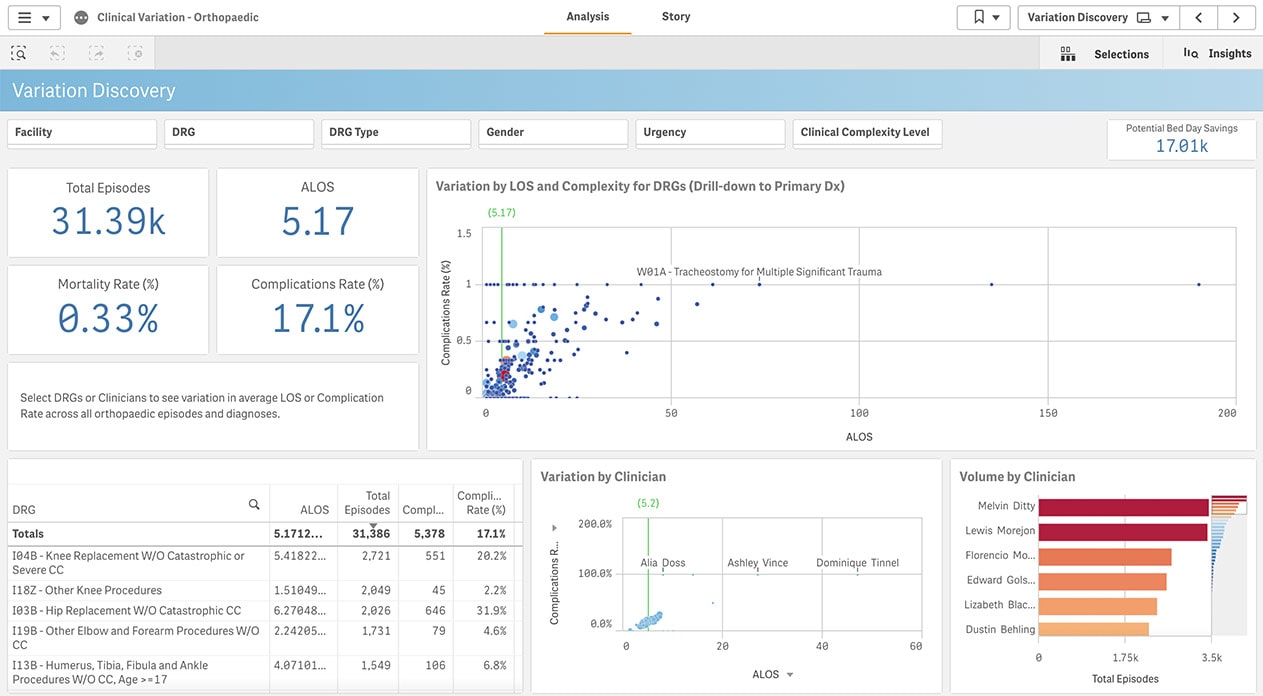
The on-premise deployment model attracted financial services organizations, healthcare systems, government agencies, and defense contractors — regulated industries where data residency requirements made cloud deployment non-negotiable. For those environments, Qlik Sense Enterprise offered serious governance capabilities. Section Access provided row- and column-level data security. The Qlik Management Console gave IT teams centralized control over apps, users, and data connections. NPrinting distributed pixel-perfect reports — PDF, Excel, PowerPoint, Word — to non-Qlik users at enterprise scale.
The on-premise product is stable and capable. Where it shows its age is in the assumptions baked into the architecture: that your data needs to be extracted, transformed, and loaded into a proprietary engine before users can analyze it. In 2015 that was a reasonable trade-off. In a world where Snowflake and Databricks already do the computational work on cloud data, it's a meaningful operational cost.
The reload pipeline: what warehouse-native analytics actually means
The Qlik Sense Enterprise architecture works like this: data lives in your source systems — Oracle, SQL Server, SAP, or increasingly Snowflake and Databricks. The QlikScript load script extracts that data into QVD files. Those files are loaded into the QIX associative engine on a reload schedule. Users analyze the result — a snapshot current as of whenever the last reload completed successfully.
That architecture was innovative when Qlik built it. The problem is the word "successfully." At enterprise scale — hundreds of apps, dozens of departments — the reload pipeline becomes the platform's most operationally demanding component. Cascading reload failures can take an entire analytics estate offline. The QMC complexity grows with every new app and every new data source. IT teams carry meaningful headcount overhead just to keep the pipeline running. And when it fails, the data users see is wrong — silently, without any obvious indicator.
G2
★★★☆☆
"Sometimes there are loading issues, especially when business intelligence is running updates. It can be an issue, usually on Mondays, from morning into late afternoon, when all my data is pulling in at once."
Terrance M.
Human Resources Manager
Astrato's architecture removes the reload problem entirely. There is no extract step. There are no QVD files. When a user opens a dashboard or filters a chart, Astrato generates pushdown SQL and runs it directly against the warehouse. The computation happens on Snowflake or Databricks infrastructure — purpose-built for exactly this kind of work. The result users see reflects what's in the warehouse at that moment, not what was in it when the last reload ran.
This isn't a minor operational convenience. For data teams managing a large Qlik estate, eliminating the reload pipeline removes the single largest source of operational risk and IT overhead on the platform. The argument for maintaining dedicated BI infrastructure — separate from the cloud warehouse that already holds the data — becomes difficult to sustain when the warehouse can serve the same queries, live, without the extract layer in between.
"Astrato redefines what cloud-native business intelligence should look like. What sets it apart from any other BI tool I've worked with is its true direct query capability against Databricks: not a cached approximation, not a scheduled refresh, but real-time pushdown processing that leverages the full computational power of your Databricks clusters."
Sergio D.
Consultant — Mid-Market
Source: G2
Embedded analytics: built for it vs. bolted on
Qlik Sense Enterprise has embedding capabilities via the Qlik Analytics Platform — a separate SKU, licensed on CPU cores, not users. The QIX engine, APIs, and SDKs are available for integration into external applications. In practice, multi-tenant and white-label embedded setups require significant front-end engineering. Themes and mashups can get you close to a branded experience, but the configuration complexity and the QAP license cost both scale with ambition. One TrustRadius reviewer described the embedded pricing experience plainly: getting quoted a high price and not wanting to put customers through the analyst UI.
For SaaS companies embedding analytics into their product, that friction has real consequences. Long development cycles, complex licensing negotiations, and a UI that doesn't feel native to the host product create time-to-market problems that compound with every customer requirement change.
Astrato's embedded analytics was designed from the start for this use case. Dashboards embed via a single iframe. White-labeling is built in — no custom front-end work required to remove Astrato branding and apply your own. Multi-tenancy is handled at the platform level, not through custom Section Access configurations. And because Astrato queries the warehouse live, the data in your customer-facing dashboard is always current — no reload schedule for your operations team to manage.
"Astrato has given us speed and flexibility. Time-To-Market was really important to us. The no-code environment means we can meet constantly changing customer requirements without long development cycles. Whitelabeling and embedding are seamless, so our clients experience analytics as part of our platform. And the visuals are stunning — interactive dashboards that actually elevate our product experience."
Chris H.
COO — Small Business
Source: G2, Oct 2025
Self-service analytics: who actually owns the experience
Qlik Sense's associative engine is genuinely powerful for exploratory analysis. Business users can click any value, any chart, any filter — and the engine responds by showing associated and non-associated data in green and white, revealing relationships across the entire data model without writing a query. For exploratory data analysis on complex, multi-source datasets, this is a real differentiator that SQL-based tools don't replicate.
Where the self-service model hits a ceiling is at the app creation layer. Business users can explore within existing apps. Creating or modifying apps — defining metrics, adjusting the data model, adding new data sources — requires QlikScript, Set Analysis, and Section Access expertise. That means a BI team in the middle of nearly every new analytics use case. The learning curve for power users coming from other platforms is steep, and the gap between what a business user can do independently and what requires developer involvement is wider than most organizations expect when they sign.
Astrato's guided self-service takes a different approach. The semantic layer defines metrics, dimensions, and relationships centrally — in the warehouse, in SQL, once. Business users build dashboards and explore data within the guardrails that the data team has set. They're not writing QlikScript, but they're also not blocked on the BI team for every new chart. The no-code environment handles the common cases; SQL handles the edge cases. Neither requires rebuilding logic in a proprietary scripting language per app.
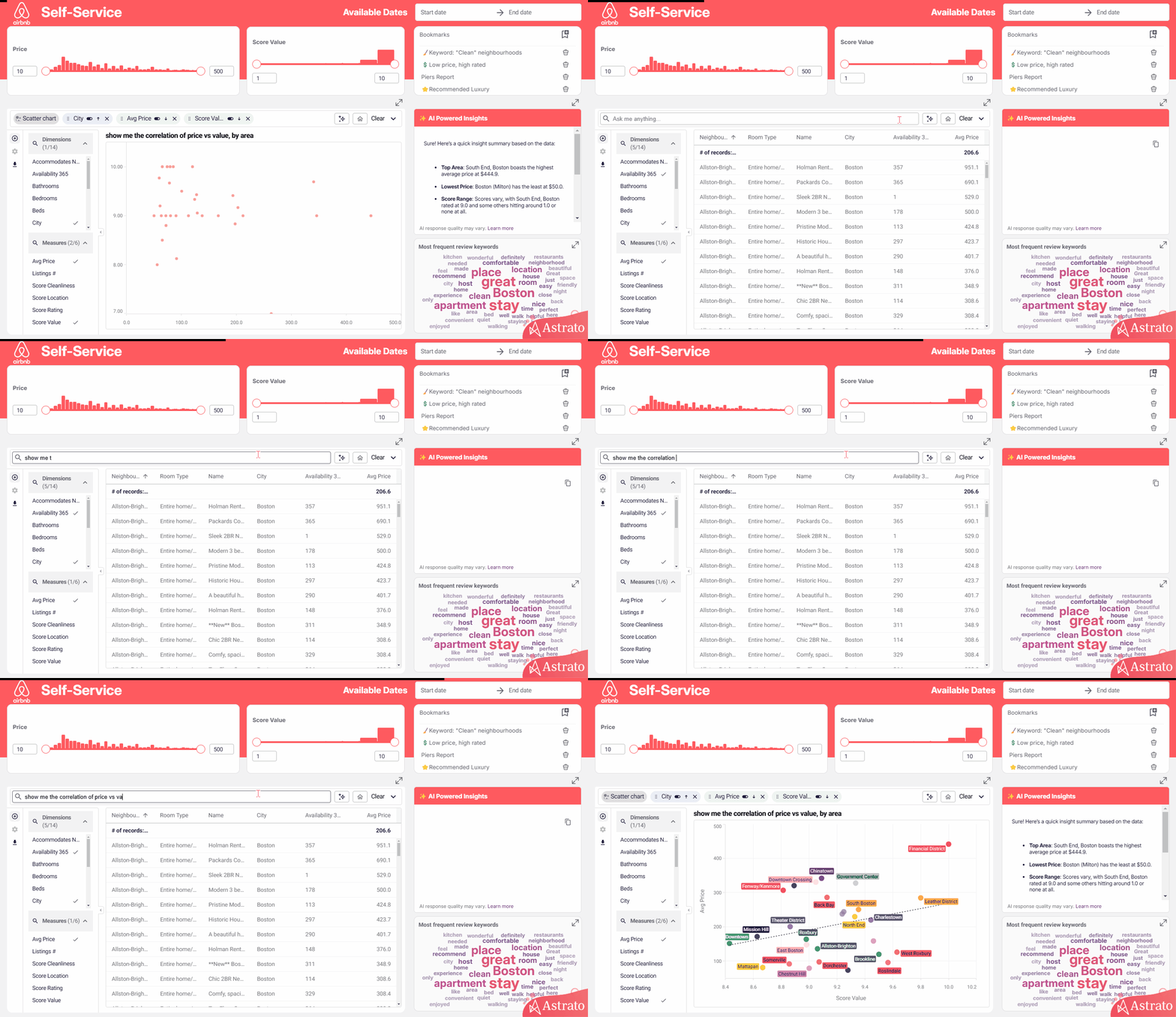
For non-technical business users specifically, the distinction matters more than any feature list makes apparent. When decision making depends on data, the friction between a business user and the answer to their question is a real operational cost — one that compounds across every team on the platform.
Writeback: why the extension model has a ceiling
This is where the Astrato team's Vizlib history becomes directly relevant. Vizlib Writeback — now part of the extension ecosystem Astrato was built to succeed — was one of the most widely used solutions for getting data back into a source system from a Qlik Sense dashboard. It worked. But it required a separate license, a separate installation, and a separate vendor relationship. And it reflected a broader pattern: native Qlik Sense Enterprise has no writeback capability, so any workflow that requires pushing data back into a database — budget planning, approval workflows, data corrections, operational inputs — routes through a third-party extension.
Astrato's native writeback removes that dependency. Users can edit values directly in a dashboard and sync those changes to the warehouse in real time. No third-party license, no additional vendor, no separate configuration. The same platform that serves the dashboard handles the write. And because writes go to the warehouse, they're immediately visible to every other system and query that touches that data — no integration gap between what the dashboard shows and what the warehouse holds.
For teams building planning, budgeting, or operational workflows on top of their analytics, this is the difference between a BI tool that reports on decisions and a data app that participates in making them.
AI-powered analytics: where the on-premise gap is widening
Qlik Sense Enterprise on-premise has Insight Advisor — natural language querying that generates charts and analyses from plain-language questions. It works. But the AI investment inside Qlik has clearly shifted to Qlik Cloud: Qlik Answers, Qlik Predict, and AutoML are cloud-only capabilities. On-premise releases happen four times per year; cloud releases are weekly. The feature gap between what on-premise customers can access and what Qlik Cloud customers get is growing with every release cycle.
For teams that want AI-native analytics — natural language querying that's grounded in a defined semantic layer, with answers that can be trusted because the business logic behind them is controlled — the on-premise product is not where that investment is going.
Astrato's GenAI capabilities are grounded in the same semantic layer that powers the rest of the platform. Natural language questions translate to warehouse queries through defined, governed business logic — not pattern-matched against raw data. Integrations with Snowflake Cortex, Gemini, and OpenAI give teams flexibility in the underlying model. The result is AI that produces actionable insights business users can trust, because the definitions behind the answers are the same ones the data team approved.
Governance, security, and the dual-maintenance problem
Section Access is one of Qlik Sense Enterprise's genuine strengths. Row-level and column-level data reduction, dynamic security based on user attributes, and centralized management through the QMC — for regulated industries, this has been a mature, auditable security model for years.
The architectural constraint is that Section Access is defined in the Qlik load script, not inherited from your data warehouse. When your organization's access control source of truth is Snowflake or Databricks — where roles, groups, and row-level policies are defined — Qlik requires a parallel implementation. A user changes roles; both systems need updating. A new data table gets access controls applied in the warehouse; Section Access needs a corresponding update. Data governance defined in two places is data governance that can drift. Data integrity depends on both staying in sync.
Astrato's approach to data governance is to inherit security directly from the warehouse. Row-level policies, column masking, and role-based access defined in Snowflake or Databricks apply automatically in every Astrato dashboard. Define access once, in the system that already manages it, and it's enforced everywhere — in the warehouse queries, in the BI layer, in embedded analytics. There is no second system to keep synchronized.
For compliance-sensitive environments, this matters beyond operational convenience. A single authoritative source for access control is an easier audit posture than two systems that must be manually kept consistent.
Pricing and total cost of ownership: what the headline number doesn't show
Qlik Sense Enterprise on-premise pricing is not publicly disclosed. Named user licenses run approximately $70–$150/user/month for Professional (full authoring) and $30–$50/user/month for Analyzer (consumption). But the license cost is the starting point for a TCO conversation, not the end of it.
Server hardware runs $16,500–$55,000 upfront. IT staff for administration and maintenance adds $66,000 or more per year. Initial implementation and consulting runs $35,000–$200,000. NPrinting — the enterprise reporting distribution layer, required for scheduled delivery to non-Qlik users — is a separate license. Third-party extensions for writeback, advanced charts, and planning capabilities are additional licensed products. When costs scale across a mid-market deployment of 25 users, total year-one cost reaches approximately $105,000, with $60,000 or more per year ongoing. At 500 users, total annual cost reaches $280,000 or beyond.
G2
★★★☆☆
"Qlik Sense is expensive for users compared to other BI tools which are mostly free for making dashboards, but for even creating a single dashboard they would need to pay, even though they have 30 days trial but after 30 days they can't do anything."
Verified reviewer
Gartner Peer Insights
The cost structure for Astrato is transparent and doesn't require a separate infrastructure budget. There are no servers to provision or patch, no IT staff dedicated to reload pipeline management, no extension licenses for capabilities that are native to the platform. Per-user, usage-based, and hybrid pricing models are available. For teams where costs scale unpredictably on Qlik — as apps, users, and NPrinting distribution lists grow — the predictability of a warehouse-native BI platform with no infrastructure overhead is itself a material cost savings.
Scheduled reporting: what NPrinting does and where Astrato stands
NPrinting deserves an honest assessment. For organizations that distribute analytics to thousands of non-Qlik users — pixel-perfect PDF reports, formatted Excel outputs, PowerPoint decks, Word documents delivered on a burst schedule — NPrinting is a mature, enterprise-grade distribution engine. There is no direct equivalent in Qlik Cloud; the absence of NPrinting in the cloud is one of the most frequently cited migration blockers for organizations evaluating that path.
Astrato's scheduled reporting covers PDF, Excel, and PowerPoint delivery to email and Slack, with branded formatting and configurable schedules. For most organizations with standard scheduled reporting requirements, this is sufficient. For enterprise environments with complex NPrinting setups — burst reporting to thousands of recipients, deeply formatted layouts with conditional logic, distribution to groups defined in Active Directory — a careful evaluation of whether Astrato's reporting meets those specific requirements is warranted before committing to migration.
This is one of the places where the brief asks for honesty rather than spin, so here it is: if NPrinting distribution is core to how your organization consumes analytics, this is an evaluation item, not an assumption.
When to switch from Qlik Sense Enterprise to Astrato
These are the signals worth paying attention to at contract renewal time:
- Your data has moved to a cloud warehouse but your BI layer hasn't. If Snowflake or Databricks is the primary source of truth and Qlik is extracting from it on a reload schedule, you're adding an infrastructure layer on top of a system already built for live querying.
- The reload pipeline is taking more of your team's time than the analytics. When infrastructure management becomes the primary operational concern of a BI team, that's an architecture problem — not a staffing one.
- Your extension bill is growing. If writeback, advanced charting, and planning capabilities all route through third-party extension licenses, the real cost of the platform is the headline license plus a growing stack of add-ons.
- You're trying to build embedded analytics into a product. The QAP licensing model, configuration complexity, and multi-tenant setup requirements make this path expensive and slow for SaaS companies.
- Section Access and warehouse access controls are drifting apart. Two security systems that should agree but require manual synchronization to stay that way is a data governance risk that compounds over time.
- Your team wants AI analytics now, not on the Qlik Cloud migration roadmap. Qlik's AI investment is in Qlik Cloud. On-premise releases are quarterly. The gap widens every month.
FAQ
What is the best alternative to Qlik Sense Enterprise?
The right alternative depends on where your data lives. For organizations whose data is in Snowflake, BigQuery, Databricks, Redshift, ClickHouse, or PostgreSQL, Astrato offers live-query warehouse-native analytics without the extract and reload infrastructure that Qlik requires. It covers self-service BI, embedded analytics, and native writeback in one platform.
How does Astrato compare to Qlik Sense Enterprise?
The core difference is architectural. Qlik Sense Enterprise extracts data into a proprietary in-memory engine on a reload schedule; Astrato queries the warehouse directly on every interaction. Astrato also offers native writeback (no extension required), warehouse-inherited security (no parallel Section Access model), and embedded analytics built for multi-tenant white-label deployment without complex configuration.
Why are companies moving away from Qlik Sense on-premise?
Three drivers appear most frequently: the operational overhead of managing the reload pipeline at scale, the growing feature gap between the on-premise product and Qlik Cloud, and the architectural mismatch between a reload-based BI tool and a cloud warehouse that's already the primary source of truth. For teams whose data has moved to Snowflake or Databricks, maintaining separate on-premise BI infrastructure is increasingly hard to justify.
Does Astrato support writeback like Vizlib Writeback for Qlik?
Yes — and natively, without a third-party extension. Astrato's writeback lets users edit values in dashboards and sync those changes directly to the cloud warehouse. The same team that built Vizlib Writeback built Astrato, so the capability is first-party and tightly integrated.
Can Astrato replace Qlik Sense for embedded analytics?
For most embedded analytics use cases, yes. Astrato's embedded analytics is white-label from day one, embeds via single iframe, and handles multi-tenancy at the platform level. The Qlik Analytics Platform approach requires a separate SKU, significant front-end development for white-labeling, and custom configuration for multi-tenant setups. For SaaS companies building customer-facing analytics, Astrato's model is substantially faster to deploy.
What happens to my data governance when I leave Qlik Sense?
In Astrato, data governance is inherited directly from the warehouse. Row-level security, column masking, and role-based access defined in Snowflake or Databricks apply automatically in every Astrato dashboard. You're not rebuilding a parallel security model — you're using the one you already have. This is a simpler audit posture than dual-system governance.
How does Astrato handle the reload problem?
It doesn't have one. There is no reload step in Astrato's architecture. Every query runs live against the warehouse using pushdown SQL. Data is always current because the platform never holds a copy — it queries the source directly on every interaction.
Is it hard to migrate from Qlik Sense Enterprise to Astrato?
The migration process involves rebuilding dashboards and data connections — Qlik's QVD files and QlikScript load scripts don't translate directly. But the data modelling work that was embedded in QlikScript typically maps to the warehouse's existing structure, where it can be maintained in SQL or dbt. The semantic layer in Astrato replaces the per-app metric logic that Qlik apps carried individually.
Does Astrato work with on-premise data sources?
Astrato connects natively to cloud warehouses — Snowflake, BigQuery, Databricks, Amazon Redshift, ClickHouse, and PostgreSQL. For organizations whose data primarily lives in on-premise databases without a cloud warehouse layer, Qlik Sense Enterprise or another on-premise-capable tool may be a better fit until a cloud warehouse is in place.
What is the cost difference between Qlik Sense Enterprise and Astrato?
Qlik Sense Enterprise pricing is not publicly disclosed, and the headline license cost understates the real TCO. Infrastructure, IT staffing, implementation, NPrinting licensing, and extension costs push mid-market deployments to $60,000–$105,000 per year and enterprise deployments to $120,000–$280,000 or more. Astrato's pricing is transparent — per-user, usage-based, or hybrid — with no infrastructure budget required. For a direct comparison, book a demo and Astrato's team can model the numbers for your specific deployment.
Can Astrato replace NPrinting for scheduled reporting?
For standard scheduled reporting requirements — PDF, Excel, PowerPoint delivery to email or Slack on a defined schedule — yes. For complex enterprise NPrinting setups with burst distribution to thousands of recipients and deeply formatted conditional layouts, a careful evaluation of Astrato's scheduled reporting against those specific requirements is the honest recommendation before committing.
Final verdict
Qlik Sense Enterprise on-premise is a capable, mature platform. The associative engine is a genuine technical differentiator for complex exploratory analysis. Section Access is a proven enterprise security model. NPrinting has been distributing pixel-perfect reports to enterprise organizations for years. For regulated industries with strict data residency requirements and data that primarily lives in on-premise databases, it may still be the right tool.
The structural shift that makes this comparison worth having is what happened to where enterprise data lives. For most of the organizations that adopted Qlik Sense Enterprise over the past decade, Snowflake, BigQuery, or Databricks is now the primary source of truth. The BI layer — built around extracting from that warehouse into a separate proprietary engine, maintaining a parallel security model, and managing a reload pipeline — is increasingly expensive to justify when the warehouse already performs the computational work, live, on demand.
Astrato's clearest wins for this specific comparison: no reload infrastructure to build, manage, or recover from; native writeback without a third-party extension license; security inherited from the warehouse with no parallel Section Access model to maintain; and embedded analytics built for white-label, multi-tenant deployment without complex custom configuration. The team that built Vizlib — the leading extension ecosystem for Qlik Sense, built precisely because the platform needed gap-filling — built Astrato to address the problems that extensions can't solve. That's not a positioning claim. It's an architectural one.
For analytics leaders at contract renewal who are weighing on-premise renewal, a Qlik Cloud migration, or an architectural alternative: the question worth asking is whether the platform you chose when the warehouse was an external data source still makes sense when the warehouse is the center. Book a demo and see how Astrato runs analytics directly on your warehouse.
Ready to experience next-gen analytics?
See how Astrato runs natively in your warehouse.