Astrato vs Qlik Cloud: Warehouse-Native BI vs Extract-and-Govern Platform
Looking for a Qlik Cloud alternative? Compare Astrato vs Qlik Cloud on architecture, embedded analytics, and pricing to find the right fit for warehouse-native BI.


Most cloud data teams have already made the hard architectural decision. They've chosen Snowflake, BigQuery, or Databricks as the single source of truth for their analytics — and they've invested real time, real money, and real headcount into making it work. The question they face now isn't whether to have a cloud data platform. It's whether the BI layer sitting on top of it should mirror that architecture — or contradict it.
Qlik Cloud is, by most measures, the best version of Qlik that has ever existed. It runs weekly releases, it has a growing AI suite, and it's where Qlik's engineering attention is focused. For the 40,000 customers in the broader Qlik portfolio, it represents a genuine upgrade path from legacy QlikView and on-premise Qlik Sense deployments. The Gartner Magic Quadrant has recognized it as a Leader for eleven consecutive years.
But Qlik Cloud's core architecture hasn't changed with the move to SaaS. Data still gets extracted into the QIX in-memory engine. Business logic still lives in QlikScript inside individual apps. Security still runs in a parallel layer — Section Access — that doesn't inherit from the warehouse. For teams already running on a cloud data warehouse, this creates a second truth layer to maintain alongside the first. That's the tension this article resolves: not whether Qlik Cloud is good, but whether it's right for a team that already treats the warehouse as the only layer that matters.
TL;DR
Astrato is the right fit if:
- You're running Snowflake, BigQuery, Databricks, Redshift, ClickHouse, or PostgreSQL and want BI that queries live — no extract, no reload schedule, no stale data.
- You're building customer-facing or embedded analytics and need pixel-perfect white-labelling without per-tenant provisioning overhead.
- You need writeback that writes directly and durably to the warehouse — not a 90-day change store that permanently deletes data.
- Your team has QlikScript expertise but your data engineering has matured to dbt and a semantic layer — and you don't want proprietary logic drift across 200 apps.
- You received a Qlik Cloud embedded analytics quote and found the per-tenant operational overhead or the Year 1 total cost of $110K–$220K unworkable.
- You want governance and row-level security that inherits directly from warehouse permissions — without maintaining a separate Section Access configuration.
Qlik Cloud may still be the right call if:
- You have hundreds of existing .qvf apps and a skilled Qlik team — migration has a real cost that shouldn't be minimised, and Qlik Cloud gives you cloud infrastructure without rebuilding.
- You have complex multi-fact-table data environments where the associative engine's green/white/gray selection model genuinely helps users discover hidden relationships.
- You need connectors to legacy systems — SAP, Oracle, mainframe sources — that aren't in a cloud warehouse yet. Qlik's 160+ connector ecosystem is broad.
- Your AI use case includes unstructured data analytics (Qlik Answers) or AutoML (Qlik Predict) — Qlik's AI suite is substantive and ahead of most BI competitors.
- You're already locked into a legacy Qlik contract and the migration process needs to wait for the right renewal window.
Quick comparison: Astrato vs Qlik Cloud
What is Astrato?
Astrato is a warehouse-native BI platform built to run analytics directly against your cloud data warehouse — no data extraction, no reload schedules, no copies. Every query is a live SQL pushdown against the warehouse, which means your dashboards, data apps, and embedded analytics always reflect current data, not yesterday's refresh.
The platform was built by the Vizlib team — the people behind the most widely adopted extensions in the Qlik ecosystem. That history matters: Astrato was designed by engineers who knew exactly where Qlik's ceiling was from the inside, and built the platform to sit above it.

Astrato's three core use cases are guided self-service BI, customer-facing embedded analytics, and data apps with native writeback. It connects natively to Snowflake, BigQuery, Databricks, Redshift, ClickHouse, and PostgreSQL.
What is Qlik Cloud Analytics?
Qlik Cloud is the SaaS version of the Qlik platform — distinct from the on-premise Qlik Sense Enterprise and the legacy QlikView product. Founded in 1993 in Lund, Sweden, Qlik was taken private by Thoma Bravo in 2016, with ADIA co-investing in May 2025. The cloud product has 40,000+ customers across the full portfolio, with notable enterprise logos including Volvo, NHS, Deutsche Telekom, Intuit, and ABB.
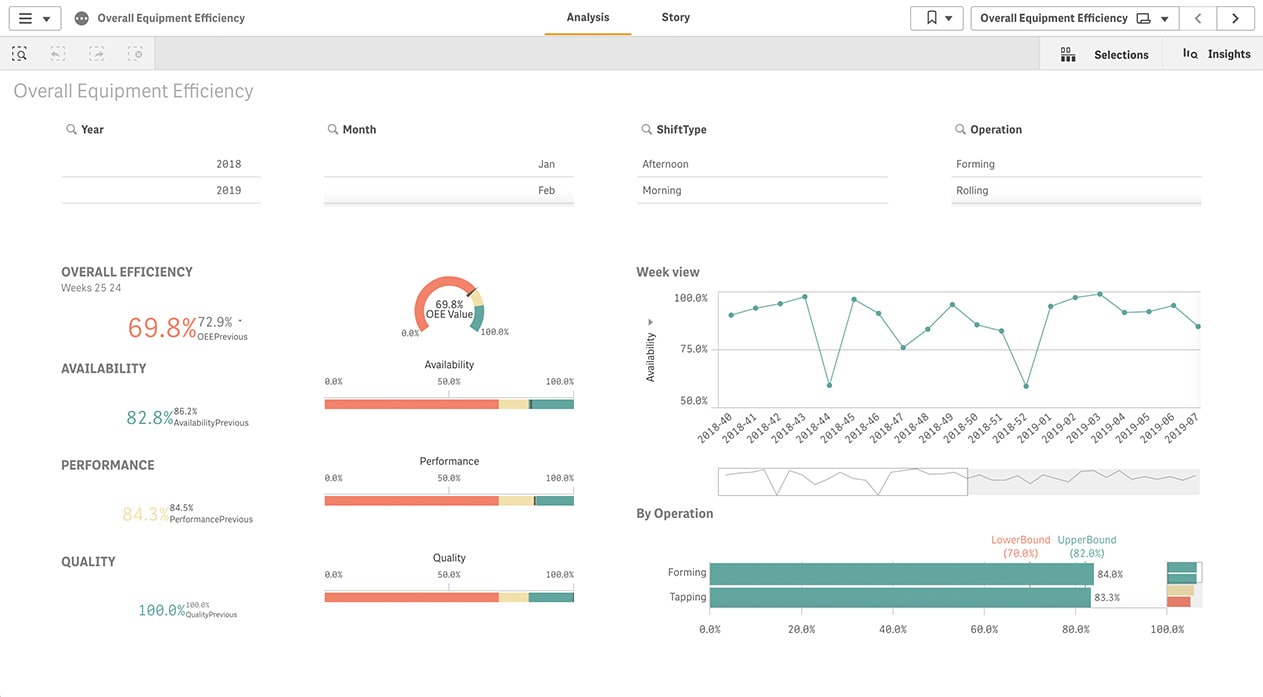
Qlik Cloud's defining feature is the associative engine — a genuine architectural differentiator that lets users explore data relationships across multiple tables through a green/white/gray selection model. No other BI platform replicates this. The AI suite (Qlik Answers for unstructured data, Qlik Predict for AutoML, Insight Advisor for NLQ) is substantive and represents Qlik's most active product investment.
Since March 2025, all new subscriptions use capacity-based pricing measured in data volume analysed rather than user count. The Gartner Magic Quadrant has recognised Qlik Cloud as a Leader for eleven consecutive years.
Architecture: live query vs the in-memory extract layer
The most important difference between Astrato and Qlik Cloud isn't a feature — it's a design choice made at the foundation of each platform. Qlik Cloud's default mode is in-memory: data is extracted from source systems, loaded into the QIX associative engine on a reload schedule, and held there for querying. Direct Query mode exists — and it works — but it's an opt-in secondary path with trade-offs. Most Qlik Cloud deployments still reload.
What does that mean in practice? It means every Qlik Cloud app is working from a snapshot. The freshness of that snapshot depends entirely on how frequently the reload runs. Real-time decision making requires real-time data — and scheduled refreshes create a gap between what the warehouse knows and what the dashboard shows.
Astrato has no in-memory mode. There's no alternative path. Every query is a live SQL pushdown to the warehouse. When a user filters a dashboard, Astrato runs the query against Snowflake, BigQuery, or Databricks directly. There's no stale cache to manage, no reload schedule to monitor, no data integrity risk from an extract that diverged from the source.
For teams who have already invested in a cloud data warehouse as their single source of truth, the Qlik Cloud architecture asks them to maintain two sources of truth: the warehouse and the QIX engine sitting on top of it. The performance optimisation work done at the warehouse level — query acceleration, clustering, materialized views — doesn't carry through to the in-memory layer. The governance and row-level security defined in the warehouse doesn't inherit into Qlik's Section Access. Every layer added is a new place for data to drift.
The slow load times Qlik users report aren't bugs — they're an architectural consequence. Loading large datasets into the QIX engine takes time, and that time increases as data volumes grow. Astrato sidesteps this entirely by never holding data outside the warehouse in the first place.
Embedded analytics: single iframe vs one tenant per customer
Embedded analytics is where the operational gap between Astrato and Qlik Cloud becomes most visible — and most expensive. Qlik Cloud's embedding approach uses an SDK and iframe-based Mashup framework that requires developer implementation. White-labelling is possible, but it involves custom theme and CSS work, not a configuration option.
The more significant constraint is multi-tenancy. Qlik's own documentation recommends provisioning one Qlik tenant per customer organisation for full data isolation. That's not a workaround — it's the recommended architecture. For an ISV with 200 customers, that means 200 tenant provisioning and management operations. Every customer onboarding, offboarding, and permissions change involves a separate tenant. The operational overhead scales linearly with customer count.
Astrato's embedded analytics is built differently from the ground up. The entire embedding is a single iframe. White-labelling is a configuration, not a development project. Multi-tenancy is managed at the warehouse level — warehouse permissions flow through to the embedded experience automatically, without a separate tenanting layer. An ISV adding a new customer doesn't provision a new BI tenant; they add the customer to their warehouse access controls.
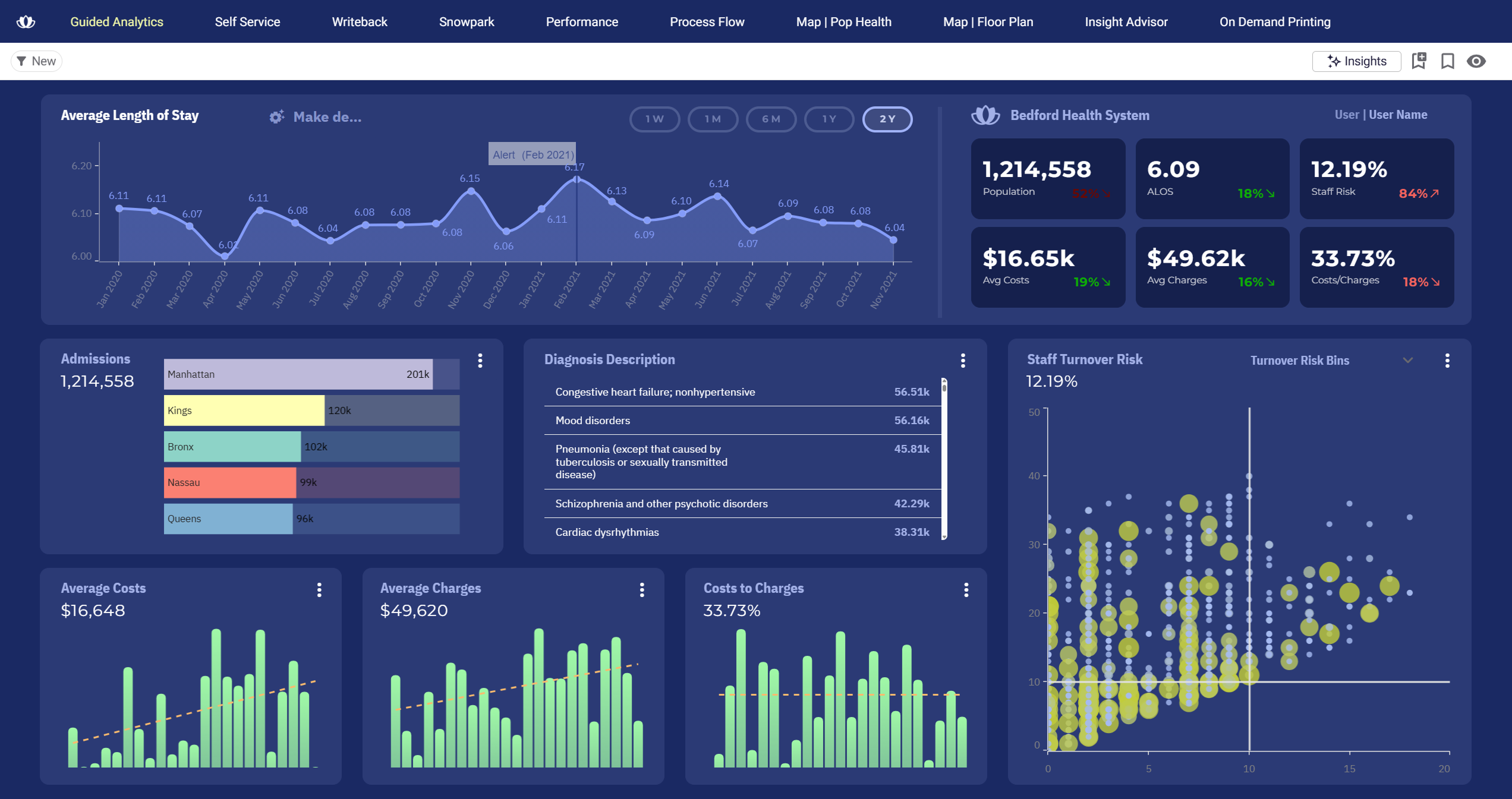
For product teams and SaaS builders, the practical impact is time-to-market. Building on Qlik Cloud's SDK requires front-end development resources and ongoing maintenance. Astrato's no-code embedded environment means teams can meet changing customer requirements without long development cycles — and the visual output is built to match product aesthetics without custom CSS overrides.
Writeback: durable warehouse writes vs a 90-day change store
Qlik Cloud shipped Write Table in December 2025. It's a real feature — native to the cloud platform, available without a reload, and genuinely useful for basic table editing scenarios. This is not a roadmap item; it shipped. Any fair comparison needs to acknowledge that.
But the architecture of Write Table matters. Changes written through Write Table are stored in Qlik's own managed change store — not in the warehouse. After 90 days, that data is permanently deleted. There is no direct write to Snowflake, BigQuery, or any other warehouse in the initial release. For operational use cases — financial planning, budget management, forecast inputs, data quality workflows — a 90-day retention limit with no direct warehouse integration is a meaningful constraint.
Astrato's writeback writes directly to the warehouse in real time. Data entered through an Astrato data app lands in Snowflake or BigQuery immediately, permanently, and under the same governance controls as the rest of the warehouse. There's no separate change store, no retention cliff, and no second reconciliation step to push data from a BI-managed store into the data lake.
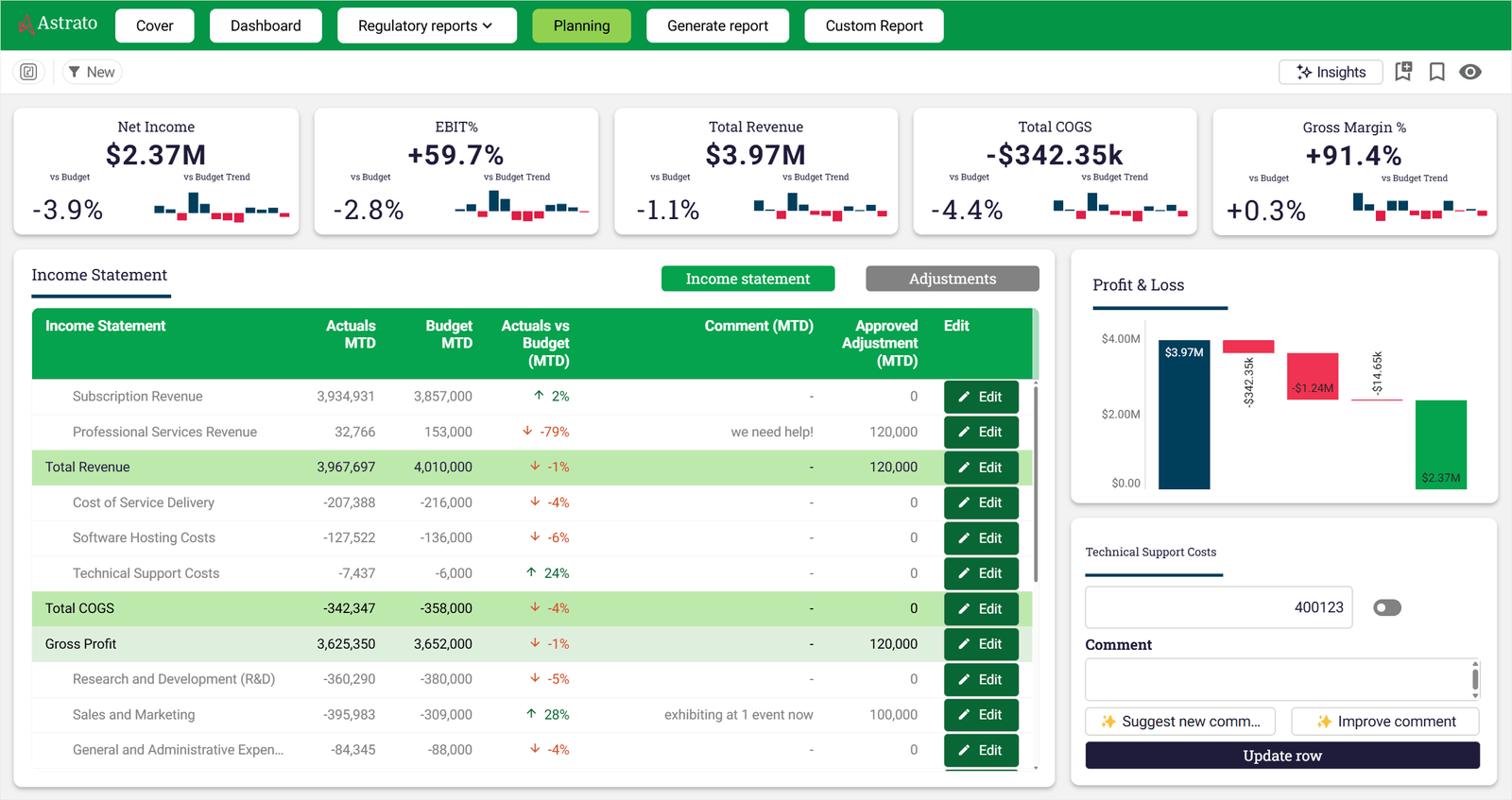
This distinction matters most for teams building operational workflows — where the input data needs to be part of the data governance and audit trail, not siloed in a BI platform's proprietary storage. If the use case is basic in-app editing of non-critical data, Qlik's Write Table may be sufficient. If the use case is planning, forecasting, or any operational workflow where data durability and warehouse integration matter, it isn't.
AI-powered analytics: genuinely different approaches
Qlik Cloud has the strongest AI suite among the platforms it competes with. Qlik Answers processes unstructured data — documents, PDFs, knowledge bases — and surfaces answers through natural language queries. Qlik Predict brings AutoML capabilities for predictive analytics without requiring a data science team. Insight Advisor handles NLQ against structured data. Agentic analytics is on the active roadmap. This is substantive investment, and it shows.
Astrato's AI approach is different in philosophy. Rather than bolt AI onto a separate product layer, Astrato grounds its GenAI capabilities in the semantic layer — meaning AI-generated insights inherit the same business logic, data governance, and access controls as every other query. Connections to Snowflake Cortex, Gemini, and OpenAI are available. The advantage is consistency: AI answers come from the same governed, live data as every dashboard, not from a separate index.
The right answer here depends on the use case. For teams with unstructured data analytics needs — searching internal documents alongside structured dashboards — Qlik Answers is a genuinely differentiated capability that Astrato doesn't currently replicate. For teams whose AI use case is NLQ against warehouse data, semantic search, or automated analysis grounded in live SQL, Astrato's approach gives more control and tighter integration with the warehouse layer.
Self-service BI: who can actually build an app?
Qlik's associative engine is one of the most genuinely powerful tools for data exploration that exists in BI. Users who understand it can surface relationships across complex multi-source datasets that other platforms would require custom joins to expose. For experienced data analysts working with messy, multi-fact-table environments, this is a real advantage.
Creating or modifying Qlik Cloud apps is a different story. QlikScript — the proprietary language used for data load logic, transformations, and business calculations — has a steep learning curve. Business users exploring existing apps get the associative interface. Building or changing those apps requires BI team involvement, script knowledge, and familiarity with the data load editor. The no-code, low-code experience for app development lags behind what users expect from a modern SaaS platform.
Astrato's self-service experience is designed around drag-and-drop interface building for non-technical users, with a semantic layer that centralises business logic rather than embedding it per-app in proprietary scripts. A business user can build a dashboard. A data team lead can define business metrics once in the semantic layer and have them flow consistently to every report, embedded view, and data app across the organisation — without QlikScript drift across hundreds of apps.
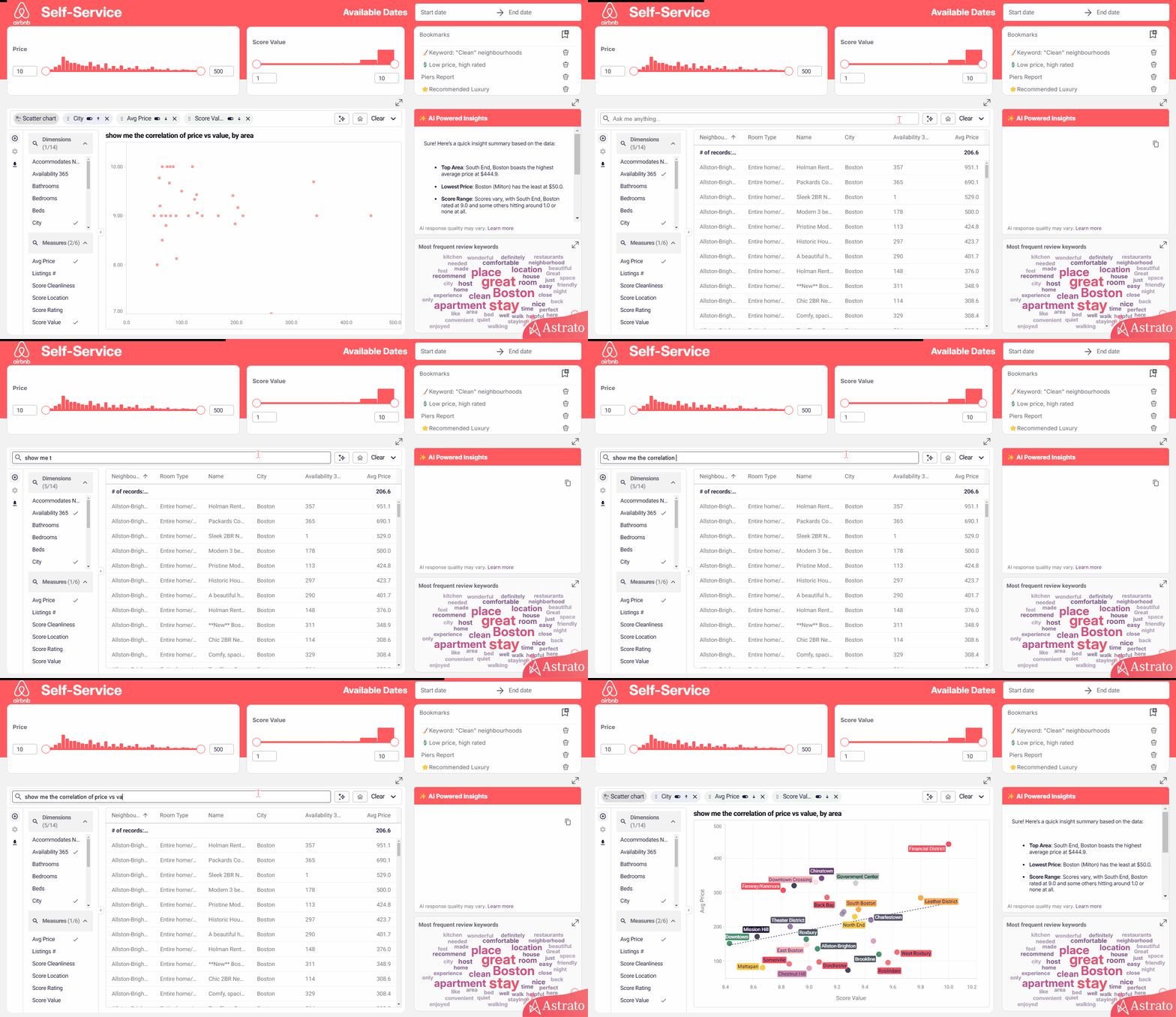
The difference shows up most clearly in large organisations. When business logic lives in QlikScript inside individual .qvf files, consistency across an app estate requires discipline that's hard to enforce at scale. When it lives in a semantic layer that every connected tool queries, consistency is structural.
Governance and security: warehouse-inherited vs parallel layer
Qlik Cloud's Section Access is mature and enterprise-grade. SAML/OIDC, SOC 2, GDPR compliance, and a centralised management console are all present and production-ready. For enterprises that came from on-premise Qlik Sense, this is a familiar and trusted model.
The operational complexity is in the migration and the ongoing maintenance. Section Access in Qlik Cloud behaves differently from on-premise — authentication happens via IdP subject claims rather than Windows domain. Migrating existing on-premise Section Access to cloud requires rework. And because Section Access is a Qlik-specific layer sitting above the warehouse, any permission change that happens at the warehouse level needs to be manually reflected in Section Access to stay synchronised.
Astrato inherits warehouse security directly. Row-level security, column-level permissions, and access controls are defined once in the warehouse — in Snowflake, BigQuery, or wherever the data lives — and Astrato enforces them on every query. There's no parallel security layer to maintain, no risk of drift between the warehouse access controls and the BI layer, and no rework required when users join or leave. The warehouse is the security source of truth, and Astrato doesn't add a layer on top of it.
Pricing: capacity overage vs predictable scale
Qlik Cloud's new capacity-based pricing model — mandatory for all customers since March 2025 — prices on data volume analysed per year rather than user count. On the surface, this sounds more scalable. In practice, it creates cost unpredictability as data grows.
The Standard tier starts around $2,700–$3,300/month for 25 GB of data for analysis. Premium runs $3,800–$5,500/month for 50 GB. Enterprise is custom-priced from 250 GB upward. Overages trigger additional charges. And the headline subscription price doesn't reflect total cost: Year 1 implementation and training costs for a 50-user deployment regularly run $110,000–$220,000 in total.
Astrato's pricing is per-user, usage-based, or hybrid — without data volume overage billing. Teams can scale to more users without triggering a separate capacity charge for the analytics they run. For embedded and customer-facing deployments where user count is directly tied to revenue, this distinction is material: every new customer you onboard doesn't generate a separate BI capacity bill.
The AI features that matter most — Qlik Answers and Qlik Predict — are Premium tier or separate add-ons. Standard tier includes Qlik Answers in limited form. For teams evaluating the full suite, the effective cost sits toward the higher end of the published ranges.
Scheduled reporting: the NPrinting gap
NPrinting — Qlik's enterprise scheduled reporting product — is not available in Qlik Cloud. For organisations migrating from on-premise Qlik Sense, this is one of the most commonly reported feature gaps. The Qlik Reporting Service available in Qlik Cloud handles some reporting scenarios, but it doesn't replicate NPrinting's burst reporting, pixel-perfect layouts, or distribution breadth.
Astrato's scheduled reporting delivers automated branded reports in Excel, PDF, and PowerPoint formats via email or Slack. For organisations that need reporting delivered to stakeholders who don't log into a BI tool, this covers the use case without requiring a separate enterprise reporting product.
When to consider moving from Qlik Cloud to Astrato
These are signals worth paying attention to — not a checklist for everyone.
- If your data team spends meaningful time managing reload schedules, troubleshooting stale dashboards, or reconciling BI data against warehouse data — that's a sign the extract layer is creating work.
- If you've received a Qlik Cloud embedded analytics quote and the per-tenant operational overhead or pricing made customer-facing deployment economically unworkable.
- If your Year 1 implementation and training costs came in above $150,000 and the ROI is hard to justify against what the platform actually delivers.
- If QlikScript expertise in your team is thin, and app creation requires BI team involvement for every change a business user needs.
- If Qlik Write Table's 90-day retention limit rules it out for your operational or financial planning workflow, and you need writeback that lands durably in the warehouse.
- If you're fully committed to Snowflake or BigQuery as your data governance layer, and you want security, business logic, and query execution all running from that same foundation — not maintained in a parallel Qlik layer.
Whichever platform you land on, switching BI tools is also a documentation exercise: metric definitions, semantic-layer logic, and dashboard ownership all need to live somewhere your whole team can find them, or adoption stalls. Dedicated knowledge bases keep that context — data dictionaries, governance rules, onboarding notes — in one searchable place, so moving off Qlik doesn't leave tribal knowledge stranded in the old tool.
FAQ
What is the best alternative to Qlik Cloud Analytics?
For teams on Snowflake, BigQuery, or Databricks who want live-query BI without an extract layer, Astrato is the most direct alternative. It covers the same use cases — self-service BI, embedded analytics, writeback — with an architecture that inherits directly from the warehouse rather than sitting on top of it.
How does Astrato compare to Qlik Cloud?
Astrato is warehouse-native: every query runs live against the data source. Qlik Cloud defaults to in-memory extraction with Direct Query as a secondary mode. Astrato's embedded analytics uses a single iframe with no per-tenant provisioning; Qlik Cloud's SDK-based embedding recommends one tenant per customer organisation. Astrato writes directly to the warehouse; Qlik's Write Table uses a 90-day change store. Qlik Cloud has a broader AI suite (Qlik Answers, Qlik Predict) and the associative engine for multi-table exploration.
Is Qlik Cloud worth the cost?
For teams migrating from on-premise Qlik Sense with existing app estates, QlikScript expertise, and complex multi-source environments, Qlik Cloud is a genuine upgrade with infrastructure handled. For teams building net-new on a cloud warehouse, the Year 1 TCO of $110K–$220K for 50 users and the ongoing capacity-based billing require careful analysis against alternatives that don't carry implementation overhead.
Does Qlik Cloud support live query from Snowflake?
Yes — Qlik Cloud supports Direct Query mode for Snowflake, BigQuery, and Databricks. However, Direct Query is a secondary mode, not the default. Most teams still use in-memory reload. Direct Query in Qlik Cloud comes with trade-offs in performance and feature availability compared to the in-memory path.
How does Qlik Cloud's writeback (Write Table) compare to Astrato?
Qlik's Write Table (launched December 2025) stores changes in Qlik's managed change store for 90 days, then permanently deletes them. It doesn't write directly to the warehouse. Astrato's writeback writes directly and immediately to Snowflake, BigQuery, or the connected warehouse — permanently, under the same governance controls as the rest of the data.
Can Astrato replace Qlik Cloud for embedded analytics?
For most embedded and customer-facing use cases, yes. Astrato's single-iframe embedding with white-labelling as a configuration and warehouse-inherited multi-tenancy is operationally simpler than Qlik Cloud's SDK-based approach with recommended one-tenant-per-customer provisioning. The distinction matters most for ISVs and SaaS builders with large customer counts.
Why are companies looking for Qlik Cloud alternatives?
Three themes appear consistently: the capacity-based pricing model creates cost unpredictability as data volumes grow; QlikScript's learning curve means non-technical business users can't create or meaningfully modify apps without BI team involvement; and teams fully committed to a cloud warehouse find the Qlik in-memory extraction layer adds complexity rather than value.
What is the difference between Qlik Cloud and Qlik Sense Enterprise?
Qlik Sense Enterprise is the on-premise deployment of Qlik's analytics platform, managed on customer infrastructure. Qlik Cloud is the SaaS version — hosted by Qlik, with a weekly release cadence, capacity-based pricing (new customers), and a growing AI suite. All new feature development is focused on Qlik Cloud; Qlik Sense Enterprise is maintained but no longer the investment priority.
How does Astrato's pricing compare to Qlik Cloud?
Qlik Cloud's Standard tier starts around $2,700–$3,300/month for 25 GB of data for analysis, with Year 1 total costs of $110K–$220K for a 50-user deployment. Astrato uses per-user, usage-based, or hybrid pricing without data volume overage billing. For embedded deployments where user count scales with customer revenue, this distinction is material.
What happens to my QlikScript and apps if I move to Astrato?
QlikScript and .qvf app files are proprietary to Qlik — they don't transfer. A migration to Astrato requires rebuilding business logic in Astrato's semantic layer and recreating app layouts in Astrato's drag-and-drop interface. The real migration cost is in this rebuild, not in data connectivity. For organisations with large app estates and specialist QlikScript teams, this cost is real and shouldn't be minimised.
Final Verdict
Qlik Cloud is a well-engineered product with real strengths: the associative engine for complex data exploration is a genuine differentiator, the AI suite is among the strongest in the category, and for teams migrating from on-premise Qlik Sense, it offers cloud infrastructure without rebuilding every app from scratch. The Gartner recognition is earned, not honorary. If you're running a complex multi-source environment with existing QlikScript investment and a skilled Qlik team, Qlik Cloud is a defensible choice.
The structural question is simpler than the feature list suggests. If your data already lives in Snowflake, BigQuery, or Databricks — if you've already made the architectural decision to treat the warehouse as the source of truth — then the in-memory extraction model doesn't add value. It adds a second layer to maintain, a second place for data to drift, and a second security model to keep synchronised with the first. Qlik Cloud's Direct Query mode doesn't resolve this; it's a secondary path, not the default.
Astrato's clearest wins in this comparison are architecture (live query only — no extraction layer), writeback (direct warehouse writes, not a 90-day change store), and embedded analytics (single iframe, warehouse-inherited multi-tenancy, no per-tenant provisioning). For teams building embedded analytics products, data apps with operational workflows, or governed self-service BI on a cloud warehouse, these aren't marginal improvements — they change what's possible to build.
Book a demo and see how Astrato runs analytics directly on your warehouse.
Ready to experience next-gen analytics?
See how Astrato runs natively in your warehouse.